
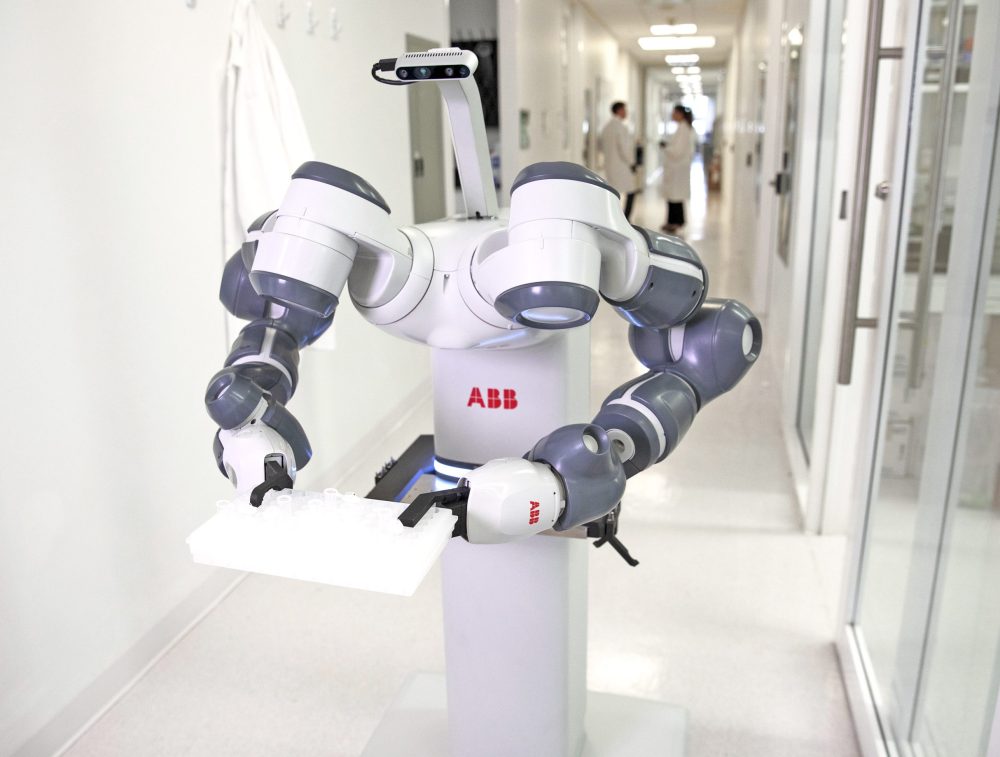
ABB has announced it is divesting its Robotics division to SoftBank Group for an enterprise value of USD 5.375 billion, reversing its earlier plan to spin it off as a separately listed business. The transaction is subject to regulatory approvals and further customary closing conditions and is expected to close in mid-to-late 2026.
This decisive move reshapes not only ABB’s corporate structure and capital allocation, but also signals a reorientation of robotics strategic leadership, one with profound implications for sectors that are embracing digital transformation, among them digital construction and industrial automation.
Although robotics has long been part of ABB’s “Robotics & Discrete Automation” portfolio, ABB itself has acknowledged that the robotics division shares limited business and technology synergies with its remaining electrification, process, and automation units.
In practice, the demand profile, investment cycles, customer base and innovation drivers in industrial robotics differ markedly from those in electrification, power grids or large-scale process automation, making it harder to integrate strategic planning or resource allocation across all units.
A more focused future for ABB
With robotics removed, ABB becomes a more streamlined group focused around electrification, automation, and process systems. Leadership can concentrate on fewer domains, easier governance, and clearer capital priorities. This also removes the “split personality” tension of balancing robotics innovation with more stable, infrastructure-grade business segments.
Peter Voser, Chairman of ABB, said: “SoftBank’s offer has been carefully evaluated by the Board and Executive Committee and compared with our original intention for a spin-off. It reflects the long-term strengths of the division, and the divestment will create immediate value to ABB shareholders. ABB will use the proceeds from the transaction in line with its well-established capital allocation principles. Our ambitions for ABB are unchanged and we will continue to focus on our long-term strategy, building on our leading positions in electrification and automation.”
ABB CEO Morten Wierod added: “SoftBank will be an excellent new home for the business and its employees. ABB and SoftBank share the same perspective that the world is entering a new era of AI-based robotics and believe that the division and SoftBank’s robotics offering can best shape this era together. ABB Robotics will benefit from the combination of its leading technology and deep industry expertise with SoftBank’s state-of-the-art capabilities in AI, robotics and next-generation computing. This will allow the business to strengthen and expand its position as a technology leader in its field.”
SoftBank’s strategic bet: “Physical AI”
For SoftBank, acquiring ABB Robotics is not simply adding a robotics manufacturer, it is a core play in its ambition around Physical AI, combining robotic hardware, intelligent software, and next-generation computing. Masayoshi Son, Chairman & CEO of SoftBank Group Corp. said: “SoftBank’s next frontier is Physical AI. Together with ABB Robotics, we will unite world-class technology and talent under our shared vision to fuse Artificial Super Intelligence and robotics —driving a groundbreaking evolution that will propel humanity forward.”
How this transaction intersects with the digital construction sector
The digital construction or “construction 4.0” ecosystem is characterised by the convergence of robotics, automation, digital twins, BIM, AI, sensors and software. The ABB–SoftBank transaction reshuffles one of the most prominent robotic players in that ecosystem.
Robotics in construction: current state and challenges
- Automated on-site tasks: Robots (e.g. bricklaying, tying rebar, finishing operations) are increasingly used for repetitive or hazardous tasks.
- Prefabrication and off-site manufacturing: Robotic assembly of modular units in controlled factory settings, which are then deployed to site.
- Digital twin and BIM integration: Linking robotic tasks to BIM models and dynamically updating as-built data, a field where research is active (e.g. hybrid frameworks for human–robot collaborative workflows)
- Labour constraints, safety and productivity pressure: The construction sector suffers from labour shortages, cost pressures, and a drive for productivity and safety improvements.
However, the uptake is still uneven due to high capital costs, bespoke site conditions, integration complexity, and risk aversion in construction firms.


Acceleration of innovation in robotics tools for construction
Under SoftBank’s stewardship, ABB Robotics may receive enhanced investment in AI, computing, and platform scaling, potentially accelerating development of robot systems more suited for construction tasks (terrain adaptation, perception in complex unstructured environments, dynamic adjustment to site variability).
Greater integration with AI and software ecosystems
The amalgamation of ABB’s robotics hardware with SoftBank’s software, AI, and computing assets could give rise to more integrated offerings: robotics + intelligent orchestration + data platforms. This opens opportunities for construction firms to adopt robotics as part of a larger digital ecosystem rather than isolated automation.
Changes in supply chain and vendor relationships
Construction digitalisation providers (robotics OEMs, robotics integrators, software platforms, IoT/sensor firms) may see evolving partnership dynamics. Some may align more closely with the new ABB Robotics / SoftBank entity, while others might hedge or diversify across multiple robotics platforms.
Opportunities for modular construction, factory automation and advanced fabrication
The robotics division’s expertise in factory automation could further enable modular and prefabrication approaches in construction. For example, ABB has already been involved in robot-powered microfactories for sustainable housing in partnerships such as with Automated Architecture (AUAR) in the UK.
As robotics innovation accelerates under SoftBank, these factory-based approaches could scale further.
Digital twin, BIM, and closed-loop feedback
As robotics become more tightly integrated with software and analytics, the potential for closed-loop digital twin frameworks grows, robots executing tasks, feeding as-built data back to BIM, adjusting next operations dynamically. The construction research community is exploring this area actively.
Strategic implications and recommendations for digital construction stakeholders
To capitalise on this transformational moment, firms in the digital construction and automation ecosystem should consider the following strategic priorities:
1. Reassess robotics vendor strategy with agility
With a major robotics player shifting ownership, firms should evaluate:
- Which robotics platforms offer future viability, flexibility, open interfaces and support for construction-specific modules
- Whether to adopt a “multi-vendor robotics stack” to avoid lock-in
- Opportunities for co-development or partnership with the new ABB Robotics / SoftBank group in pilot projects
2. Invest in modular, scalable frontends for robotics + software
Robotics hardware is only part of value. The differentiator will increasingly lie in software orchestration, perception, autonomy layers, digital twin integration, site-adaptive control, and analytics. Building modular software frontends that can interface with multiple robotic backends will future-proof investments.
3. Pilot integrated robotics + BIM + digital twin workflows
Early adopters should test closed-loop BIM-driven robotic workflows in controlled pilot settings (labs, mock sites, prefabrication factories). Integrating human oversight and dynamic adaptation (to real-world site variation) is a key challenge to solve.
These pilots will position firms to scale when robotic systems become more mature under new ownership.
4. Focus on off-site, factory-based robotics first
Given the predictable environment of factory settings, modular construction or sub-component fabrication is a lower-risk terrain to deploy, prove, scale and refine robotics + automation. Success there will build confidence to bring the solutions onto variable job sites.
5. Prepare for regulatory, safety and standards evolution
As robotics in construction increase, regulatory frameworks, safety standards, insurance, compliance rules and site certification practices will need updating. Early engagement with regulators and standards bodies will influence how the industry evolves.
6. Monitor SoftBank’s strategic moves and product roadmap
As SoftBank begins to orchestrate the merger with ABB Robotics, the new entity’s roadmap, strategic priorities, product investment directions, pricing models and go-to-market partnerships will affect the entire robotics landscape in industrial and construction applications. Keeping a close watch and seeking channels of influence (via pilot partnerships, consortia, user groups) is prudent.
Evolution of robotics industry
The divestment of ABB’s Robotics division presents a pivotal moment in the evolution of the robotics industry, one that will ripple through the realm of digital construction, industrial automation, smart infrastructure and built-environment innovation. For construction firms, automation integrators, software providers and technology investors, the shift demands renewed strategic clarity:
- Reassess vendor roadmaps and flexibility
- Invest in software, interoperability and modular control layers
- Pilot robotics workflows integrated with BIM and digital twins
- Engage early in standards, regulation, and ecosystem development
- Monitor and, where possible, influence the evolution of the new ABB Robotics / SoftBank entity
If executed well, this shift could accelerate the arrival of robotics as a ubiquitous enabler in construction, not just as exotic pilots, but as a foundational element of digital construction at scale.
Read next: Uncertainty derails $2.5T in global construction activity – Build in Digital
Are you a building professional? Sign up for a FREE MEMBERSHIP to upload news stories, post job vacancies, and connect with colleagues on our secure social feed.

