
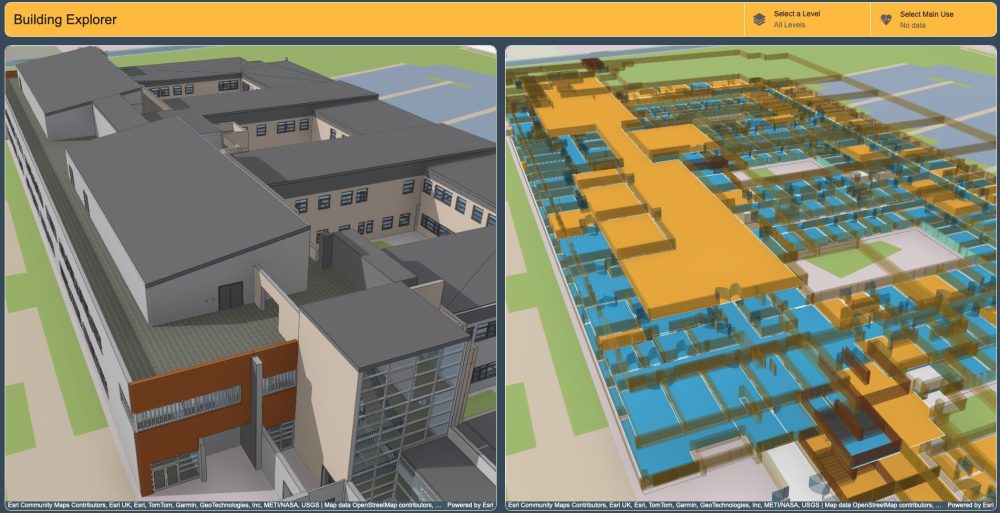
Manchester University NHS Foundation Trust (MFT) has implemented a digital twin of six hospitals in a significant step towards creating a smart hospital estate. The initiative, designed to unify estates data and support more informed decision-making, marks a major milestone in MFT’s digital transformation strategy to enhance operational efficiency, safety and sustainability across one of the UK’s largest NHS Trusts.
A single source of truth for hospital estates
The new digital twin replaces a complex mix of legacy systems and paper-based workflows with a centralised 3D model of six MFT hospitals. The model visualises floors, rooms and spaces alongside associated data, creating a single source of truth for the Trust’s estate. It is already being used to improve space utilisation, monitor Reinforced Autoclaved Aerated Concrete (RAAC) and asbestos, and support maintenance and compliance activities.
Built using Esri UK’s Geographic Information System (GIS) platform, the digital twin went live in October 2025. The GIS platform provides indoor mapping, spatial analysis, navigation and asset tracking capabilities. Strategic data partner BIS Consult led the development of the data strategy and oversaw the integration of information from multiple systems, including Computer-Aided Facility Management (CAFM) and Computer-Aided Design (CAD) floor plans.
Spanning more than 274,000 square metres of internal floor space, the 3D model covers Manchester Royal Infirmary, Royal Manchester Children’s Hospital, Manchester Royal Eye Hospital, and Saint Mary’s Hospital on the Oxford Road campus, as well as Altrincham Hospital and Withington Community Hospital.
Improving estate management and patient safety
David Bailey, Head of Digital Estates at MFT, explained: “Integrating all of our existing data into one 3D model has created the foundation for building a digital twin and is driving new opportunities for efficiency gains. Moving from analogue to digital achieves a better understanding of our buildings and assets, which helps improve their management and maintenance, as well as improving patient safety.”
The digital twin is being trialled to analyse space utilisation, identifying areas where rooms are underused. Once rolled out fully, staff will have real-time visibility of occupancy and space requests, enabling better allocation of facilities and resources. Clinicians will also be able to use the system to plan new services and adapt existing ones based on accurate spatial data.


Streamlining maintenance and risk management
The model is already transforming how the Trust manages RAAC and asbestos. Digital surveys completed on mobile devices feed directly into the 3D environment, allowing estates teams to visualise different risk levels. This approach improves accuracy, accelerates data collection and enhances safety through more effective maintenance regimes. At one site, digitising asbestos management has reduced information preparation time by up to ten days per month.
The next stage of MFT’s smart estate programme will extend the digital twin to the remaining four hospitals in its portfolio. Building condition surveys will be digitised, replacing spreadsheet-based reporting with mobile data capture linked directly to the model. This will provide a clearer picture of maintenance requirements, helping prioritise resources and tackle the maintenance backlog.
Energy consumption data will also be integrated to support carbon reduction goals and identify opportunities for energy savings across the Trust’s estate.
Overcoming data integration challenges
Bringing together data from multiple sources presented one of the project’s biggest challenges. Combining information from CAFM systems, CAD plans and other datasets required a robust integration strategy and improvements in data quality. Establishing new data governance frameworks has ensured that all information connected to the model remains accurate, consistent and up to date—crucial for long-term success in digital estate management.
According to Duncan Booth, Head of Health & Social Care at Esri UK: “Indoor mapping is playing a central role in the modernisation of MFT’s estates and facilities department by giving users situational awareness of the entire site. Optimising the use of existing buildings and making RAAC and asbestos management more efficient are the first of many new benefits. Already used at airports, universities and industrial sites, this technology is now driving the next phase of digital transformation in healthcare.”
Towards a smarter, more connected healthcare estate
Future plans include developing applications for indoor navigation to help patients and staff find their way around large hospital campuses, reducing missed appointments and improving accessibility. Other planned innovations include digital contact tracing to help control the spread of infections and asset tracking to locate equipment such as beds, scanners or wheelchairs in real time.
Nicholas Campbell-Voegt, Director at BIS Consult, said: “This project shows how smart use of data can transform NHS estates. By creating a single source of truth for assets and space, MFT is paving the way for a new standard in how Trusts manage their estates. The approach provides a blueprint that other NHS organisations can follow, helping build smarter, safer and more sustainable healthcare environments.”
A benchmark for NHS digital transformation
MFT’s digital twin demonstrates how GIS technology and data integration can transform facilities management in healthcare. By connecting data, people and processes, the Trust is building a foundation for smarter decision-making, better resource allocation and improved safety.
As the NHS faces growing pressures to modernise and optimise its estate, Manchester’s approach highlights the strategic role of digital twins in healthcare, setting a benchmark for how digital estate management can support efficiency, safety and sustainability in the built environment.
Read next: Building digital foundations that last – Build in Digital
Are you a building professional? Sign up for a FREE MEMBERSHIP to upload news stories, post job vacancies, and connect with colleagues on our secure social feed.

