
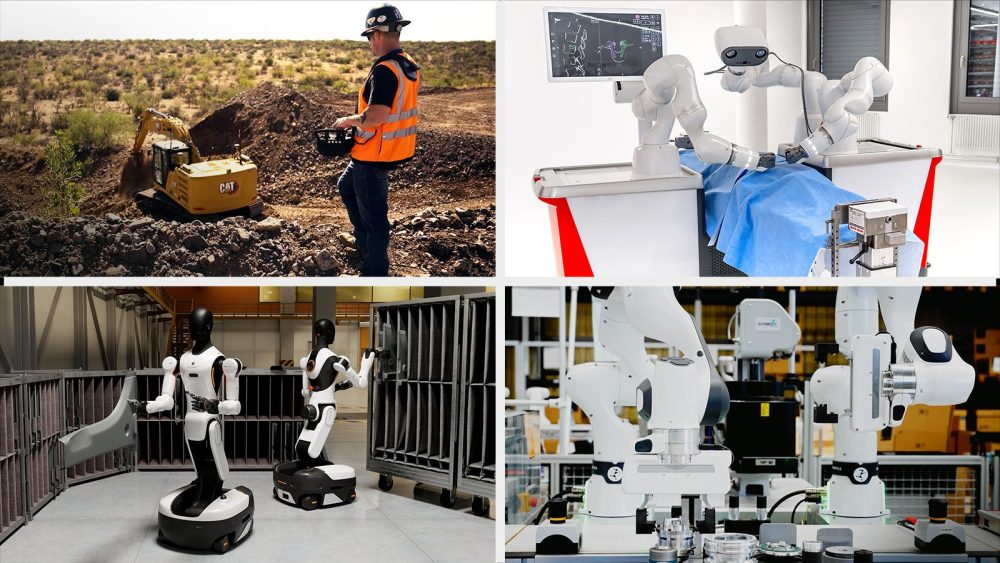
NVIDIA has unveiled new physical AI models and robotics frameworks, reshaping digital construction and industrial development.
NVIDIA has announced a major expansion of its physical AI portfolio, releasing new open models, simulation frameworks and AI infrastructure while global partners revealed next-generation robots at CES 2026. The announcement signals a significant step forward for robotics in construction, manufacturing, healthcare and industrial automation, with direct implications for the digital construction sector.
At the centre of the announcement is NVIDIA’s focus on physical AI: artificial intelligence systems that can perceive real-world environments, reason about them and plan actions accordingly. According to Jensen Huang, founder and CEO of NVIDIA, this marks a turning point for the robotics industry. “The ChatGPT moment for robotics is here. Breakthroughs in physical AI, models that understand the real world, reason and plan actions, are unlocking entirely new applications,” he said. Huang added that NVIDIA’s full stack, including Jetson processors, CUDA, Omniverse and open physical AI models, is enabling partners to transform industries with AI-driven robotics.
Long-standing challenges
For digital construction and the built environment, these developments address long-standing challenges around automation, safety, productivity and skills shortages. Historically, robots have been costly, single-purpose machines that are difficult to program and slow to adapt. NVIDIA’s strategy is to support the development of generalist-specialist robots that can learn multiple tasks and operate across changing environments, including construction sites, factories and infrastructure projects.
A key part of this strategy is the release of new open physical AI models available on Hugging Face. NVIDIA Cosmos Transfer 2.5 and Cosmos Predict 2.5 provide world models for physically based synthetic data generation and robot policy evaluation in simulation. These capabilities are critical for training robots safely before deployment on live construction or industrial sites. NVIDIA Cosmos Reason 2 introduces an open reasoning vision language model that enables machines to interpret complex environments and act with greater contextual awareness.
For humanoid and mobile robots, NVIDIA Isaac GR00T N1.6 offers an open reasoning vision language action model designed for full-body control. Companies including Franka Robotics, NEURA Robotics and Humanoid are already using GR00T-enabled workflows to simulate, train and validate new robot behaviours. This approach reduces development time while improving reliability, an essential requirement for construction automation and heavy industrial use.

Biggest bottlenecks
Beyond models, NVIDIA is addressing one of the biggest bottlenecks in robotics development: fragmented simulation and compute workflows. The new open-source Isaac Lab-Arena framework provides large-scale robot policy evaluation and benchmarking in simulation, connecting to industry benchmarks such as Libero and Robocasa. This standardisation supports more robust testing before robots are deployed to physical hardware, improving safety and performance in real-world environments.
NVIDIA OSMO, a cloud-native orchestration framework, further simplifies robotics development by unifying workflows such as synthetic data generation, model training and software-in-the-loop testing. Already in use by companies such as Hexagon Robotics and integrated into the Microsoft Azure Robotics Accelerator, OSMO enables faster iteration cycles across workstations and cloud environments. For digital construction firms managing complex automation pipelines, this orchestration capability is increasingly relevant.
Open-source
The company is also strengthening its collaboration with the open-source community. Robotics has become the fastest-growing category on Hugging Face, and NVIDIA is integrating Isaac and GR00T technologies into the LeRobot framework. This partnership brings together NVIDIA’s two million robotics developers with Hugging Face’s thirteen million AI builders, accelerating innovation across sectors including construction robotics, site automation and autonomous inspection.
Hardware advancements underpin these software developments. NVIDIA Jetson Thor is being adopted by humanoid robot developers such as Boston Dynamics, NEURA Robotics and LG Electronics to meet the demanding compute requirements of reasoning-enabled robots. For the industrial edge, the new NVIDIA Jetson T4000 module delivers four times the performance of previous generations within a power-efficient envelope suited to autonomous machines on energy-constrained sites.
Extending capabilities
NVIDIA IGX Thor extends these capabilities further, supporting enterprise-grade AI computing with functional safety for industrial environments. This is particularly relevant for construction, mining and aviation, where safety certification and reliability are critical. Caterpillar’s expanded collaboration with NVIDIA to bring AI and autonomy to construction and mining equipment highlights the practical application of these technologies on real job sites.
As physical AI, simulation and edge computing converge, the digital construction sector stands to benefit from more adaptable robots, safer automation and faster deployment cycles. NVIDIA’s latest releases position robotics as a core component of future construction workflows, rather than a niche or experimental technology.
By combining open physical AI models, scalable simulation and industrial-grade computing, NVIDIA is accelerating robotics adoption, enabling digital construction organisations to deploy adaptable, intelligent machines across complex, safety-critical environments.
Read next: Precision installation of Clifton railway bridge over M6 – Build in Digital
Are you a building professional? Sign up for a FREE MEMBERSHIP to upload news stories, post job vacancies, and connect with colleagues on our secure social feed.
