

David Shepherd further explores data management and BIM for SMEs in the sixth article in his series
Both public- and private-sector clients have been the silent losers of the UK’s misaligned BIM evolution. For 15 years they have relied on official guidance and information management consultants to commission digital deliverables, rewrite employer’s requirements, refresh asset information strategies, and to rebrand BIM as “Better Information Management”.
Despite all of these measures, they’ve received far less than what the 2011 Government Construction Strategy promised; only to be blamed for not being able to articulate their requirements using detailed information management jargon.
There isn’t a week that goes by without high-profile information management professionals complaining that clients remain the most significant hindrance to realising the benefits that were envisaged in the 2011 strategy.
Yet, despite over a decade of BIM-enabled project delivery, instead of structured, federated, lifecycle-ready information, clients typically end up with:
- PDFs in nested folders
- Models without reliable properties
- Fragmented O&M manuals
- Asset lists that differ from what was actually installed
- COBie sheets that are formally correct but practically useless
This is not a failure of intent. It is a failure of execution, and specifically of data payload execution.

I should re-iterate that the payload is simply the useful information inside of information containers. For example, spaces, systems, assets, classification codes, attributes like flowrates, capacities, materials, geometry that describes shapes and sizes, relationships (asset → space → system); properties required for maintenance, carbon modelling, cost, safety, etc.

As Article 2 established, PwC’s Benefits Measurement Study demonstrates that the overwhelming majority of achievable benefits (i.e., 61 – 73%) come from structured asset data used in operations, not from the information container governance that ISO 19650 prioritises.
In this penultimate article of the series, I explain why the SME + Tier 1 architecture transforms the value proposition for clients, reinstating what was lost when BIM drifted into process focused compliance.
To show exactly what I mean, I am providing the following ‘user experience’ prototype of the freemium SME Asset Capture and Assurance Platform: Prototype SME Data Updater.
Feel free to take a look. At the top-left of the app, there is a feedback button, and I’d encourage you to use this to share your constructive ideas about how the app could be improved.
Clients Don’t Want BIM. Clients Want Predictability.
Clients care about five things above all else:
- Operational efficiency
- Risk reduction
- Regulatory compliance
- Reduced cost of ownership
- Reliable, repeatable handovers
The promise of BIM in 2011 was that digital information would unlock these outcomes. The Government Construction Strategy framed BIM as one of a raft of key initiatives that would improve whole-life value and reap cost reductions of 15–20%.
But none of this can be delivered if the data required for FM, maintenance and operations is incomplete, inaccurate or inconsistent. Until now, structured asset data has been aspirational, not normal.
A payload driven supply chain flips this: structured data becomes the default output.
Statutory Compliance: Why Clients Need SME Captured Asset Data to Legally Operate the Building
A building cannot legally operate without a full suite of statutory certificates, and every one of those certificates depends on accurate as installed asset data, captured at the moment of installation. This is the single largest blind spot in traditional BIM and handover processes and the largest value driver for clients adopting a structured SME data workflow.
The PwC BIM Benefits Measurement Model makes clear that operational, compliance driven benefits are the largest share of BIM’s total value, especially in maintenance planning and asset safety evidence. However, those benefits can only be realised if the underlying data exists. PwC notes that benefits often shrink simply because the necessary evidence was not captured at the point of delivery.
Every Statutory Certificate Requires Accurate Asset Information
Before occupation, the client must provide (and retain):
- Fire Safety Information (Regulation 38)
- Electrical Installation Certificates
- Gas Safe commissioning documents
- Pressure Systems Written Scheme of Examination
- Lifts conformity declarations and commissioning records
- Legionella compliance records
- Ventilation and airtightness tests
- EPC / BRUKL outputs
- Pre completion acoustic tests
- Safety Case data (for HRBs under the Building Safety Act 2022)
Note that these are legal obligations. They’re not optional digital deliverables.
Each certificate depends on having:
- correct serial numbers
- the right manufacturer/model
- the correct installation location
- commissioning evidence
- date/time of installation
- competent person attribution
These are precisely the data SMEs can (and must) capture during installation but which cannot be recovered reliably after void closure.
SME Data Capture Solves Statutory Compliance at Its Source
As described in Article 5, the proposed SME-friendly data capture platform captures:
- asset identity
- location
- regulatory tags (fire dampers, pressure vessels, medical gases)
- commissioning photos
- conformity declarations
- installer attribution
- timestamps
Because this happens during installation, the client receives:
- complete Regulation 38 evidence
- complete fire safety asset lists for the Safety Case
- accurate distribution board schedules
- validated ventilation/airflow data
- reliable gas, electrical, and pressure system evidence
- asset data structured for CAFM ingestion (PPM compliance)
This directly supports the regulatory emphasis on digital evidence of fire safety and operational performance highlighted in the post Grenfell regulatory reforms, which demand accurate and reliable digital information for safe operation across the building lifecycle.
O&M Legal Risk Shifts From the Client to the Evidence
Without structured as installed data, the client’s statutory responsibilities become guesswork:
- fire doors cannot be traced
- fire dampers cannot be verified
- pressure vessels cannot be enrolled in a WSE
- Legionella controls lack asset level attribution
- medical gases cannot be safely certified
- lifts and electrical systems lack conformity evidence
Structured SME data eliminates this risk.
When regulators review the Safety Case, or when Building Control assesses compliance, the client can present:
- asset lists
- locations
- commissioning data
- certificates
- digital evidence bundles
This aligns directly with the PwC finding that operational benefits (especially maintenance and safety compliance) are the largest ROI drivers for BIM-enabled processes. This amounts to more than the benefits that could be realised in design and construction.
Clients Move From Reactive Compliance to Predictable, Defensible Compliance
With SME captured data, clients achieve:
- legally defensible Golden Thread data
- early CAFM readiness
- fully evidenced PPM regimes
- reduced compliance audit cost
- transparent lifecycle risk management
- smoother, faster Building Control approval
- demonstrable safety and performance assurance
This is not “nice to have BIM data”; it is legally necessary operational evidence captured through a workflow SMEs actually follow.
What Clients Actually Receive When SMEs Capture Payloads at Source
When SMEs capture asset information through a guided, consistent platform (as described in Articles 3 and 4), clients gain immediate, tangible benefits:
a) A trustworthy Asset Information Model (AIM)
Instead of manually stitched data, the AIM is automatically built from validated, field-level entries.
b) Accurate spatial, system and asset hierarchies
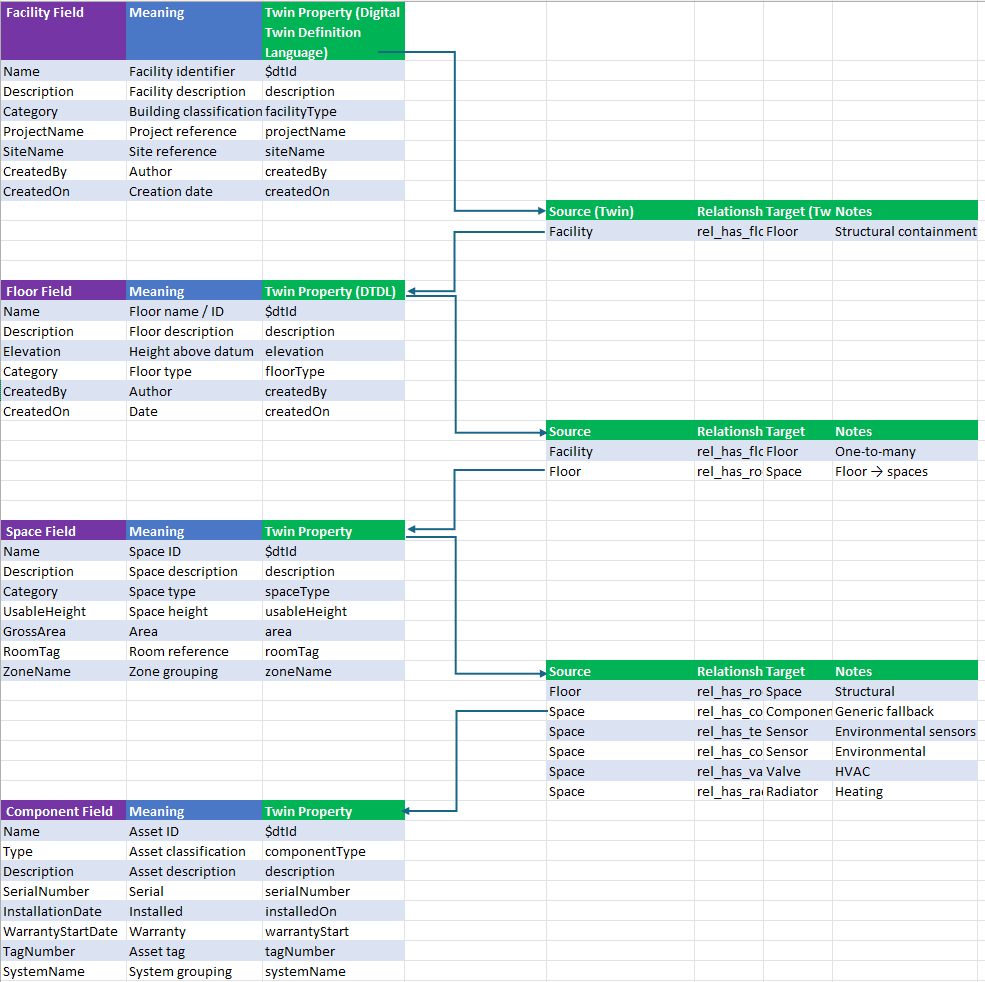
Because the platform enforces consistent facility → floor → space hierarchy, federation (something ISO-19650 references but does not provide any guidance to operationalise) is achieved in practice.
c) Eliminated “handover panic”
Clients no longer endure the months-long document chase that precedes practical completion.
All structured data has accumulated continuously.
d) Faster mobilisation of FM contracts
FM teams can import clean data directly into CAFM or SharePoint lists (SharePoint being the most common platform for public-sector estates teams).
e) Assurance that statutory assets are properly logged
Fire dampers, fire doors, emergency lights, lifts, pressure systems, i.e., everything required for statutory compliance, is captured as part of the installation workflow.
The Operational ROI: Reaching the PwC Value Horizon
PwC’s analysis showed that for the two examined public-sector assets:
- 73% (DoH) and 61% (Foss Barrier) of benefits occurred in operations.
- The largest single benefit category was maintenance planning and execution, driven directly by structured asset data.
Clients finally achieve:
- Smoother handover: everything required for statutory compliance is captured as part of the installation workflow.
- Reduced reactive maintenance costs
Clear asset histories and accurate data make first-time fixes more likely.
- Optimised planned maintenance
Assets can be maintained on condition and risk, not on guesswork.
- Extended asset life
As PwC note, better scheduling and full visibility can extend asset life by 15–20% for M&E components.
- Lower operational variance
Better data reduces contingency allowances, as demonstrated by PwC’s OPEX variance reduction findings.
Operational excellence is not achieved through file naming or container approvals; it is achieved through payload fidelity.
A Clearer Line of Sight From Client Requirements to Delivered Data
The SME payload platform enables something ISO 19650 has always conceptually required but practically struggled with:
“Line of Sight”
Between:
- OIR: Organisational Information Requirements
- AIR: Asset Information Requirements
- EIR: Exchange Information Requirements
- TIDP/MIDP: Information Delivery Plans
- Delivered data
ISO 19650 guidance emphasises responsibility matrices, container breakdown structures, and information delivery planning as key instruments for ensuring this alignment.
But the link is broken if SMEs deliver spreadsheets with unpredictable columns.
The platform becomes the mechanical linkage that turns operational requirements into daily SME actions.

Clients Gain A Real Digital Twin Foundation (Not a Rendered 3D Model)
A digital twin is not a 3D model. A digital twin is a synchronised asset register with:
- Unique IDs
- Spatial context
- System relationships
- Operational metadata
- Condition inputs
- Monitoring integrations
The SME payload system produces 80% of what a digital twin needs before any sensor data is added.
It converts every handover into a scalable, maintainable information foundation.
Assurance, Compliance, and Governance Become Evidence Based
Clients finally gain:
- Automated audit trails of who created, validated and updated each data field.
- Change histories compatible with ISO 19650 4 information exchange criteria.
- Consistent quality across projects, even when subcontractors differ.
- Comparable data across regions, estates, and programmes.
This is the missing capability needed for portfolio-level asset management.
What Article 7 Will Cover
Article 7 will synthesise the entire series and introduce the policy, procurement and industry adoption roadmap required to embed this approach nationally. It will demonstrate how the SME payload model could do, in three years, what 15 years of standards alone could not.
David Shepherd is Product Manager (Data & Construction Programme Enablers)
Read the previous articles in the series:
- Article 4: Designing the SME Payload Platform: Architecture, Workflow, and the Route to Sector Wide Whole-Life Value Creation
- Article 3: Solving the SME Bottleneck: The Missing Link in the UK’s Digital Construction Strategy
- PART 2: Article 2: Why BIM Lost Its Economic Enabler (and How SMEs Can Restore It)
Read next: Robot construction pioneer raises $25m seed funding
Are you a building professional? Sign up for a FREE MEMBERSHIP to upload news stories, post job vacancies, and connect with colleagues on our secure social feed.
