

David Shepherd completes his series of articles exploring BIM for SMEs with this final piece explaining how the promise can finally be achieved
Part 1: Operational assurance
Over my previous six articles, a clear pattern has emerged.
The UK established a world leading foundation for collaborative information management through BS 1192, Avanti, and Terminal 5. It articulated an ambitious vision for whole life value in the 2011 Government Construction Strategy. It then internationalised a robust framework for process governance through ISO 19650.
Yet more than a decade later, the outcomes promised at the outset, e.g., extended asset life, reduced reactive maintenance, lower operational carbon, and stronger regulatory assurance, remain only partially realised.
The explanation is now unavoidable. As an industry, we have not failed to adopt standards. Neither have we failed to implement Common Data Environments. Instead, we’ve failed to preserve data representing as -built truth. In turn, that failure resulted in owner-operators being unable to unlock lifecycle value from data that proved to be unrepresentative of the built asset.
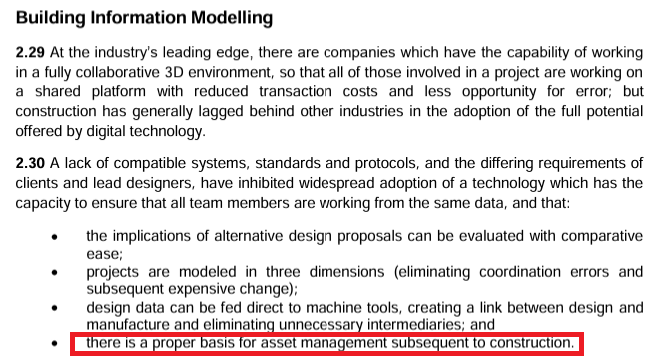
What’s worrying is that, as far back as 2011, the importance of capturing and preserving as-built truth was writ large in the then Government Construction Strategy. Back then, BIM was described as “a technology which has the capacity to ensure…that there is a proper basis for asset management subsequent to construction”.

Process compliance is not value creation
To some extent, ISO 19650 succeeded at what it was designed to do. Governance of information containers, workflows, responsibilities, and exchange are key to professionalising information management at scale.
Nevertheless, what ISO-19650 does not do (and was never designed to do) is to ensure that asset data representing as-built truth is captured when physical reality can still be observed.
As the findings of PwC’s BIM Level 2 Benefits Measurement research demonstrated, ISO-19650 produces a predictable result: strong process compliance, but handover data that is unrepresentative of the as-built truth, resulting in very modest whole life savings (1.5-3%).
The deeper value of reduced capital churn and meaningful operational optimisation remains elusive. That’s not because governance or documentation is missing. Instead, it is because, once an owner-operator encounters a mismatch between handover data and the physical reality, trust in the dataset collapses quickly and visibly.
Handover information is no longer treated as authoritative; engineers default to physical verification, parallel “shadow” asset registers emerge, and the ISO-19650-compliant Asset Information Model is quietly sidelined.
Maintenance behaviour becomes conservative: diagnosis gives way to replacement, repeated intrusive surveys are commissioned to uncover concealed assets, and compliance assessments harden as undocumented or inferred assets are assumed non-compliant.
Digital initiatives stall as teams conclude they need a “clean baseline” before optimisation or automation can proceed. These responses are not cultural resistance; they are rational reactions to uncertainty.
The cost impact of this perception of undue risk is immediate and compounding. Labour costs rise as every task takes longer to verify on site. Assets are replaced early to manage risk, shortening useful life and shifting avoidable capital expenditure into operational budgets. Intrusive surveys and remedial works (often undertaken in occupied buildings) frequently cost multiples of the original installation. Compliance failures trigger premium-rate remediation, insurance restrictions, and operational disruption. Most critically, optimisation, energy reduction, and digital transformation are deferred indefinitely, locking in higher OpEx for decades. Once as-built truth is lost at installation, the financial penalty is not a one-off correction, but rather a permanent erosive impact on lifecycle value.
Documents are revisable; evidence must be immutable
The ISO-19650 workflows address design/construction information, which is documentary by nature. Over the project lifecycle, those documents express the development and refinement of intent. They can be corrected, revised, superseded, and re issued through formal workflows.
In contrast, installation phase asset data is different. To be reliable, those data must be immediate evidence of the as built truth at the time of installation, identifying:
- what was physically installed;
- where it was installed;
- how it was configured;
- whether it functioned correctly at first operation.
Once ceilings are closed, systems energised, and buildings occupied, the opportunity to capture this truth has passed. Tampering ‘after the fact’ (to fix what’s missing) invalidates evidence. For example, if the location, manufacturer, model, and serial number of fire dampers are not captured at the point of installation, the later reconstruction of that data by inference from supplier invoices or construction documents will rarely result in an owner proactively shutting down the building.
In fact, day-to-day operation will typically continue. However, when the absence of first–hand installation evidence is identified during a statutory inspection, audit, or enforcement action, the outcome is not a request for clarification but a failed compliance assessment; often triggering intrusive surveys, remediation, and, in some cases, restricted use of the building.
This costly distinction has been consistently overlooked.
Trigger events versus evidential moments
ISO 19650 rightly formalises trigger events: the process milestones that initiate information exchange and acceptance.
But asset evidence is reliant on a different logic. There are points in a project when physical facts can be directly witnessed and verified. These points are evidential moments (or evidential windows):
An evidential moment is the point in the asset lifecycle at which a fact about the physical asset can be directly witnessed and evidenced, and after which that fact cannot be reliably recreated without unacceptable uncertainty.
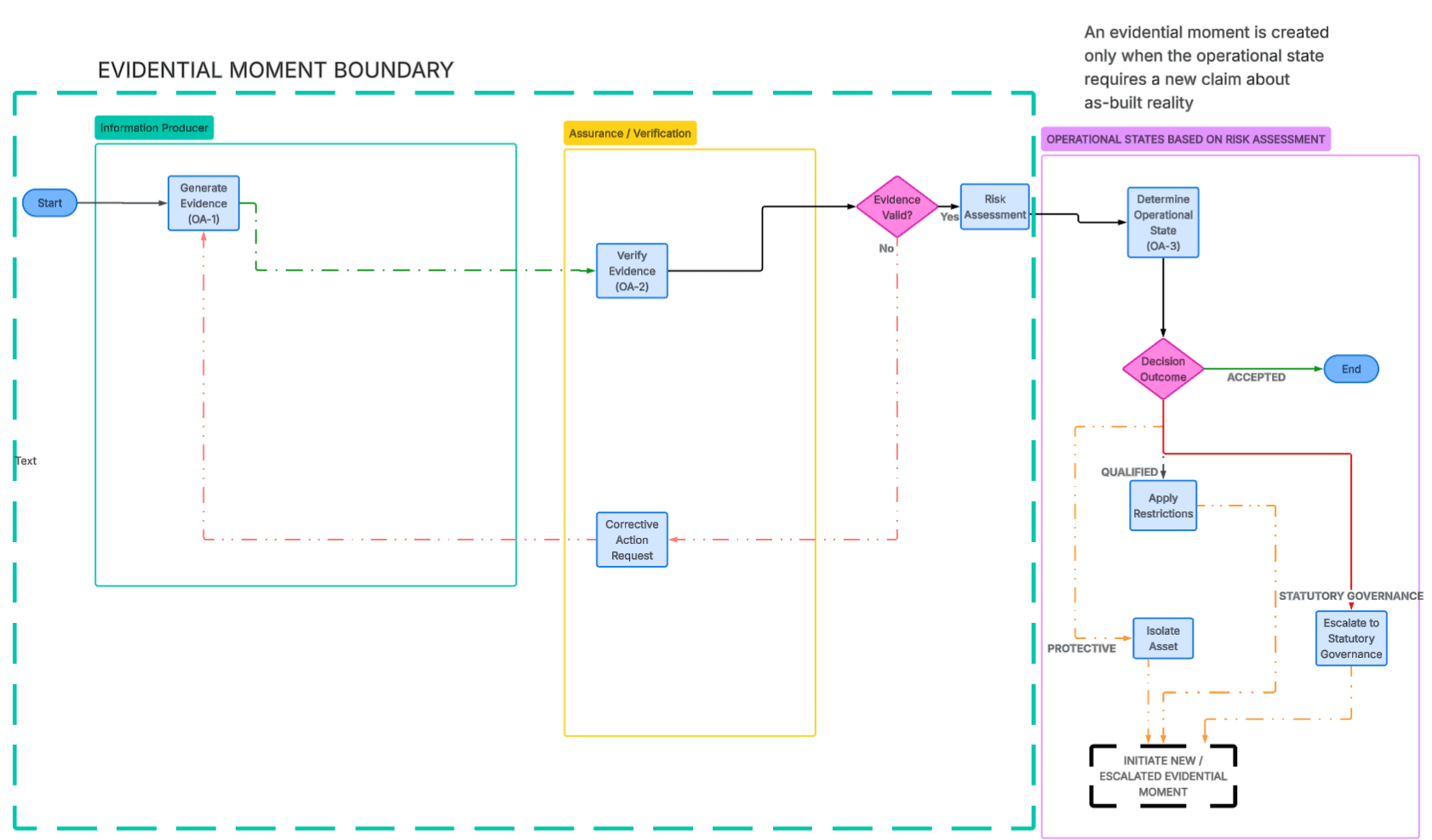
Examples include installation prior to concealment, commissioning, life safety testing, and configuration at operational handover.
Therefore, while trigger events manage information flow, evidential moments anchor truth.
ISO 19650 governs the former extremely well. However, it is the absence of provision for the latter explains why procedurally compliant projects still don’t deliver the most advantageous (lifecycle) benefits that were envisaged in the 2011 Government Construction Strategy.

Part 2: The missing instrument: asset expectation models
The original BIM strategy assumed professional practice would naturally preserve these moments. In a fragmented, SME -heavy delivery ecosystem, that assumption has failed.
What has been missing is a mechanism for owners and operators to state in advance what facts must be true at handover.
For this purpose, the mechanism that I propose is the Asset Expectation Model (AEM).
To be clear, the AEM is not a BIM model, schema, or software requirement. It is an operator authored declaration of minimum evidential sufficiency, the minimum level of as-built truth that must be captured at installation because it cannot later be recreated.
An Asset Expectation Model defines the minimum evidential facts that must exist and be captured at installation, with any operator-specific expectations layered on top.
Of course, some will contend that there is no need for this mechanism because it is just another information requirement. However, in contrast with information requirements that are milestone driven, document centred, and aligned to trigger events; the Asset Expectation Model protects the unrepeatable moment in which observations of as-built truth can be captured as evidence (by installers and commissioning engineers).
Critically, AEMs operate at two levels.
Asset-level AEMs: protecting irrecoverable facts
Asset level AEMs specify what must be captured at installation.
[subhead]Example: Fire Damper (Asset level AEM)
Evidential moment: installation prior to void closure
Mandatory evidence:
- confirmation of physical existence linked to a unique tag;
- precise installed location (room, zone, elevation);
- manufacturer, model, serial number;
- orientation and compartment served;
- installation condition evidence;
- commissioning test result;
- confirmation of completeness within the defined system boundary.
Explicit exclusions: shop drawings, design intent models, O&M documents.
Acceptance rule: absence of this evidence renders the asset non conforming, regardless of document completeness.
System level AEMs: protecting consequences
Assets do not fail in isolation. Systems fail when something essential is missing.
System level AEMs define what must be true for a system to be considered complete, safe, and optimisable as a whole. They introduce a requirement that asset records alone cannot meet: positive confirmation of absence as well as presence.
[subhead]Example: Fire and Smoke Control System (System level AEM)
Mandatory evidence includes confirmation that every compartment boundary contains the required devices, that all detection zones actuate intended responses, and that no safety critical elements were omitted or bypassed.
Asset data proves things exist.
System level evidence proves nothing essential is missing.
| Operational Assurance element | Revised ISO / governance alignment |
| Asset Expectation Models (AEMs) Operator defined minimum evidential sufficiency protecting irrecoverable as built truth | Defined by Operator (outside ISO) Declared via OIR/AIR context, but not an information container or data model |
| Evidence requirements (what must be captured, when) | ISO 19650 (via OIR / AIR / EIR) Informed by AEMs as minimum thresholds |
| Evidence structure & metadata | ISO 19650Container structure, identifiers, metadata standards |
| Evidence admissibility (timeliness, proximity, authority, scope) | Operational Assurance definition (outside ISO) Governs evidential moments and irreversibility |
| Risk assessment | ISO 31000 (Risk Management) |
| Reliance / acceptance decision | ISO 55000 (Asset Management) |
| Conditional / protected operational states | ISO 55000 (Asset Management) |
| Statutory escalation | Jurisdictional law (e.g. Building Safety Act 2022), not ISO |
WIIFM: why this matters to SMEs and clients
For SMEs, the ‘what’s in it for me’ is that AEMs remove ambiguity. They make expectations explicit, bounded, and fair. Capture happens once, at installation, with clear acceptance criteria, instead of endless rework or downstream blame.
For clients, AEMs protect statutory compliance, reduce conservative over maintenance, enable safe optimisation, and unlock credible digital twins. They reduce re survey, rather than burdening oversight.
This is the missing “push–pull” the 2011 strategy anticipated but never operationalised.
A focused policy response
No new standards are required. What is required is repositioning existing levers:
- Mandate asset and system level AEMs pre procurement.
- Align Government Soft Landings to evidence backed AIMs built from installation capture.
- Enable SMEs with freemium lightweight capture tools (e.g., see Prototype SME Data Updater) aligned to these expectations.
- Measure evidential completeness, not BIM maturity.
- Link payment milestones to AEM defined evidential sufficiency.
Conclusion: finishing what BIM started
The UK did not lose BIM’s value by doing the wrong things. It lost value by being incapable of safeguarding the as-built truth without which owner-operators cannot decisively optimise operations.
Recovering that lions’ share of lost value requires a subtle but decisive shift. A shift that goes beyond ISO 19650 process compliance to enabling SMEs to capture (and Tier 1s to assure) the minimum viable asset dataset. A shift that goes beyond trigger events to safeguarding evidential moments. A shift that goes beyond reconstructed asset data to as-built truth.
Asset Expectation Models provide that shift.
In 2011, our industry promised that BIM would provide a proper basis for asset management subsequent to construction. In 2026, this article explains how that promise can finally be achieved.
David Shepherd is Product Manager (Data & Construction Programme Enablers)
Read the previous articles in the series:
Read next: Ecocem and Tata agree deal for low-carbon cement solutions
Are you a building professional? Sign up for a FREE MEMBERSHIP to upload news stories, post job vacancies, and connect with colleagues on our secure social feed.
