
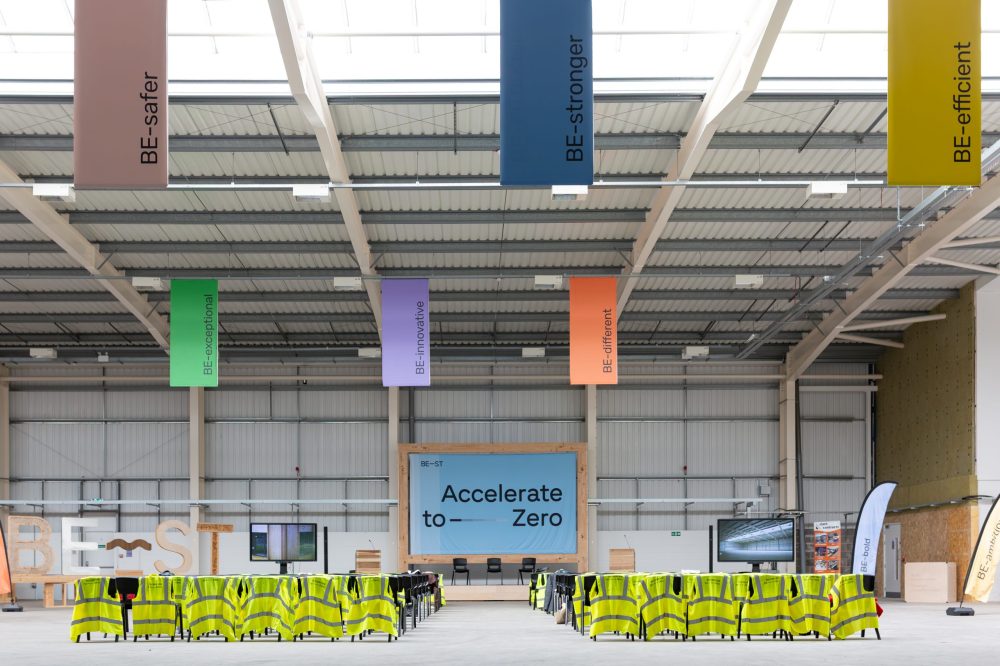
BE-ST (Built Environment – Smarter Transformation) marked a major milestone with the relaunch of its Innovation Campus in Hamilton. The event unveiled two flagship facilities—the Mass Timber Centre of Excellence and Scotland’s National Retrofit Centre (SNRC)—both designed to accelerate innovation, sustainability, and skills development in the UK’s construction sector.
The relaunch coincided with the opening of BE-ST Fest 2025 Fringe Festival, bringing together industry leaders, academics, policymakers, and innovators to explore collaboration opportunities and showcase cutting-edge approaches to low-carbon construction.
Driving innovation in the UK construction sector
The UK construction sector is at a turning point, facing urgent challenges around climate change, housing demand, rising energy costs, and skills shortages. The BE-ST Innovation Campus has been relaunched to provide advanced facilities and resources to help the industry address these challenges.
Supported by the Scottish Funding Council and Edinburgh Napier University, the two new centres offer:
- State-of-the-art mass timber manufacturing capabilities to boost local supply chains and reduce carbon emissions.
- Specialised retrofit facilities to scale retrofit solutions, support skills development, and improve building energy performance across the UK.
Together, they create a unique ecosystem for innovation, collaboration, and sustainable transformation.
The Mass Timber Centre of Excellence
The newly launched Mass Timber Centre of Excellence is a first-of-its-kind facility in the UK, equipped with £1.5 million of advanced timber post-processing machinery and a fully integrated extraction system.
Key capabilities include:
- Largest commercially available CNC machine in the UK, enabling high-precision timber processing.
- Full-scale production of Cross Laminated Timber (CLT), Nail Laminated Timber (NLT), and Glued Laminated Timber (Glulam).
- Annual output of 8,000m³ when operated at full capacity, on a single shift.
- Enhanced health and safety processes through modern extraction and finishing technologies.
Largest commercially available CNC machine in the UK, enabling high-precision timber processing.
- Full-scale production of Cross Laminated Timber (CLT), Nail Laminated Timber (NLT), and Glued Laminated Timber (Glulam).
- Annual output of 8,000m³ when operated at full capacity, on a single shift.
- Enhanced health and safety processes through modern extraction and finishing technologies.
This investment positions the UK to reduce reliance on imports, as the country currently brings in around 73,000m³ of mass timber each year. By localising production, the centre aims to:
- Strengthen domestic supply chains.
- Support the creation of new jobs in Scotland.
- Accelerate adoption of UK-grown mass timber solutions.
- Reduce embodied carbon in construction projects.
“The Mass Timber Centre of Excellence opens up huge opportunities for the construction sector. By investing in mass timber, we are not just advancing low carbon approaches to construction, we are also investing in economic growth, creating jobs, and providing solutions to some key challenges facing the built environment sector,” said Sam Hart, Associate Director of Manufacturing and Housing, BE-ST.

Scotland’s National Retrofit Centre
Alongside timber innovation, the relaunch also celebrated the reopening of Scotland’s National Retrofit Centre (SNRC). The centre has itself undergone a deep retrofit, delivered by Clark Contracts and part-funded through Phase 1 of Scotland’s Public Sector Heat Decarbonisation Fund.
The retrofit project was supported with £1.2 million from the fund, administered by Salix on behalf of the Scottish Government, and hosted by Edinburgh Napier University.
The SNRC’s role in the UK retrofit challenge:
- Hands-on training hub for retrofit skills development.
- Demonstration space for low-carbon retrofit technologies.
- Collaboration platform for academia, government, industry, and public sector clients.
- Living case study for energy efficiency, decarbonisation, and improved building performance.
Retrofitting existing buildings is widely recognised as one of the UK’s biggest challenges in achieving net zero carbon targets. With more than 80% of the buildings that will exist in 2050 already standing today, the SNRC provides a national platform to accelerate retrofit delivery and build capacity in the sector.
“Scotland’s National Retrofit Centre is the hub for developing retrofit skills and knowledge, both through hands-on training and by serving as a living case study. Our mission is to coordinate and support Scotland’s journey to decarbonise its existing buildings,” states Caitriona Jordan, Associate Director of Retrofit and Energy Efficiency, BE-ST
Tackling climate, housing, and skills challenges
The launch of the Mass Timber Centre of Excellence and Scotland’s National Retrofit Centre reflects BE-ST’s mission to help the UK construction sector adapt and thrive in a rapidly changing landscape. These facilities are designed to provide practical solutions to some of the most pressing issues:
- The Climate Emergency – accelerating adoption of low-carbon materials like mass timber and scaling retrofit to cut emissions.
- The Housing Crisis – enabling faster, more sustainable construction methods to meet demand.
- Rising Energy Costs – reducing energy demand through deep retrofit and efficiency improvements.
- Skills Shortages – equipping the workforce with the knowledge and experience needed for future-ready construction.
“Through these facilities, BE-ST will continue to support innovation, collaboration and skills development that will drive economic growth, improve delivery of the built environment, and benefit communities across Scotland and the wider UK,” states Stephen Good, CEO, BE-ST
A new era for the Built Environment
The relaunch of the BE-ST Innovation Campus marks a significant step forward for the UK’s construction sector. By combining cutting-edge timber manufacturing with a national retrofit hub, BE-ST is positioning Scotland as a leader in low-carbon innovation, sustainable construction, and skills development.
These facilities will play a pivotal role in helping the UK transition to a net-zero built environment, while also supporting local economies and strengthening the construction supply chain.
Read next: Ten challenges in the UK digital construction sector – Build in Digital
Are you a building professional? Sign up for a FREE MEMBERSHIP to upload news stories, post job vacancies, and connect with colleagues on our secure social feed.
