
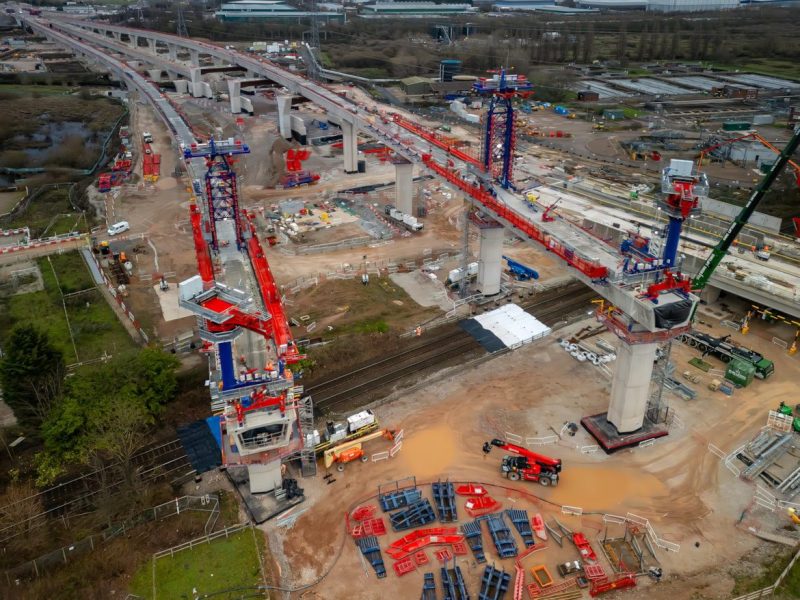
Progress has been achieved on one of the most technically demanding sections of the HS2 route, with the successful completion of two key viaduct spans near Water Orton in Warwickshire. Delivered by Balfour Beatty VINCI over the Christmas period, the works mark a significant milestone in the construction of the Delta Junction, a major rail interchange east of Birmingham that will connect HS2 services to the West Midlands and the wider national rail network.
The newly installed spans cross the existing Birmingham to Peterborough railway line and form part of the northern section of the Delta Junction. This vast triangular junction is comparable in complexity to motorway interchanges such as Spaghetti Junction, but on a much larger scale. It comprises a network of interconnected viaducts, flyovers and underpasses designed to carry high-speed rail over motorways, local roads, rivers, floodplains and operational rail corridors.
The Delta Junction has been engineered to support HS2 operating speeds of up to 360km/h on the mainline and approximately 200km/h on the approaches into Birmingham. To achieve this, the alignment extends across 2.6 miles of track, significantly longer than a conventional road junction, and incorporates five major viaduct structures. This design approach reduces curvature, maintains speed, and ensures safe and efficient rail operations.
The Water Orton viaducts play a critical role within this layout. Located at the northern end of the junction, they will enable southbound HS2 services to diverge towards Birmingham Curzon Street and the rolling stock depot at Washwood Heath. Once complete, the two single-track viaducts will extend for approximately 1.4 kilometres, crossing two railways, a river, multiple local roads and the M42 motorway.
To safely deliver the railway crossing, engineers took advantage of a five-day possession during the quieter Christmas period. This minimised disruption to passengers while allowing complex construction activities to be carried out within a constrained operational environment. With the railway spans now in place, work can progress on the next phases, including crossings over the A446 and the M42 motorway.
Stephane Ciccolini, Senior Works Manager at Balfour Beatty VINCI, said: “This complex section of the HS2 route has taken a major step forward, after Balfour Beatty VINCI teams successfully erected two viaducts spans over an existing railway near Water Orton.
“We’ve worked around the clock during the Christmas period to deliver this incredible feat of engineering, using a specialist cantilever technique not seen in the UK before this project. This approach involves using a 22-metre-high mast and a 14-metre-high swivel crane to move each individual segment into place until the span is complete.”
Precast segmental viaduct construction
The Water Orton viaducts are being constructed using precast segmental viaduct construction, a method increasingly associated with large-scale digital construction projects. Each viaduct is formed from hollow precast concrete segments that are assembled sequentially using a cantilever process. Temporary cable stays support the structure as each segment is installed, after which permanent post-tensioned cables are threaded through the internal voids to provide long-term structural integrity.
Once a span is completed and post-tensioned, the temporary stays are moved forward, allowing the next span to be assembled. This process is repeated between each pier until the full length of the viaduct is complete. The supporting piers, 32 in total, are up to 20 metres high and are cast in situ using bespoke formwork and reinforcement cages manufactured locally in Coleshill.
The scale of offsite and local manufacturing is notable. All 2,742 precast concrete segments required for the Delta Junction viaducts are being produced at a temporary factory at nearby Lea Marston. This approach supports quality control, programme certainty and more efficient logistics, aligning with wider digital construction and modern methods of construction strategies across the HS2 programme.
Sam Hinkley, HS2 Ltd’s Senior Project Manager, said: “It’s great to see the Water Orton viaducts in place across the railway and I’d like to thank everyone who gave up their Christmas to help us reach this important milestone and I’d like to thank passengers for their patience.
“These precast segmental viaducts form a key part of the Delta junction – one of the most complex parts of the HS2 project and I look forward to seeing more progress in the year ahead.”
The Water Orton viaducts form part of approximately 3.7 miles of viaduct construction across the Delta Junction, all being delivered using the same cantilevered, precast segmental methodology. The successful installation of these spans demonstrates how careful planning, digital coordination and advanced construction techniques are being applied to deliver critical HS2 infrastructure safely and efficiently.
Together, these works highlight how digital construction methods, precast engineering and collaborative delivery are enabling HS2 to progress one of Europe’s most technically demanding rail infrastructure programmes.
Read next: Technology translates into consistent operational value – Build in Digital
Read next: Are you a building professional? Sign up for a FREE MEMBERSHIP to upload news stories, post job vacancies, and connect with colleagues on our secure social feed.
