
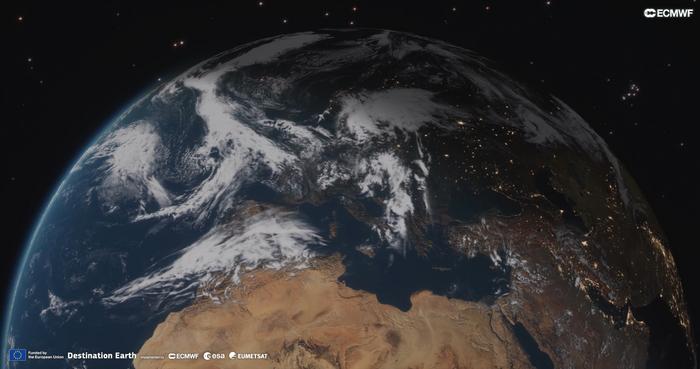
Destination Earth advances digital twin technology to strengthen climate intelligence supporting resilient infrastructure planning worldwide today.
The European Commission and the European Centre for Medium-Range Weather Forecasts (ECMWF) have signed an agreement launching the third implementation phase of Destination Earth (DestinE), Europe’s flagship programme to create a digital twin of the Earth system. Running from June 2026 to June 2028, Phase Three advances Europe’s capacity to model climate and weather conditions using artificial intelligence, supercomputing and integrated Earth-system science.
For the Digital Construction sector, the DestinE initiative represents a major development in how climate intelligence informs infrastructure design, asset management and resilience planning. High-resolution climate projections and weather simulations increasingly influence decisions on urban expansion, transport corridors, flood mitigation, energy infrastructure and long-term asset performance.
Reshaping climate intelligence for construction
Destination Earth’s digital twin programme enables the simulation of past, present and potential climate conditions. These capabilities include tailored “what if” scenarios, allowing institutions to explore how historic weather events might unfold under changing climate conditions, including scenarios in a world two degrees warmer.
For planners and digital construction professionals, access to accurate climate modelling and weather-induced extremes data enables better forecasting of risks such as flooding, heat stress, drought impact and storm exposure. These insights support climate adaptation strategies in infrastructure projects, reducing lifecycle risk and supporting investment planning.
Roberto Viola, Director-General of DG Communications Networks, Content and Technology at the European Commission, emphasised the programme’s wider impact: “Destination Earth demonstrates how Europe can transform major investments in supercomputing and artificial intelligence into concrete benefits for its citizens. By uniting world-class EuroHPC infrastructure, cutting-edge AI Factories, and Europe’s unparalleled expertise in climate and weather science, DestinE strengthens our collective capability to anticipate climate and weather threats — and to act decisively on them. This is how Europe builds resilience.”
High-resolution climate and extreme weather modelling
Since 2022, ECMWF has worked alongside the European Space Agency (ESA), EUMETSAT and over 100 partner organisations to deliver the Climate Change Adaptation Digital Twin and the Weather-Induced Extremes Digital Twin.
These platforms have evolved from prototype systems into operational modelling frameworks producing high-resolution climate projections and detailed simulations of extreme weather events. Such capabilities provide infrastructure planners and construction teams with datasets supporting digital twins of cities, transport networks and utilities.
A core component supporting this progress is the Digital Twin Engine, which coordinates workflows and data flows across EuroHPC supercomputers and the DestinE infrastructure. The engine enables secure access to high-resolution datasets across Europe, supporting researchers, authorities and industrial users.

AI Earth-system models support construction risk planning
Phase Two of DestinE significantly expanded artificial intelligence integration, introducing machine-learning models across land, ocean, sea ice, wave and hydrology systems. These developments enhance user interaction with digital twin data and allow faster modelling workflows.
Phase Three will consolidate these achievements while further integrating AI into Earth-system modelling.
Florian Pappenberger, Director-General of ECMWF, explained: “Phase 3 allows us to consolidate the digital twins while taking the next major steps towards delivering an AI Earth-system model, building on the combined expertise of ECMWF, our Member States and partners.”
He added: “By integrating physical understanding with innovative AI approaches, we will further enhance Europe’s weather and climate prediction capabilities.”
He continued: “This will support European National Meteorological and Hydrological Services and other public institutions in preparing for extreme events in a changing climate and protecting communities. At the same time, the combination of high-resolution, AI-ready digital twin datasets and Europe’s AI ecosystem—including the AI Factories —creates the conditions for a new generation of AI applications for weather and climate and supports innovation across European industry and the public sector. Together, these developments strengthen Europe’s leadership in trustworthy AI for environmental intelligence, while supporting preparedness, resilience and innovation across Europe.”
For the Digital Construction sector, AI Earth-system models support uncertainty modelling, allowing infrastructure planners to test resilience under multiple climate conditions. Such modelling assists in designing infrastructure able to operate under future environmental stresses.
Collaboration drives European digital twin innovation
Destination Earth represents collaboration between supercomputing specialists, meteorological services, climate researchers and technology providers. Irina Sandu, Director of Destination Earth at ECMWF, highlighted the programme’s cooperative nature: “Destination Earth is, above all, a collaborative European effort. It brings together expertise in Earth system modelling, software engineering, high-performance computing, and artificial intelligence. By pooling resources and working closely with our partners, we are building capabilities that complement existing national and European services and help European institutions and Member States prepare for the challenges posed by climate change and extreme events.”
The Climate Digital Twin is developed through a consortium led by CSC-IT Center for Science, alongside research institutes and technology partners across Europe. ESA oversees the Core Service Platform, while EUMETSAT delivers the DestinE data lake supporting global observation integration.
Implications for digital construction and infrastructure resilience
As Destination Earth progresses towards its 2030 objective of creating a digital replica of the planet, construction and infrastructure sectors gain access to improved environmental intelligence. Long-term climate data supports better siting decisions, infrastructure durability planning and adaptation strategies for transport, water and energy systems.
The availability of AI-ready climate datasets and supercomputing-powered simulations strengthens the link between digital construction workflows and environmental risk modelling. Digital twins of assets and cities can increasingly incorporate predictive climate modelling, allowing planners to simulate operational impacts decades ahead.
For governments and construction stakeholders delivering climate-resilient infrastructure, DestinE provides a foundation for informed decision-making grounded in Earth-system science and artificial intelligence.
Destination Earth’s progress equips governments, infrastructure planners, and digital construction leaders with data-driven climate foresight, strengthening resilience, investment decisions, and environmental stewardship across Europe and globally sustainably.
Read next: Data ethics in the age of AI – Build in Digital
Are you a building professional? Sign up for a FREE MEMBERSHIP to upload news stories, post job vacancies, and connect with colleagues on our secure social feed.
