
A new international study has revealed that the global construction sector’s carbon footprint is set to double by 2050, posing a major threat to achieving net-zero targets and the Paris Agreement climate goals.
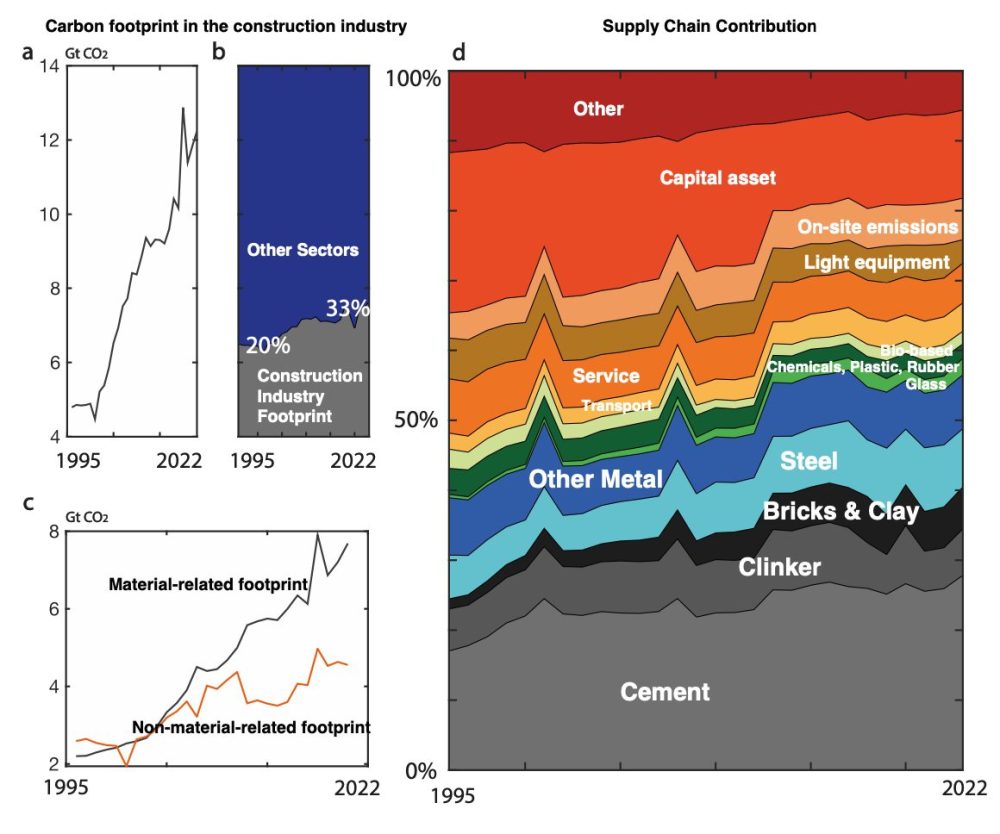
Published by researchers from Peking University, Bauhaus Earth, and the University of Groningen, the study offers the most comprehensive global analysis of construction-related emissions to date. Covering 49 countries and regions across 163 sectors between 1995 and 2022, it shows that the construction industry is now responsible for nearly one-third of total global CO₂ emissions, up from around 20% three decades ago.
A growing carbon burden
According to lead author Chaohui Li, the sector’s share of emissions has ballooned due to its continued reliance on carbon-intensive materials such as cement, steel, and bricks. In 2022, these materials alone accounted for over 55% of the construction industry’s total emissions. A further 6% came from materials like glass, plastics, and chemicals, while 37% resulted from transport, machinery, and on-site operations.
“If current trends continue, the construction industry will exceed the 2°C per annum carbon budget as early as 2040,” warns Li.
The study’s emission projections paint an alarming picture. Under a business-as-usual trajectory, cumulative emissions between 2023 and 2050 could reach 440 gigatonnes of CO₂, enough to consume the entire remaining global carbon budget for limiting warming to 1.5°C.
From developed to developing economies
The analysis also reveals a major geographical shift in emissions. In 1995, high-income countries produced roughly half of all construction-related emissions. By 2022, emissions in these economies had largely plateaued, but developing regions were experiencing rapid growth, fuelled by demand for carbon-heavy materials to support urban expansion and infrastructure projects.
At the same time, the use of bio-based building materials such as timber and bamboo has declined globally, a trend the authors say represents a missed opportunity to scale up low-carbon construction.
A call for a global material revolution
To avoid overshooting climate targets, the study’s authors are calling for a “material revolution”, a fundamental transformation of the sector’s material base. This involves shifting away from carbon-intensive products and embracing low-carbon, circular, and bio-based alternatives like engineered timber, bamboo, and recycled composites.
“Decarbonising construction will require system-wide change,” explains Jürgen Kropp from the Potsdam Institute for Climate Impact Research (PIK) and Bauhaus Earth. “This means rethinking material supply chains, reducing dependency on traditional materials like cement and steel, and innovating with sustainable alternatives.”
High-income regions, the authors argue, must lead by example through innovation, circular design, and stronger regulatory frameworks. Meanwhile, developing economies, where most new urban construction will occur, need financial and technological support to leapfrog directly to sustainable building methods.
Urgent need for collective action
The findings underscore that without decisive global collaboration, the construction sector alone could exhaust the carbon budget for the 1.5°C target within the next two decades. A coordinated international effort to promote low-carbon building materials, improve energy efficiency, and redesign construction systems is critical to keeping global warming within safe limits.
As cities continue to expand rapidly, the transformation of the construction sector will be central to achieving sustainable, climate-resilient urban development. The study’s message is clear: a material transition in construction is no longer optional; it is essential for the future of both the planet and its people.
Read next: Taking a pragmatic path to digital transformation – Build in Digital
Are you a building professional? Sign up for a FREE MEMBERSHIP to upload news stories, post job vacancies, and connect with colleagues on our secure social feed.


