
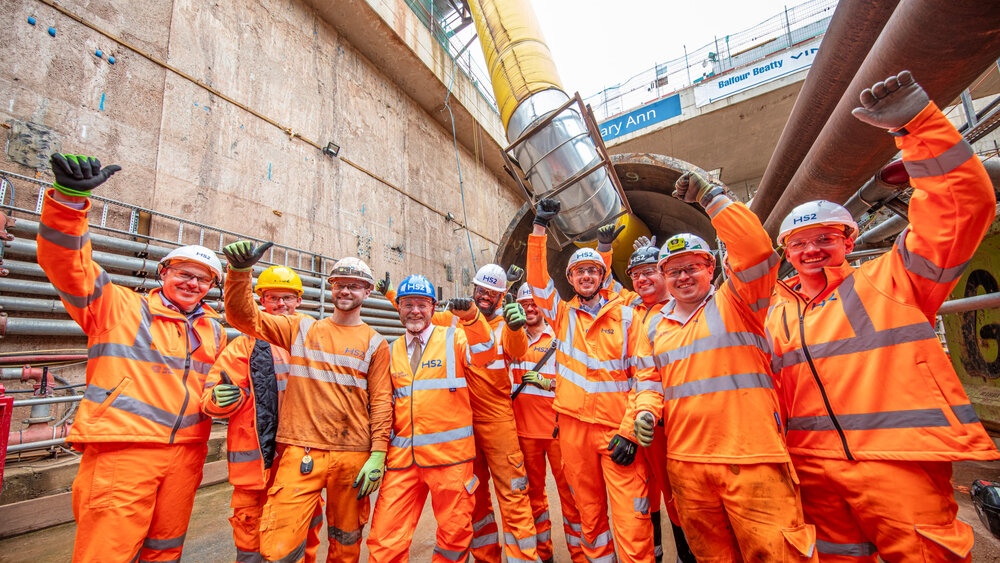
The massive machine chewing its way through the ground to create the tunnel for HS2’s route into Birmingham has reached the half-way point; to the delight of the project team.
‘Mary Ann’, as the 125-metre long tunnel boring machine (TBM) is known, has so far excavated and built a 1.75-mile stretch of the 3.5-mile Bromford Tunnel.
The 1,600-tonne machine – which bears the real name of Warwickshire-born author, George Eliot – began digging the tunnel last year from a large underground box in Water Orton.
Driving around 40 metres underground towards Washwood Heath in Birmingham, the TBM has excavated under the Park Hall Nature Reserve and River Tame, and is now passing under Castle Vale. It will continue adjacent to and under the M6 before breaking through at Washwood Heath early next year.
An expert tunnelling team have been working around the clock on shifts to operate the TBM, which also builds the tunnel as it excavates. A total of 20,797 concrete segments will be put in place by the machine, making 2,971 concrete rings to form the tunnel.

‘Elizabeth’, the second TBM – named after Dame Elizabeth Cadbury by local school pupils – started building the tunnel’s second bore in March 2024, and is due to finish her journey towards the end of 2025.
The tunnel’s 47-metre-deep ventilation shaft at Castle Vale marks the halfway point of Mary Ann’s journey. The shaft, which is 18.6 metres in diameter, will feature cross passages which will eventually link to the two tunnels either side to provide ventilation, servicing and emergency access.
A ‘headhouse’ will be built on top of the shaft, and the whole structure will be complete in 2027, says Balfour Beatty VINCI, which is delivering the project.
Jules Arlaud, the company’s tunnelling director, said: “Reaching the halfway point on this complex stretch of the HS2 route into Birmingham is a great milestone for our 180-strong tunnelling team. We’re looking ahead now to delivering the final stages of tunnelling and celebrating the breakthrough of both TBMs at Washwood Heath next year.”
Steve Powell, HS2’s head of delivery, added: “We’re now at peak construction in the West Midlands, and it’s great to celebrate the halfway point for the Mary Ann tunnel drive into Birmingham. By the end of next year, both of these tunnels will be built, marking a significant step in HS2’s construction in the region.
“Around 31,000 people are working on HS2, with around a third of these in the West Midlands including 615 apprentices and over 1,650 people who were previously unemployed, providing a unique opportunity for local people to learn new skills while delivering the UK’s largest construction programme.”
World class engineering
The two TBMs will remove 1.87m tonnes of excavated material, which is being sifted at the on-site slurry treatment plant and reused on nearby sites at the Delta Junction, where a complex network of 13 viaducts is being built. HS2 has built dedicated roads between these construction sites, including an access off the M6/M42 link roads, in order to take lorries off public roads.
In preparation for the arrival of the TBMs at Washwood Heath, a huge earthworks operation has been completed by a team of 130 people to build the tunnel’s West portal, which at 22 metres below ground is the deepest of the four tunnel portals on the Midlands section of the HS2 route.
The portal is at the start of a 750-metre-long cut and cover structure, which is currently being excavated and built. This is where HS2 trains will emerge from the Bromford Tunnel and travel below ground level, before raising up onto a series of viaducts through Birmingham’s industrial heartland and into Curzon Street Station.
Liam Byrne, Labour MP for Hodge Hill and Solihull North said: “The extraordinary tunnelling under Water Orton and Birmingham is a world-class bit of engineering which would have made Matthew Bolton and James Watt proud. What is more, there are now more local residents working on the project than ever before.
“HS2 is going to transform the economy of Birmingham and the West Midlands and the first trains will be running in just a few years’ time. What is now needed is the same genius that there is in this power of engineering to help us figure out how to bring down costs and drive up the economic benefits to the city and to Solihull.”
The specialist tunnelling teams are from UK firm Tunnelcraft, and Solihull-based Rorcon, with a total of 10 apprentices including formerly unemployed people from the local area who now have jobs on the project.
Main image: The Balfour Beatty VINCI Bromford tunnel team with Liam Byrne MP
Read next: Ordnance Survey deal puts data at heart of planning reform
Are you a building professional? Sign up for a FREE MEMBERSHIP to upload news stories, post job vacancies, and connect with colleagues on our secure social feed.
