
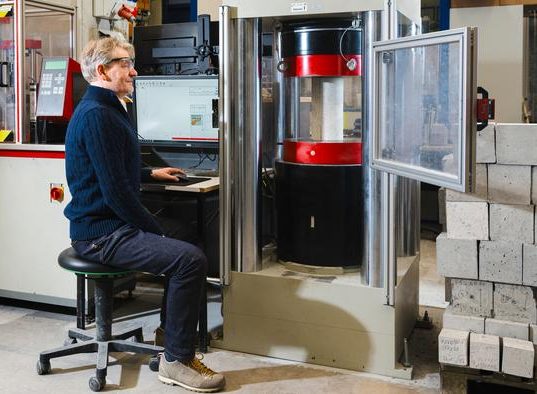
Concrete production contributes significantly to global emissions, driving research into carbon-binding materials for sustainable infrastructure.
Concrete is the most widely used construction material globally, yet its environmental impact presents a major challenge for the digital construction and infrastructure sectors. The production of cement, the binding agent within concrete, is responsible for a significant share of global carbon emissions. As the industry transitions toward low-carbon construction materials and data-driven design methods, researchers are investigating new solutions that could fundamentally change concrete’s environmental footprint.
One such initiative is the C-SINC project, an EU-funded research programme focused on developing concrete capable of permanently binding carbon dioxide. Researchers at the Karlsruhe Institute of Technology (KIT) are assessing the structural performance, durability, and safety of these new concrete formulations to determine whether they can meet the demands of modern infrastructure.
Why cement production drives construction emissions
Concrete’s environmental impact primarily stems from cement production, particularly the manufacture of Portland cement clinker. This process requires high temperatures and releases carbon dioxide through both energy consumption and chemical reactions.
“These high emissions result from the energy consumed during production, but especially from the deacidification of limestone during the production of Portland cement clinker, which is the most common binding agent for concrete,” explained Professor Frank Dehn, head of the Institute of Concrete Structures and Building Materials and the Materials Testing and Research Institute at KIT.
Currently, the construction sector uses supplementary cementitious materials such as fly ash and ground blast-furnace slag to partially replace clinker. However, these materials are expected to become less available due to structural changes in energy and steel production, including Germany’s coal phase-out and the transformation of the steel industry.
This supply challenge has accelerated research into alternative cement substitutes capable of supporting low-carbon concrete production.

C-SINC project: developing carbon-binding concrete
The C-SINC research programme brings together academic and industrial partners from Germany, the Netherlands, Belgium, and Spain to develop sustainable cement alternatives.
A key focus of the project is magnesium silicates, which react with carbon dioxide through a controlled mineralisation process. During this reaction, CO₂ is converted into magnesium carbonate, allowing the material to function as a secondary cement additive while permanently binding carbon.
“By using CO₂ that’s extracted from industrial exhaust gases, not only can we lower emissions due to concrete, we can also make it work as a carbon sink,” said Dehn. “The CO₂ isn’t just stored, it’s chemically bound in a mineral. It remains firmly bonded, so it can’t escape over very long periods.”
This approach enables carbon captured from industrial processes to become a structural component within concrete, contributing to both emission reduction and long-term carbon storage.
Digital modelling and structural testing for low-carbon concrete
Beyond laboratory development, the C-SINC project aims to deploy the new concrete formulations in real construction scenarios. Researchers are combining advanced computational techniques with physical testing to validate the material’s performance.
“Using machine learning strategies and structural-mechanical modelling, we’re investigating how the binding agent behaves in concrete, how to best mix the concrete, and how well it works in practice,” Dehn said.
Testing occurs across multiple scales, from laboratory samples to full-size structural elements. This integrated methodology allows researchers to analyse the material’s mechanical properties and predict long-term durability in load-bearing applications.
KIT’s materials testing facility in Karlsruhe plays a central role in this work. The institute combines simulation, experimental research, and large-scale testing to evaluate the performance of carbon-binding concrete in realistic construction conditions.
“With simulations and machine learning, we can predict which concrete formulations will work. Then we plan experiments to test our predictions,” Dehn explained.
The objective is to establish reliable parameters demonstrating that concrete incorporating the new binding agent satisfies engineering requirements for load-bearing capacity, durability, and safety.
Research into carbon-binding concrete illustrates how materials science and digital modelling are reshaping sustainable construction. Projects such as C-SINC may enable infrastructure that stores carbon while meeting structural performance standards.
Read next: Digital tools are transforming how we track upfront embodied carbon – Build in Digital
Are you a building professional? Sign up for a FREE MEMBERSHIP to upload news stories, post job vacancies, and connect with colleagues on our secure social feed.
