
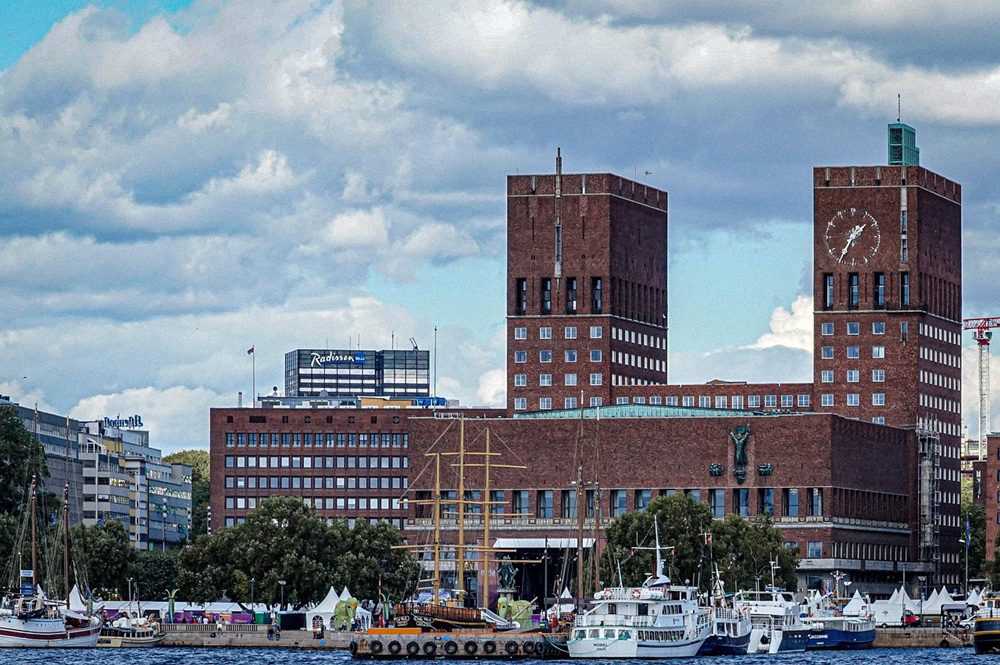
The Norwegian capital is leading the way in creating cleaner, greener, urban environments, establishing itself as a test-bed for solutions others can emulate. Tim Clark reports
When it comes to the race to net zero, governments, councils and construction firms all claim to have a recipe for success. More often than not, such claims fall short.
However, when it comes to clamping down on climate emissions one European city has managed to emerge as a genuine frontrunner in sustainability – particularly when it comes to construction.
From January this year the Norwegian capital of Oslo required that all municipal building construction projects should be completely emission free. No ifs, no buts, no half-measures. The policy is one of several to help the city reach a goal of cutting CO2 emissions to the bone by the end of the decade.
“It is an important step towards achieving the climate goal of cutting Oslo’s emissions by 95% by 2030,” says Ella Havnevik Giske, climate advisor at the Norwegian Climate Agency.
“The contractors and building owners have so far only received good feedback, including that the noise level is considerably lower. This bodes well for HSE surveys on construction sites.”

Oslo’s success stems from a combination of tough new city-wide policies, investment in cutting-edge technology, and progressive urban planning. Importantly, the race to cut emissions hasn’t been at the detriment of economic growth or quality of life.
The construction sector in Oslo hasn’t had to adapt to net-zero from a standing start. The city already had a number of policies in place to cut emissions from fossil fuels in construction sites. Several major projects had, for example, already incorporated fully electric and hydrogen-powered construction machinery as early as 2022.
Carbon city guides
To go that step further the city authorities published two guides to help the sector adapt to the new changes. The first is an electrical construction project guide, the second is for supervisors of electrical construction projects.
Construction firms need to calculate the power requirements for their projects, for charging machines and equipment such as tower cranes, and understand what grid capacity is available in their area. This includes mapping the existing grid capacity, choosing machines which have a larger capacity, evaluating peak power demand times, as well as understanding expected energy consumption patterns.
It may sound alien to UK construction firms, however the steps to net zero are over half a decade in the making.
The city’s procurement framework favours companies that can provide zero-emission services. Since 2019, all municipal projects have used this as a core criteria for tender documents. Other Norwegian cities have adopted the same criteria, leading to increased availability of zero-emission machines.
“Oslo is proof that zero-emission construction is possible,” Philip Mortensen, senior adviser at the City of Oslo’s Climate Agency, told the BBC in 2021.
“Here at Oslo’s Climate Agency, we see growing interest from different cities internationally in our work. Especially from dense cities, where many would benefit from clean construction.”
Ripple effect
One interesting aspect of the new regime is that Oslo’s regulations have also had a ripple effect beyond the city limits, with other municipalities in Norway also following Oslo’s lead. In theory this sets the stage for a raft of national policies to cement the city-inspired initiatives.
The demand for zero-emission machinery has spurred innovation in electric heavy-duty equipment. How far manufacturers go to meet this demand remains to be seen. Although a capital city, Oslo doesn’t command the pull to make global players change their manufacturing processes overnight. The initiative does however add to the growing consensus that more, and better electric construction machinery should enter the market.
Another aspect of the net-zero equation is carbon capture. Oslo has taken steps to reduce industrial carbon output, particularly from waste incineration. One initiative is the Hafslund Oslo Celsio carbon capture and storage (CCS) facility, which aims to capture 400,000 tonnes of CO2 annually from the city’s waste-to-energy plant.
“Carbon capture and storage is a crucial part of Oslo’s broader environmental strategy. Without it, reaching net zero would be significantly harder,” says Jannicke Bjerkås, carbon capture and storage director at Hafslund Oslo Celsio.
Carbon capture does have its critics, and there are questions over the cost-benefits of capturing direct emissions. However Oslo’s approach demonstrates that, when combined with broader decarbonisation strategies, it can play a critical role in managing emissions from industries that cannot simply be electrified overnight.
The third pillar of Oslo’s carbon transformation is transport. While the UK has battled conspiracy theories over low traffic neighbourhoods and “15 minute cities” Oslo has actively pursued a combination of strategies, including expanding electric public transport, implementing car-free zones in key urban areas, and heavily investing in cycling and pedestrian infrastructure.

The push for electric vehicles (EVs) has been particularly transformative. Thanks to a network of thousands of charging stations and government incentives, nearly 80% of all new cars sold in Oslo are now fully electric. This shift has had results, significantly reducing transport-related emissions and improving air quality – two major issues that the current mayor of London, Sadiq Khan has made a priority for the capital.
Although electric vehicle adoption is the headline-grabbing element of Oslo’s transport transformation, other measures such as electrified public transport networks and the prioritisation of pedestrian-friendly urban spaces, have proven to be just as crucial.
The city’s ferry system is being electrified on top of those of rail and bus transport. Political decisions also are a key aspect of the climate-friendly transformation.
“When I moved to Oslo in 1989, the downtown area looked very different. Today, Oslo’s climate measures have given the city cleaner air, less noise, and safer, more human-centred streets,” says Heidi Sørensen, who leads Oslo’s climate agency.
“Some of these measures were controversial at first, but now a majority of the population supports them – even those not particularly concerned about climate change. This demonstrates that environmental policies do not mean sacrifice; they improve urban life for everyone.”
Sørensen was instrumental in piloting Oslo’s first zero-emission construction site. “The Agency of Urban Environment transformed a street into a pedestrian zone in Oslo’s city centre,” she adds.
“They used powerful electric machinery to lift and break slabs of asphalt, and the machines were so quiet that nearby cafes and restaurants kept their doors open. Today, we have more than 30 such sites. Before this project, electric construction machinery barely existed. But we changed that through procurement, using market demand to push for new solutions that support our climate goals.”
Hurdles and obstacles
Oslo’s journey to net-zero hasn’t been without obstacles, however. The transition to zero-emission construction and transport has come with significant upfront costs, requiring careful financial planning and public investment.
There have also been technological hurdles, particularly in scaling up hydrogen-powered machinery, and ensuring that battery-electric solutions meet the needs of heavy industry. Furthermore, balancing economic growth with stringent environmental regulations has required careful negotiation with business stakeholders to prevent unintended economic slowdowns.
Despite these challenges, Oslo has remained steadfast in its commitment to sustainability, demonstrating that the trade-offs are ultimately worth it. The city has shown that bold environmental policies can go hand in hand with economic prosperity and improved quality of life.
Oslo’s approach is now serving as a blueprint for cities worldwide. European capitals such as London and Amsterdam, as well as major urban centres like New York, are examining Oslo’s strategies to inform their own environmental policies.
The idea that net zero is merely a theoretical ambition has been decisively debunked. Instead, Oslo’s success proves that with the right mix of policy, innovation, and collaboration, urban centres can radically cut emissions while remaining vibrant and economically competitive.
For now, Oslo remains at the forefront of the global net-zero movement. But the real question is – who will be next?
“If Oslo can do it, so can other cities.” Sørensen adds.
Image credit: Murat Demirel/Pixabay
Read next: Green light for Edgbaston hotel plan is just the cricket
Are you a building professional? Sign up for a FREE MEMBERSHIP to upload news stories, post job vacancies, and connect with colleagues on our secure social feed.
