
Scientists have developed a means to build electronic components so small they are made from chains of individual molecules.
It’s claimed the creation of these ultra-thin ‘nanoribbons’ could furnish a toolbox for building materials that could power the next generation of technology.
The international team, led by Birmingham and Warwick universities have published their findings in the journal, Nature Communications, setting out how they created the ‘nanoribbons’ with tailored electronic properties.
According to the scientists, potential applications include:
- Flexible organic electronics that can be printed or ‘painted’ – for example in smart clothing
- Ultra-small electronic circuits for ‘Internet of Things’ devices
- Bioelectronics that could be used in animal/human implants
- More efficient solar cells
- New types of sensors
- Quantum or molecular electronics

Professor Giovanni Costantini, a corresponding author of the study, from the School of Chemistry and the School of Physics and Astronomy at the University of Birmingham, said: “While atomically precise nanoribbons have been explored before, this is the first time they have been built by directly combining electron donor and acceptor units. Because we can choose exactly where these units appear, we can design their electronic properties in advance and realise them with atomic precision.
“By controlling the sequence and length of the molecular units, we can precisely programme and realise the material’s electronic properties in practice – paving the way for an unprecedented level of control, essential for next-generation technologies.”
Researchers used donor–acceptor (D-A) chemistry, a method widely employed in high-performance plastics for electronics – creating some molecules that ‘give up’ electrons and others that ‘take in’ electrons in controlled sequences.
Using advanced microscopes that can image individual molecules and even resolve atoms and chemical bonds within them, they could see the exact shape of each nanoribbon whilst detecting tiny irregularities and measuring how electrons behave within the ribbons.
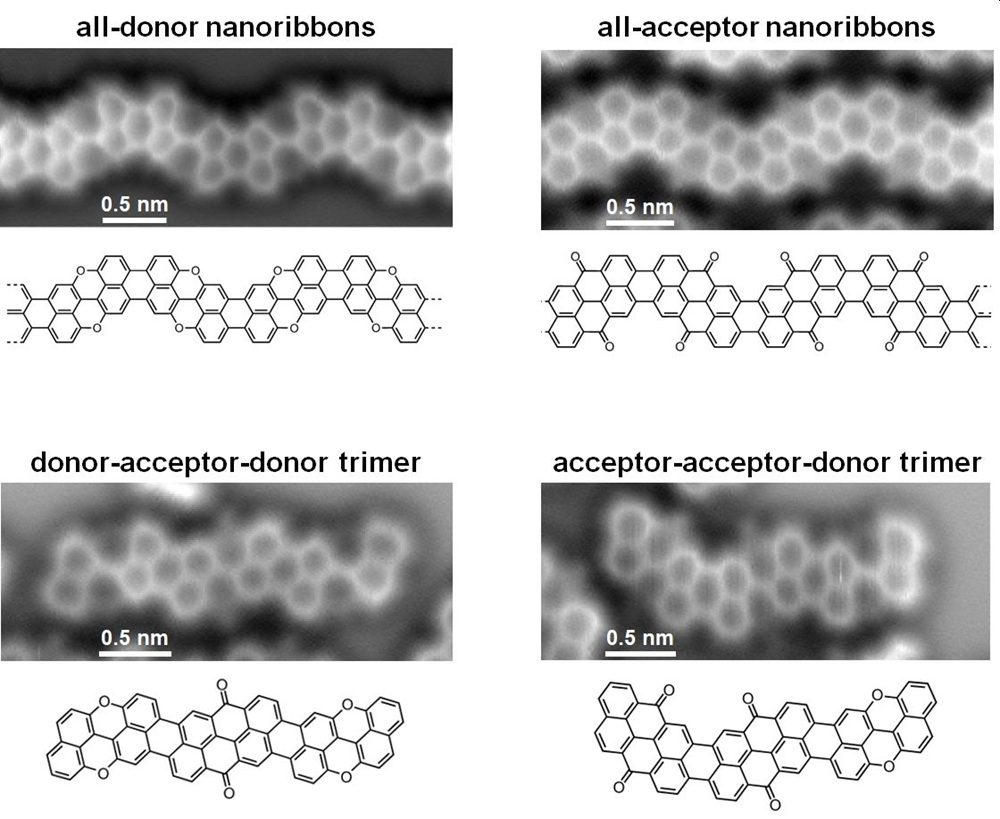
Photographic and diagrammatic representation of a range of nanoribbons. Credit: James Lawrence
Traditionally, nanoribbons have been made from graphene, which does not naturally behave as a semiconductor unless reshaped into nanoribbons or chemically modified with other elements. Even then, controlling the material’s electrical behaviour has been difficult.
Researchers led by Davide Bonifazi at the University of Vienna designed and synthesised two special molecules – an electron donor and an electron acceptor. The Warwick-Birmingham team then placed these molecules onto a gold surface in a vacuum and heated them so they would naturally join into nanoribbons, producing donor-only ribbons, acceptor-only ribbons, and mixed D-A.
Bonifazi said: “By embedding donor–acceptor concepts into these on-surface fabrication strategies it became possible to prepare extended nanoribbon structures that are otherwise difficult to make in solution.”
James Lawrence, who co-led much of this work as a PhD student at the University of Warwick and is now at the National University of Singapore, said: “This research creates a new toolbox for building electronic materials with atomic precision. Building nanoribbons directly on a metal surface can produce perfectly defined structures, which is difficult to achieve using traditional chemistry.”
Gabriele Sosso, who oversaw the computational aspects of the work at the University of Warwick, said: “From a modelling perspective, these nanoribbons show how atomic-scale design can be used to fine-tune real world electronic properties. Capturing the effects of the supporting surface and local environment will be key to guiding this approach further.”
The next step is to apply this approach to design materials with targeted properties for organic electronics, bioelectronics, and photovoltaics.
Main image: Lotus_studio/Shutterstock
Read next: Yan Evans to lead Güntner Group’s data centre operations
Are you a building professional? Sign up for a FREE MEMBERSHIP to upload news stories, post job vacancies, and connect with colleagues on our secure social feed.
