
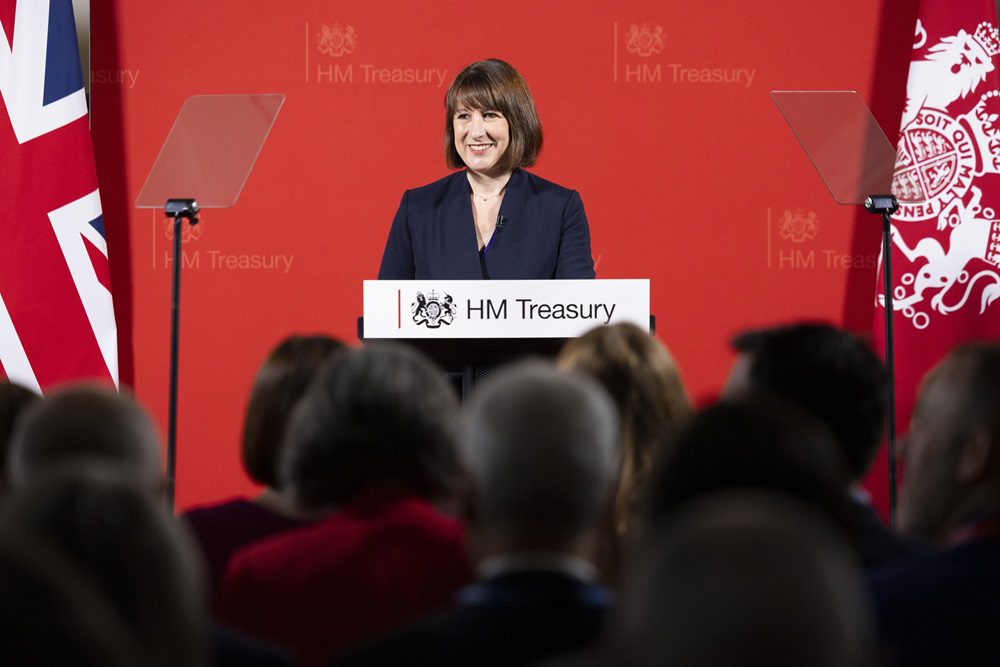
As the construction industry waits to hear what Chancellor Rachel Reeves has in store with her first budget next week, anticipation is high – but the stakes are surely higher. Tim Clark reports
The construction sector occupies a curious position in the UK economy. Often derided for a lack of productivity holding Britain back, but also placed at the heart of any government’s plans for growth.
The new Labour government’s pro-growth agenda will be put to the test on 30 October when chancellor Rachel Reeves announces her first budget. The question for many, however, is whether the government will outline a realistic roadmap for a sector that is key to delivering on its many other promises on housing, net zero, or the economy at large.
“Investment in fixed capital like roads, rail, and hospitals is crucial as tax changes alone won’t drive growth,” says David Crosthwaite, chief economist at BCIS.
“The construction industry remains disappointed by recent fiscal events, with government pledges lacking clear action to ‘get Britain building again’. Bold steps are needed to fulfil promises on housing, infrastructure, and decarbonisation.
“While slogans have been plenty, we need real details before the Spending Review in spring 2025. The government must solidify its infrastructure pipeline and commit to essential projects, backed by proper funding.”
The construction sector’s demands are clear: The government must provide substantial support if it is to fulfil its ambitions to “get Britain building again”. Bold investments, regulatory reform, and strategic planning are needed, particularly in light of promises made during the Labour Party Conference in September.

Infrastructure investment
Starting with infrastructure, the biggest question is the government’s approach to High Speed Two (HS2) which is the biggest construction project in Europe.
Labour has been coy over its plans for the rail line, seemingly acknowledging that the current Old Oak Common to Birmingham link is unsatisfactory while also refusing to – as yet – commit to any alterations.
The government did state that ministers would take direct control of the spiralling costs of HS2, with transport secretary Louise Haigh stating that: “One of my first jobs as transport secretary has been to urgently review the position I have inherited on HS2.
“It has long been clear that the costs of HS2 have been allowed to spiral out of control, but since becoming transport secretary I have seen up close the scale of failure in project delivery – and it’s dire. Taxpayers have a right to expect HS2 is delivered efficiently and I won’t stand for anything less.”
When it comes to roads, will Labour look to invest in fixing Britain’s motorways and A-roads, relieve bottlenecks or take a similar approach as the Welsh government, which has stripped back major road investment as part of a climate pledge?
Labour’s recent pledge to establish a National Infrastructure Authority aims to streamline decision-making and cut through delays, but without clear and sustained government support, this initiative will remain a distant goal.
“Housing remains a pivotal issue for Labour closely tied to economic stability. Despite recent upticks in house prices and mortgage approvals, the UK faces a severe housing shortage that threatens to prolong the economic downturn”,” says Daniel Austin, chief executive of ASK Partners.
“This shortage, driven by insufficient homes for rent and sale, has led to an affordability crisis, contributing to GDP strain and decades of unresolved social pressure. It’s particularly concerning that new analysis reveals government delays in 40% of major infrastructure project decisions.”
According to the Britain Remade campaign, several nationally significant infrastructure projects (NSIPs), intended to follow a “fast-track” approval process, have been delayed since Labour. Under the Conservatives, the rate was slightly lower, with 38% of projects delayed.
Additionally, recent research indicates that Labour risks falling short of its 1.5m homes target by 500,000 unless it intervenes with additional funding for the housing market.
The construction sector was disappointed that it was not prominently mentioned in the recent Industrial Strategy launched by Labour in early October.
“Construction is the backbone that supports and enables growth across all sectors, from housing to the infrastructure these key industries rely upon. Without recognising the central role of construction, there is a real danger that the government’s strategy will fail to deliver on its full potential,” says Sean Keyes, chief executive of civil engineering consultancy Sutcliffe.
“The omission undermines not only the sector’s contribution to GDP but also its capacity to generate jobs, innovation, and the future-proofed infrastructure required for a thriving economy. We cannot afford to overlook the very industry that builds the foundation of Britain’s future.”
Labour seem to have recognised this omission, and the launch of the British Infrastructure Taskforce last week is one step in the right direction. The government stated that it is “committed to turbocharge infrastructure investment across the width and breadth of the UK”.
The newly formed National Infrastructure and Service Transformation Authority (NISTA) will bring oversight of strategy and delivery under one roof.
The NISTA will support the development and implementation of the 10-year infrastructure strategy in conjunction with industry, which was outlined for the first time last week by the chief secretary to the Treasury, Darren Jones.
Jones said: “We are serious about ending the cycle of underinvestment that has plagued our infrastructure systems for over a decade. The best way to do that is to design the solution with business in the room. That’s what this taskforce is all about.”
Alongside better scrutiny and more long-term plans, the budget is another way to address these concerns; as the main financial statement of the year it gives the government an opportunity to lay out its funding plans for the here and now.
The government is making more positive noises on investment after a summer of doom and gloom over the fiscal shortfall. It may be that the private sector plays a bigger role in new government plans.
“It has been clear for many years that there is a need for a massive step-shift in infrastructure investment in the UK. This can only be achieved by the public and private sectors working together, with the government ensuring that the UK is an attractive place for the private sector to invest in,” says Stuart McMillian, partner at Burges Salmon.
“However, we need PPP models which the private sector can understand and easily invest into. There won’t be a ‘one size fits all’ model such as Private Finance Initiatives, but there could be a number of models the government could look at and develop to suit different aspects of infrastructure investment.
“This might include things like RAB in sectors such as nuclear, models similar to the Welsh MIM on social infrastructure and roads and other more bespoke models such as the DPC model currently being rolled out in the water sector.”

On the homes front
Housing is another priority for the government.
Brian Berry, chief executive of the Federation of Master Builders (FMB) says that the construction sector cannot be an afterthought. “The government is focusing on inviting big, innovative investment; it should not forget the fundamentals of what drives growth.”
Austin and Berry’s concerns are that construction remains on the periphery of government strategy, despite the warm words and recognition that the sector plays a crucial role in the physical rebuilding of Britain.
“The government has made several promising announcements in recent weeks with proposals for significant planning reforms, an ambitious house building target of 1.5m new homes, and the establishment of Skills England all welcome,” Berry adds.
“However, there remain questions about the viability of these plans without serious investment to tackle the root causes. The new industrial strategy raises concerns around how integral to the overall UK economy ministers see our industry, which should sit alongside services and manufacturing as a key pillar of economic growth.”
Moreover, the Labour Party has pledged to tackle the housing crisis by revisiting green belt regulations, proposing to build on the so-called “grey belt” – low-quality green belt land that could be used for development.
This move is part of a broader effort to balance housing needs with environmental protection, but its success will depend heavily on how the policy is implemented and whether adequate funding is allocated to ensure sustainable development.
The construction sector’s persistent skills shortage is another critical issue that the next Budget must address or see projects stalled or delayed despite political will or funding.
The lack of skilled workers has hampered the industry’s ability to meet demand, particularly in housing and infrastructure projects. The government has already announced the creation of “Skills England,” but questions remain about its capacity to tackle the root causes of the problem.
Climate for change
On the climate side, Mat Lown, Head of ESG at TFT, emphasises the importance of retrofitting to meet the government’s net zero goals.
“We must accelerate the pace of retrofit across the UK to avoid asset obsolescence and secure a zero-carbon future,” he says.
Retrofitting is not only necessary for environmental reasons but also for maintaining the value of buildings in an increasingly sustainability-conscious market.
“The budget needs to offer financial incentives to encourage property owners and developers to embark on retrofitting projects, thus supporting the decarbonisation of the UK’s ageing building stock,” Lown adds.
As the sector awaits the budget next week, the construction industry’s demands are clear.
Increased investment in infrastructure, housing, and green technologies, coupled with targeted support for skills development, will be essential to the country’s economic recovery and future growth.
Hopefully chancellor Reeves can deliver.
Main image: Chancellor Rachel Reeves delivers her first speech on the UK economy, July 2024, at HM Treasury. Picture by Kirsty O’Connor/Treasury
Read next: Mackie named technical director of timber frame firm
Are you a building professional? Sign up for a FREE MEMBERSHIP to upload news stories, post job vacancies, and connect with colleagues on our secure social feed.
