

By Emma Hooper, Head of Information Management Strategy, RLB Digital
As an industry we are all looking to enhance productivity, manage risk and cost, and work towards being more sustainable. There is one common theme that can help us achieve all of this, yet it often remains invisible and is inconsistently managed – information.
In my role as Head of Information Management Strategy at RLB Digital, I truly believe that information is a critical business asset, which can provide value but also depreciates if not maintained.
Why is information management important to asset owners?
With many organisations now understanding that to digitally transform their businesses they need to manage their data, information management is beginning to be recognised as a crucial part of operations and asset management. However, we still have a long way to go with many organisations still needing to understand the data that already exists in their organisations, who is using that data, and what for, and identify how the information they hold is structured, connected and labelled.
As the built environment sector continues to evolve, information management will become increasingly central to how we operate. With this growing importance comes greater complexity driven by factors such as fragmented information flows, siloed working practices alongside legacy data and diverse digital languages and an emphasis on generating new information rather than maintaining it throughout the asset lifecycle and rising information security demands.
Information will need to be managed in a standardised, consistent way to avoid the risk of incorrect, incomplete and poorly aligned data, leading to false insights, and misguided analysis. Management needs to start at a strategic level and be implemented right down to individual pieces of metadata.
What is the purpose of information in asset management?
We all contribute to and rely on information when it comes to managing our assets. Every task we undertake requires information inputs and produces information outputs. The first step is to identify those tasks and ask why information is needed within the task.
By mapping these tasks, you can pinpoint information outputs and inputs, who provides the information and who uses it, and when the information is needed, or in other words create a clear picture of your organisation’s information flow.
How do you define information requirements for development projects?
Once the why has been established, a consistent, unified set of information requirements needs to be devised.
As many of these information requirements may have multiple purposes across several assets, requirements should be designed at a strategic, portfolio level to ensure consistency. This can be done through a well-structured database, allowing requirements to be explicitly defined whether they relate to data, documentation or even geometry, making the expectations clear and eliminating ambiguities.

How can information management improve construction procurement?
With procurement being key to productivity and project success, there is a need to understand the information requirements and filter and target them for each appointment, forming exchange information requirements (EIR). These play a crucial role in assessing a supplier’s ability to deliver specified information, resulting in suppliers being able to price work more accurately, reducing the uncertainty that typically arises from hidden or unclear information expectations.
Well-defined information requirements also provide the basis for information quality assurance. Delivered information can be checked directly against the original requirements to ensure that asset owners and other stakeholders receive information aligned to their needs, providing a framework for measuring project success.
The most important outcome is that the delivered information meets the information requirements and hence the needs of the end-users.
The information management cycle
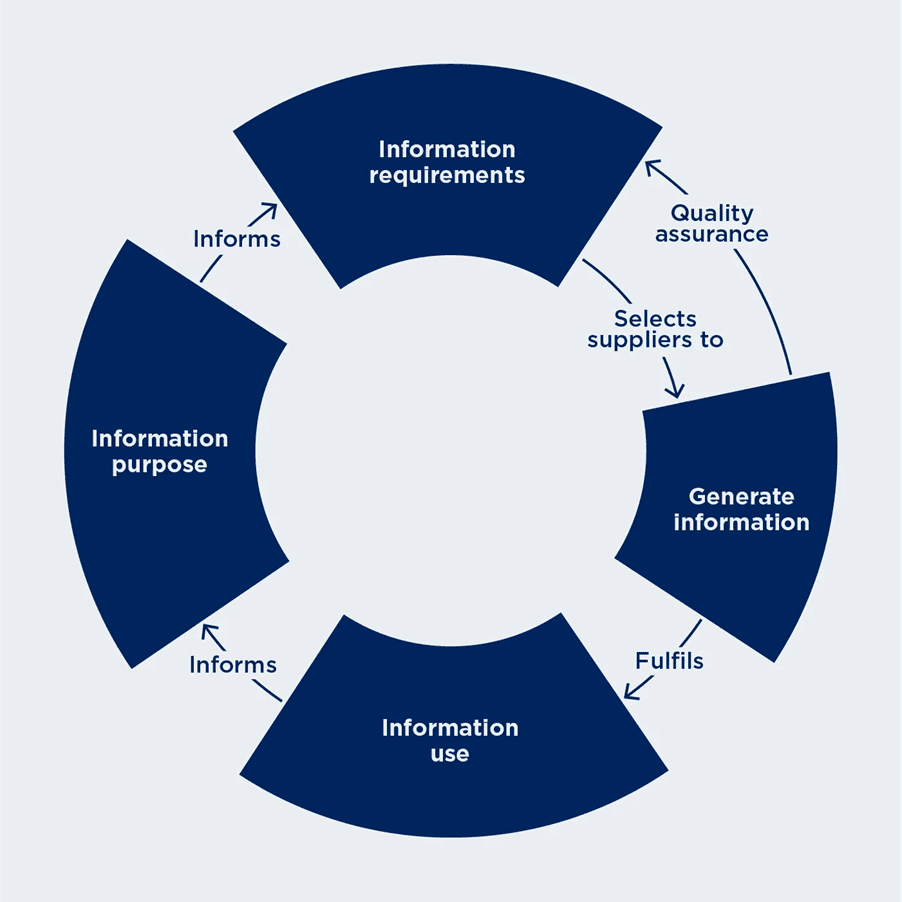
As our organisations evolve and our processes become more complex, treating information as a managed, strategic asset is no longer optional but essential. By establishing clear information requirements, standardising processes, and maintaining data quality throughout the asset lifecycle, asset owners can unlock greater value, reduce uncertainty and risk and support more informed decision making. As the industry matures and AI becomes not just commonplace, but integrated into our working lives, having robust information management processes in place will allow organisations to retain greater control and be better equipped to navigate complexity, drive efficiency and deliver outcomes, and futureproof their organisations.
Read next: Prioritising AI and national infrastructure resilience – Build in Digital
Are you a building professional? Sign up for a FREE MEMBERSHIP to upload news stories, post job vacancies, and connect with colleagues on our secure social feed.
