
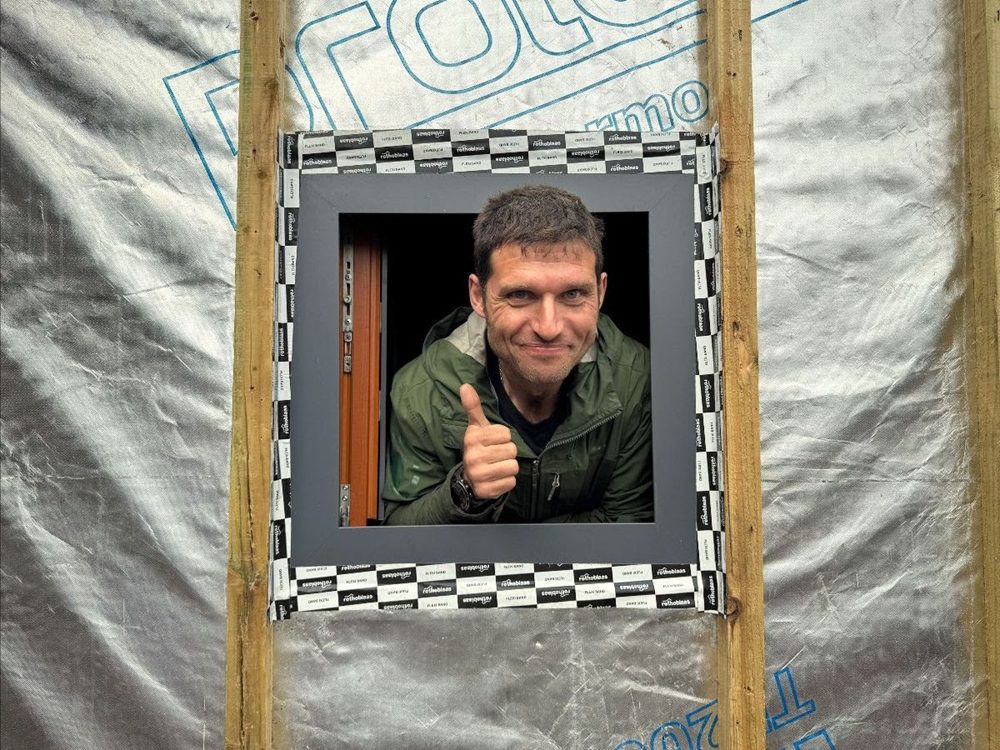
TV presenter Guy Martin used a pair of ice-filled sheds to demonstrate the thermal performance of Passivhaus buildings in a Channel 4 programme examining low-energy homes.
The experiment is now available to view on YouTube, though it was filmed for House Without Bills, which aired earlier this year. Though shot in August 2025, the issue remains very much a hot topic as Britain bakes in its latest record-breaking heatwave.
It involved two small structures – one built to the Passivhaus standard, the other to current building regulations – each loaded with half a tonne of ice and left for a week at Martin’s home in Lincolnshire.
The results showed a marked difference in performance. The Passivhaus shed retained 70% of its ice, with an internal temperature of 5C, while the building regulations shed lost 60% of its ice and reached 11C inside.

Martin said: “This was an experiment to see – are we all going to melt in well-insulated houses? Insulation works in both directions: it takes longer for the heat energy from the sun outside to penetrate all of this insulation to get to the ice. Will a well-insulated house cook you in the summer? No it won’t – it’ll keep you cooler.”
The experiment centred on what the Passivhaus Trust calls an ‘ice box’ – a small-scale building demonstrator designed to illustrate differences in thermal performance between standard construction and Passivhaus.
Each unit shares comparable dimensions, allowing a like-for-like comparison of how insulation, airtightness and fabric quality influence heat loss and internal temperature stability.
The ice boxes were originally developed as a visual teaching and engagement tool by Built Environment – Smarter Transformation, and are used by NMITE (the New Model Institute for Technology and Engineering) in Hereford as part of its applied teaching and industry engagement activity.
Before filming, they underwent a full restoration at NMITE’s Centre for Advanced Timber Technology, including fabric repairs, roof restoration, airtightness improvements and upgrades to monitoring capability.
Jon Bootland, chief executive of the Passivhaus Trust, said: “The experiment demonstrated that the Passivhaus shed is good at keeping warmth in a building in the winter months and keeping things cool in the summer months, in much the way a thermos flask works.
“The ice boxes are a great visual way to help dispel the myth that Passivhaus buildings lead to overheating. The extra insulation and airtightness actually helped reduce the ice melting in the Passivhaus shed.”
Ben Shirley, assistant professor at NMITE, said: “The ice boxes highlight the role of practical demonstration in communicating the benefits of high-performance construction to a wider audience. Together, we’re making high-performance construction more visible, understandable and achievable.”
The experiment was delivered through a collaboration involving the Passivhaus Trust, NMITE and Edinburgh Napier University, with support from the UK Research and Innovation-funded Centre for Net Zero High Density Buildings, Scotland Beyond Net Zero, and the Housing Construction and Infrastructure Skills Gateway, under the Edinburgh and South East Scotland City Region Deal. Herefordshire-based Mike Whitfield Construction, a Passivhaus Trust member, assisted with preparation of the ice boxes.
House Without Bills is available on Channel 4. The ice box experiment can be viewed on YouTube.
Main image: TV presenter Guy Martin tests how Passivhaus performs in the summer months. Courtesy of the Passivhaus Trust
Read next: Report urges Scotland to build on BIM success
Are you a building professional? Sign up for a FREE MEMBERSHIP to upload news stories, post job vacancies, and connect with colleagues on our secure social feed.
