
MIT research finds shifting data centre power use significantly lowers grid costs
Data centres that shift their electricity use away from peak hours could cut average energy costs by up to 5%, according to new research from MIT.
The study, led by economists at the MIT Sloan School of Management, examined how the rapid expansion of data centres – driven largely by artificial intelligence – might affect electricity grids in the US.
Rather than treating growth as a straightforward burden on infrastructure, the researchers modelled what happens when operators build flexibility into when they draw power.
The findings matter well beyond the US. As AI adoption accelerates globally, the built environment sector is grappling with similar questions about how data centres should be sited, powered, and integrated into national grids – questions with direct implications for construction, energy infrastructure, and planning policy.

The maths behind the savings
The researchers used the “Gen X” model of the US power grid to simulate a year’s worth of energy use across three regions: Texas, the Mid-Atlantic, and the Western Interconnect, which spans 11 states. These regions were chosen because they are expected to host around 82% of US data centres by 2030.
The study compared outcomes when data centres consumed power flexibly, shifting load to off-peak hours, against a scenario in which consumption remained fixed. The results showed that flexible arrangements could produce cost savings of up to 5% in Texas, 4% in the Mid-Atlantic, and 2% in the western states – but only if data centres moved more than 20%, and in some cases as much as 50%, of their consumption to non-peak hours.
Christopher Knittel, an economist at MIT Sloan and co-author of the paper, said the underlying logic was straightforward: “The key with data centres is: how can we add them to the network without adding a lot to our peak usage? One way for data centres to do that – to add to average usage but not the peak usage – is if they provide some grid flexibility during those high-cost periods. And that’s what we’ve been interested in understanding.”
Around 60% of grid expenses are fixed costs, such as power lines, while roughly 40% relates to energy costs. Adding data centres to the system spreads those fixed costs across a larger volume of energy use, which can lower average costs overall. Knittel described the effect bluntly: “It’s really just math.”
The catch, the paper notes, is that savings only materialise if data centres increase their average consumption faster than their peak-hour consumption, when electricity is most expensive. Most data centres already have some flexibility, since they typically run at around 80% capacity. In the study’s modelling, that flexibility involved shifting load away from early-morning and early-evening peaks towards midday hours, when demand is lower and solar generation is at its highest.
The degree of flexibility available also depends on the type of computing workload. Data centres used for AI training tend to consume energy at a steady rate but can shift that load more readily. Inference data centres, used for tasks such as online search queries, are more constrained, since consumption is driven directly by end-user demand.
Knittel argued that the scale of the potential savings should not be underestimated: “Three percent is a big number. When you’re talking about the grid, 3% or 6% doesn’t sound like a lot. But when you’re multiplying it by $100bn, it becomes real money.”
A mixed picture for emissions
The environmental implications are less clear-cut. The modelling found that projected data centre growth by 2030 would drive a substantial rise in carbon dioxide emissions compared with a scenario of no growth at all – up 58% in Texas, 20% in the Mid-Atlantic, and 24% in the western states.
However, the effect of flexible consumption on emissions varies significantly by region. In Texas, where 54% of grid power comes from wind, flexible data centre use could reduce emissions by increasing demand for wind energy at the times it is most abundant. The study found this could cut CO2 emissions by 40% relative to inflexible operation.
The Mid-Atlantic tells a different story. With a reasonable amount of solar power but relatively little wind, flexible data centre consumption there could increase both renewable and fossil fuel use simultaneously, producing a system-wide rise in emissions of 3%.

Knittel said: “When data centres provide some flexibility in that latter scenario, the data centres actually move hours to when sun and wind energy production is slowing, and that allows a coal plant to stay on. So it doesn’t necessarily attract more renewable investment. It attracts more coal investment.”
The paper, titled ‘Flexible Data Centers Reduce Power System Costs But Can Increase Emissions‘, is published in the journal iScience. Its authors are Juan Ramon L. Senga and Shen Wang, both postdocs at MIT’s Centre for Energy and Environmental Policy Research, alongside Knittel, who is the George P. Schultz professor at MIT Sloan and associate dean for climate and sustainability at MIT.
The research is described as the first to examine the “end-to-end” implications of data centres for both costs and emissions, and the team intends to continue developing the model.
Policy levers
The study’s authors are candid that none of these benefits will materialise unless data centre operators actually adopt flexible energy-use schedules – something they may have little commercial incentive to do voluntarily. Knittel believes this points towards a role for regulation.
“That’s why we have policy,” he said. More specifically, he adds, there is one big policy lever officials could use to achieve this goal: offering quicker initial hookups to the grid in return for time-of-use flexibility.
“One big concern about these data centres now is how long it takes for them to connect to the grid,” Knittel added. “One way to provide flexibility now is what’s called ‘connect and manage,’ which is, connecting you faster to the grid if you agree to provide flexibility. Tech firms would take that deal. They would rather connect a year earlier, and throttle down computation a few hours a day, than to have to wait. We do this with power plants too.”
He noted that competitive pressure among operators makes coordinated action more likely than individual voluntary commitments: “Tech companies say they won’t provide flexibility alone. But if everyone in the industry has to, it’s okay,” he said.
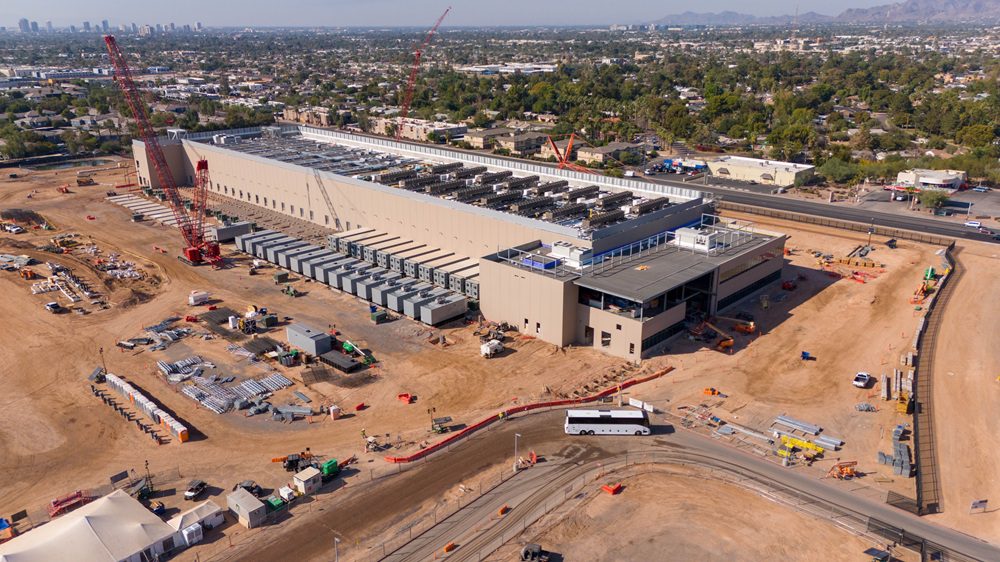
Main image: Data centre under construction in Phoenix, Arizona. Credit: Wirestock Creators/Shutterstock
Read next: Innovate UK gains further backing for low carbon concrete
Are you a building professional? Sign up for a FREE MEMBERSHIP to upload news stories, post job vacancies, and connect with colleagues on our secure social feed.
