
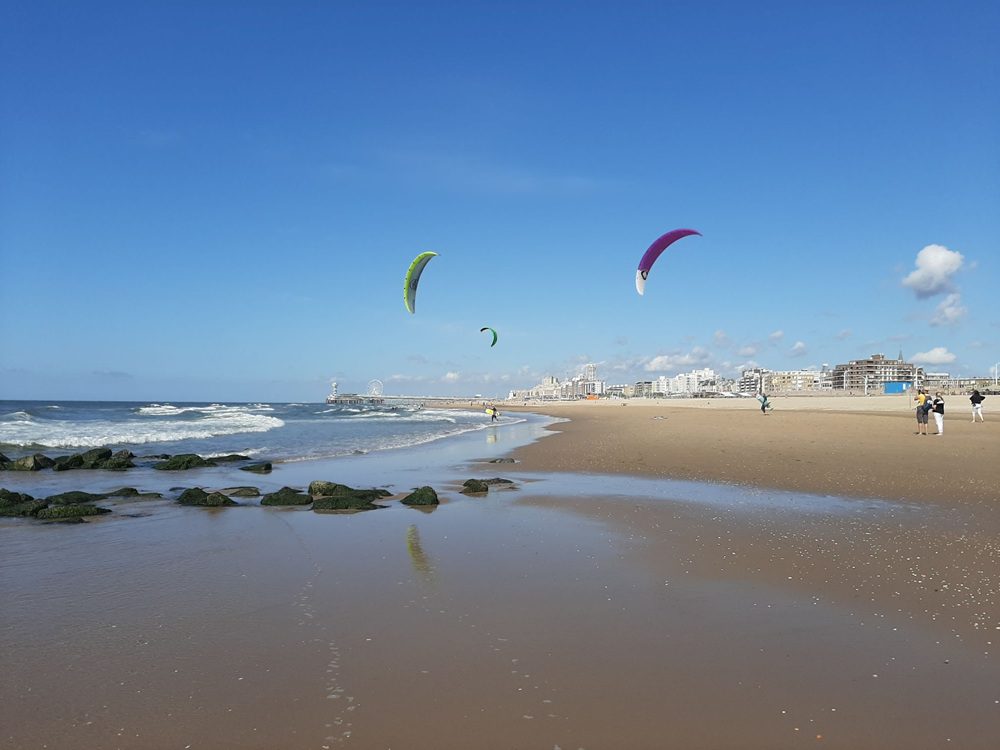
The Hague has unveiled a long-term coastal vision proposing a 200-metre dune landscape to protect Scheveningen from rising sea levels by 2100.
The Dutch city – the only major municipality on the country’s coast – has developed the strategy to guide future water management and spatial planning decisions, while stressing that the national government and regional water authorities remain primarily responsible for water safety.
Unlike other stretches of the coastline, such as Oostduinpark and Westduinpark, Scheveningen currently has no dunes able to grow naturally alongside rising seas, and there is limited space to raise or widen existing defences.
Under the ‘City Behind the Dunes scenario’, a dune system approximately 200 metres wide would develop gradually along the Scheveningen coastline through sand nourishment and dynamic dune management. The dunes would sit seaward of the existing boulevard, with the beach shifting progressively further out to sea.

The Hague said the approach would provide flood protection while creating opportunities for nature, recreation and biodiversity. Technical measures such as a storm surge barrier or lock system may eventually be needed to preserve Scheveningen Harbour.
Nur Icar, alderman for climate adaptation, said: “The Hague is the only major city on the Dutch coast. That makes us unique. We can be proud of our diverse coastline, which offers space for recreation, businesses, hospitality, nature, sports and tourism. At the same time, our location by the sea brings challenges. It makes us vulnerable to rising sea levels. That is why it is so important to understand how we can prepare for this together with our partners and residents. This future perspective is the starting point for that conversation.”
The vision was developed with experts, government partners, residents and other stakeholders, including the Scheveningen Boulevard Entrepreneurs Association (VBS) and the Association of Beach Operators (VVS).
Henk Kool, chairman of VBS, said: “It is important to explore how Scheveningen and The Hague can continue to exist safely behind the dunes. For entrepreneurs along the boulevard, maintaining a view of the sea is an important consideration. But doing nothing is simply not an option.”
Martin Wörsdörfer, chairman of VVS, said: “The Hague must remain a city by the sea, not a city in the sea. It is good that entrepreneurs are involved and will continue to be involved in shaping the future direction. We want to continue welcoming beach visitors in a safe and hospitable environment.”
The council described the vision as a strategic direction rather than a fixed plan, with feasibility and effectiveness – alongside other possible measures – to be assessed in the coming years. The municipality said it would take an active role in intergovernmental cooperation and ongoing discussions with water safety partners before a more definitive course of action is determined.
Main image: The current coastline of Scheveningen, The Hague
Read next: Space habitats inspire low-carbon summerhouse design
Are you a building professional? Sign up for a FREE MEMBERSHIP to upload news stories, post job vacancies, and connect with colleagues on our secure social feed.
