
Construction firms could gain access to up to 670,000 new homes worth of heritage conversion work, MPs have said, as they call for reform of planning and VAT rules.
A report from the Culture, Media and Sport (CMS) Committee, published last month, follows an 18-month inquiry into the state of the UK’s built heritage. It found that listed buildings, churches, industrial heritage and monuments are under increasing strain from cost pressures, workforce shortages and a planning system that is complex and inconsistent for developers and owners alike.
Dame Caroline Dinenage MP, chair of the CMS Committee, said: “Old buildings and other pieces of our past play a vital economic, social and cultural role in our communities, but the sight of leaking roofs, crumbling brickwork and vacant premises illustrates how the current policy approach to heritage is failing miserably to support either its protection or potential.
“Historic England says that there is potential to create a whopping 670,000 new homes and yet the government’s approach reveals a deep complacency, is devoid of ambition, and shows a complete lack of imagination.”

The committee is calling on the government to introduce a ‘heritage-to-housing’ scheme, modelled in part on Italy’s €1 homes initiative, to bring vacant and at-risk historic buildings back into residential use. Historic England estimates the approach could deliver up to 670,000 homes – equivalent to almost half of the government’s 1.5m homes target.
The report warns that the current VAT regime creates a structural disincentive to repair and reuse, making conversion work more expensive than new-build construction. The committee is calling for targeted VAT relief for maintenance and conversion of listed buildings, which it argues would make heritage-led projects more commercially viable for contractors and developers.
On skills, the report identifies workforce shortages as one of the most serious risks facing the sector, citing an ageing workforce, limited training routes and declining local authority expertise. It recommends the government work with Skills England, Historic England and industry bodies to create protected training pathways for endangered heritage crafts and establish a ‘heritage skills hub’.
The committee also took aim at the planning system itself, saying that while the government’s proposed reforms to the National Planning Policy Framework are welcome, they must go further to address delays and administrative burden experienced by developers, owners and community organisations.
Separately, the report criticises the state of government-owned historic buildings, including on military bases and in prisons, saying these are being left to deteriorate with little consequence, and calls on ministers to lead by example in maintaining public heritage assets.
Guiding principle
Dinenage added: “We heard compelling evidence that the best way of protecting a building is for it to be occupied, used, lived in and loved. Other countries with a similarly rich heritage have shown what can be achieved by thinking outside the box. ‘Re-use first’ should be the guiding principle, with a heritage to housing scheme offering a clear win-win by preserving our historic buildings and helping to meet the pressing need for new homes.
“Ministers also need to ensure adequate funding that incentivises repairs and renewal over construction, and meet head on the serious risk to heritage posed by the lack of skills and workforce in the sector.”
Councillor Julie Jones-Evans, chair of the Local Government Association’s Culture, Tourism and Sport Committee, said: “It is a great shame that whilst we face a housing crisis, there are hundreds of thousands of historic buildings lying empty or under-used. This presents a real opportunity to tackle the chronic shortage of housing in this country.
“As discussed at the LGA’s Annual Conference, councils stand ready to work with government and partners to help bring these back into use and give thousands of families a home.
“The committee is right to recognise the resourcing challenges and the need to tackle the shortage of skills in the heritage workforce. More investment in planning and conservation officers, particularly in rural and economically underperforming areas would allow local government to accelerate planning work.
“As the report identifies, funding for built heritage is fragmented. Aligning the different funding streams would also mean existing funding can go further and have more impact on communities.”
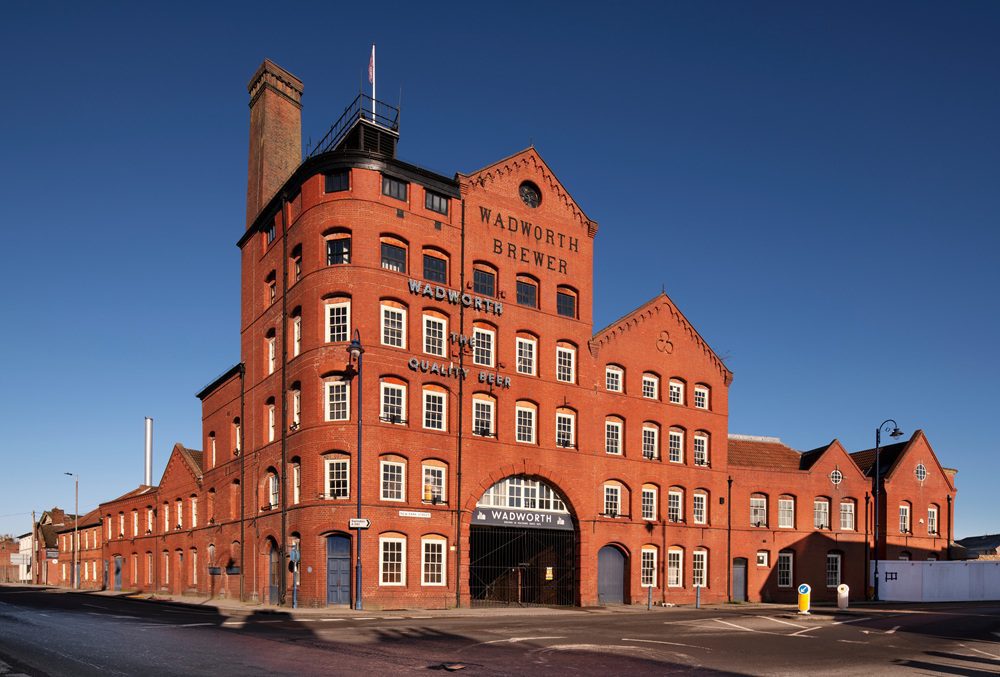
Main image: Wadworth Brewery, Devizes, Wiltshire. Copyright © Historic England Archive
Read next: Heathrow rolls out real-time asset mapping system
Are you a building professional? Sign up for a FREE MEMBERSHIP to upload news stories, post job vacancies, and connect with colleagues on our secure social feed.
