
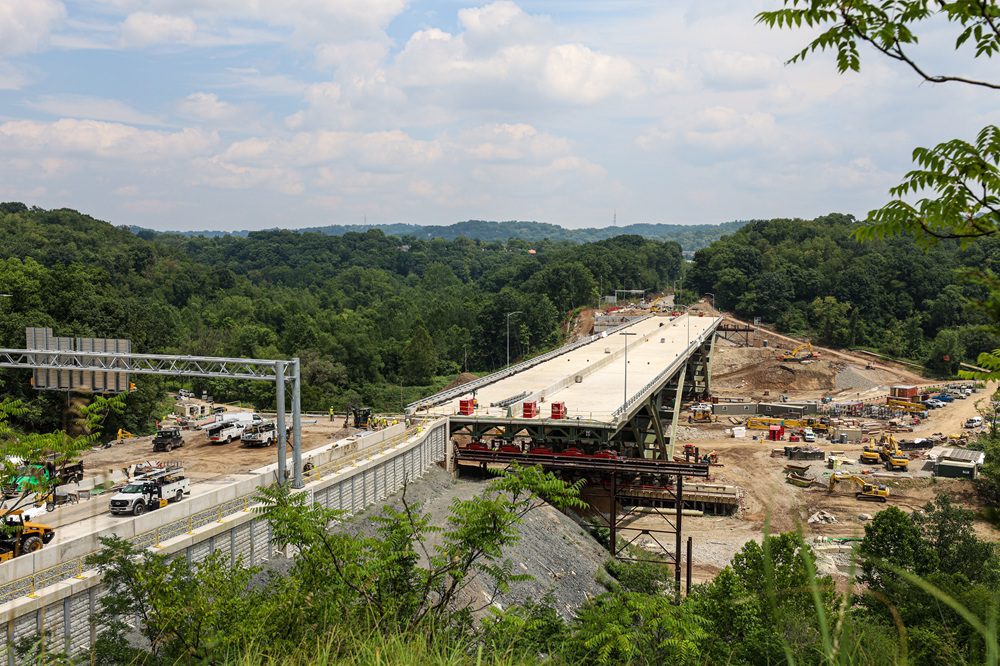
A 10,000-tonne bridge in Pittsburgh, in the United States, was installed in under 24 hours using accelerated construction methods, cutting years of expected road closures to just 17 days.
The Commercial Street Bridge, built between 1948 and 1951 and used by more than 100,000 vehicles daily, had undergone three rehabilitations – in 1980, 2006 and 2012 – before requiring full replacement to accommodate permit loads.
Rather than rebuilding in place, the project used Accelerated Bridge Construction techniques: the new steel arched delta frame bridge was assembled beside the original structure over several months, then laterally slid into position once the old bridge was demolished.
The approach reduced the period of traffic disruption from an estimated four years of intermittent lane restrictions under traditional methods to a single continuous 17-day closure, allowing the old bridge to remain in use until shortly before the switch.

Heavy-lift specialist Mammoet was responsible for the skidding installation, working alongside Fay, S&B USA Construction, the prime contractor handling construction of the new bridge and demolition of the old one, which combined conventional methods with a controlled implosion.
Mammoet used a skidding system previously deployed on the Chernobyl New Safe Containment structure in 2016, chosen for its low height and high load capacity. The system’s ability to resist transverse forces reduced stresses on the bridge during the move, while a temporary frame between the bridge and skid shoes guarded against twisting.
Mark Lane, engineering team lead at Mammoet, said: “We moved the entire bridge structure whole – the deck and the main support structures. Our skidding system allowed for this type of solution to be feasible and provided the quickest means of replacing the bridge.”
A total of 42 skid shoes were used across four primary support runs – two at the bridge piers and one at each abutment – with tolerances of just one inch (2.5cm) permitted between pier and abutment throughout the move.
Engineers first conducted a test slide of five feet (1.5m) to check deflections before performing the full skid of 102ft (31.1m) in a single continuous move over one day shift.
The project marks the heaviest bridge Mammoet has moved in the US to date. Lane added: “It has been a true global effort from our side to make this project happen. We’ve involved multiple offices and departments. I think the scale of bringing a system of this capability and size to bear on a US project is good. We are now looking at utilising this system on several other projects now that it is in the US.”
Read next: Gold star for Burnham’s education plan?
Are you a building professional? Sign up for a FREE MEMBERSHIP to upload news stories, post job vacancies, and connect with colleagues on our secure social feed.
