
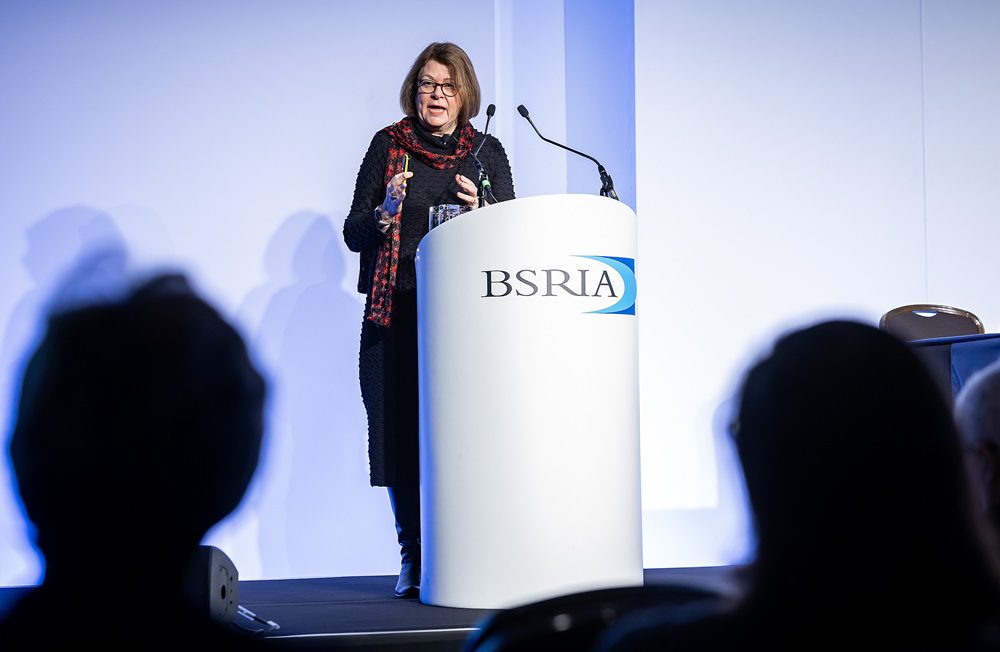
The chair of the Carbon Trust told an audience of built environment professionals that the industry must go beyond net zero and adapt buildings for climate resilience.
“We must close the performance gap on buildings, taking building standards as a minimum, said Baroness Brown of Cambridge, Dame Julia King. “Reaching net zero is no longer enough – we have to adapt our buildings to avoid uninhabitable homes.”
The message was delivered as part of her keynote speech at the BSRIA Briefing last month, before an assembled audience of professionals from across the construction and building services industry.
Hosted by the Building Services Research and Information Association (BSRIA) at the Brewery, London, the event brought together some of the most important voices in building quality and sustainability to address the critical challenge of delivering buildings that can achieve net zero by 2050.

The event examined retrofit as a key theme, outlining the importance of future-proofing our buildings and providing healthy and comfortable spaces for people to live and work, opening people’s imaginations to approach retrofit differently.
As in previous years, the briefing showcased expert insights and real-world case studies to inspire action in transforming the UK’s ageing building stock from both a physical and behavioural standpoint.
Speaking at the event, Baroness Brown emphasised the urgent need to strengthen our buildings for the realities of a changing climate, warning that rising temperatures, increased flooding, and water shortages are inevitable.
She called for a tripling of decarbonisation efforts and highlighted the need for climate-resilient design to prevent uninhabitable homes and worsening fuel poverty.
The day was grounded in independent research undertaken by BSRIA and revealed by journalist and broadcaster Nick Ferrari at the event – that 82% of consumers are unclear on retrofit as a solution.
“It suggests a certain amount of apathy”, Ferrari said, kicking off a Q&A panel about the practical steps toward greater understanding of retrofit and better energy literacy.
The conference also highlighted the critical role of retrofit assessments, with Richard Fitton, professor of building performance at the University of Salford and chairman of the upcoming British Standard for Retrofit Assessment, presenting the BS:40104 standard. This new standard is set to improve the quality of retrofit work by introducing a robust, comprehensive evaluation process.
Critical role
Talks throughout the day also stressed the importance of tailoring solutions to homeowners and occupiers. Dr Sanchayan Banerjee spoke about the need for personalised approaches, using behavioural data to encourage adoption. Meanwhile, WSP’s Joe Benson highlighted the social and economic benefits of retrofit projects, from improving indoor air quality to empowering communities.
The event also explored the digital future of buildings, with Justin Kirby from the Digital Buildings Council discussing how smarter systems and frameworks like NABERS UK (a rating system used to assess the energy efficiency and environmental impact of buildings) can optimise performance and reduce emissions.
A recurring theme throughout the day was better collaboration amongst industry, government and occupants. Recommendations included updating standards, integrating climate considerations across policies, and bridging skills gaps to drive progress.
The conference reinforced the urgent need to retrofit the UK’s 29m existing buildings to align with net zero goals, while also ensuring solutions are equitable, sustainable, and adaptable to future challenges.
Lisa Ashworth, chief executive of BSRIA, said of the event: “Addressing the performance gap in buildings is as crucial to the built environment as the very materials that shape it. We can no longer afford to wait; getting things right from the start is essential, as the cost of failure is too high. That’s why events like the briefing are so important—they offer professionals across the sector the chance to exchange innovative practices and gain valuable insights that they can apply in their daily work.”
Main image: Baroness Brown of Cambridge speaks at the BSRIA Briefing in London
Read next: RICS’ latest Global Red Book updated for AI and ESG
Are you a building professional? Sign up for a FREE MEMBERSHIP to upload news stories, post job vacancies, and connect with colleagues on our secure social feed.
