
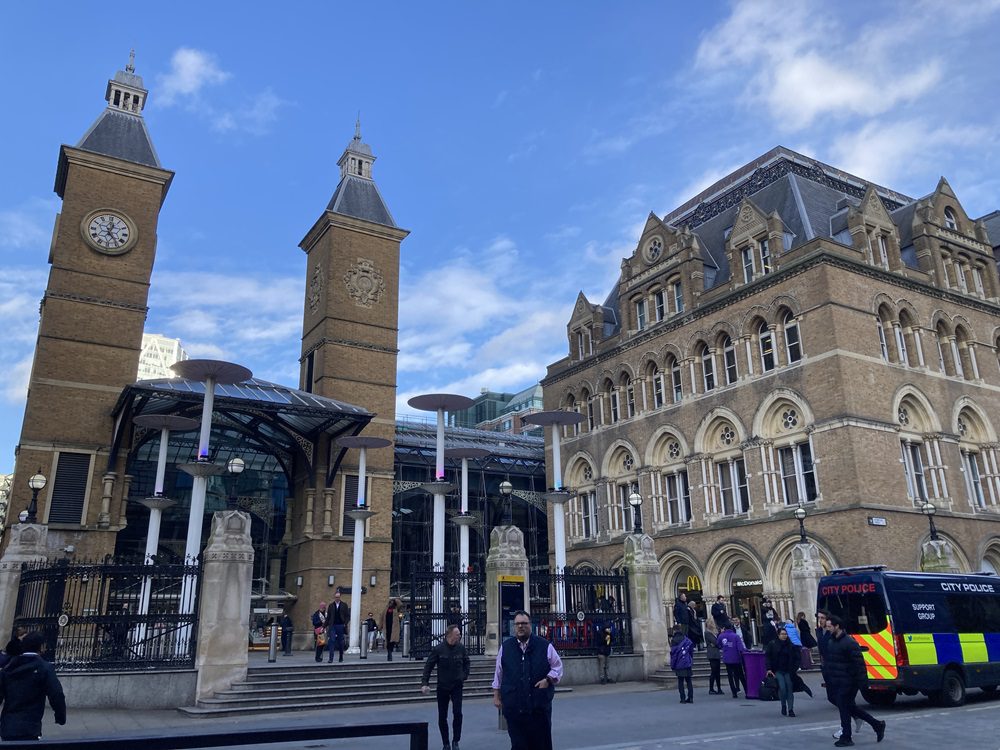
Proposals to redevelop London’s Liverpool St Station encapsulate the challenges of marrying modernisation to the preservation of the city’s world-class heritage. Tim Clark reports
The words London, development and controversy are used together so often it can feel that they are forged from a common bedfellow.
Barely a month goes by without some new furore catching the attention of the public and profession, from the Marks & Spencer store on Oxford Street to the ITV studio redevelopment.
One particular scheme, however, has come in for forceful criticism in the past year, but highlights another crucial issue for the capital – and the wider UK’s built environment – Liverpool Street Station.
Network Rail, the body in charge of Liverpool Street originally unveiled grand plans to build a whopping great tower above the listed Victorian rail terminus, and came in for scathing attacks from all quarters.
However, with the profits from the scheme due to pay for costly rail and commuter upgrades at the station, how do you balance infrastructure with development?
Scale of redevelopment plans
Previous plans were submitted in May 2023, and drawn up by architecture practice Herzog & de Meuron. They envisaged a £1.5bn plan backed by developer Sellar and Hong Kong infrastructure operator MTR that included almost 1m sq ft of commercial space in a new concourse above what would have been a partially-demolished station. The profits would have funded new escalators and access routes to the station for passengers.

“The previous scheme was rightly reviled, heartless and overbearing, like a Star Ship Destroyer sticking vertically out of the station, crassly ripping up and trashing a really thoughtful and sensitive 1990s modernisation, and would convert much of the station from a light filled temple to a subterranean passage,” says Nicholas Boys Smith, chairman of create streets and former advisor to the government on urban development.
“[It is] not quite as bad as the desecration of Euston 60 years ago but from the same school of architecture, which regards public transport as a cost not a benefit.”
The thought process that transport comes at a cost, not a benefit is an important one to consider, as is the historical legacy of Euston’s 1960s redevelopment. The issues at Euston, and how to solve the conundrum of improving the much maligned station have now dragged on for almost 15 years. The current terminus was built in 1961, therefore the dilemma over how to replace it has dragged on for a fifth of its entire lifespan.
According to Network Rail, Liverpool Street does however suffer from severe congestion problems. Its submission to the City of London stated that “whilst the station has the highest footfall usage of any station in Britain, it operates with just half the concourse space of similar London stations; at peak times of demand, the station regularly encounters significant overcrowding and widespread congestion, forcing passengers to queue on platforms and stairways on an almost daily basis”.
Former president of the Royal Society of British Architects (RIBA) Ben Derbyshire has vociferously opposed the Liverpool Street Station scheme, at least in its original form, saying that the scheme had “failed” to learn the lessons from a highly successful London Bridge redevelopment.
Derbyshire said: “First of all, there is nothing fundamentally wrong with the nineteenth century station as it is, with its sensitive 1980s adaptations by British Rail architect, Nicholas Derbyshire,” he says. “Light floods through the elegant cast iron and glass canopy, and passengers connect effortlessly to and from Liverpool Street, itself framed on both sides by buildings redolent of the age of steam.
“The place is a precious reminder of an era when Victorian architects and engineers were at their most inventive, bringing dramatic and brave interventions to civic life.”
Derbyshire adds that there is ‘plenty’ of space at Canary Wharf to house more commercial office space. In terms of Liverpool Street, however, since the last redevelopment over 30 years ago, passenger usage through the station has more than trebled.
Broader tensions
The debate also highlights the broader tension between development and conservation in London, particularly for sites with listed status. Critics often cite the National Planning Policy Framework (NPPF), which mandates that developments in heritage sites must “enhance or better reveal” their significance.
Network Rail acknowledged that its previous plans had ruffled a few feathers. In a release earlier this year it said that “a previous scheme, submitted in 2023, generated significant objection from heritage organisations”. The rail body has said it listened to the ‘broad range of views’ on the station redevelopment and the consultation it has launched will aim to deliver ‘best in class’ public infrastructure improvements.
Robin Dobson, group property director at Network Rail Property, said: “We’ve spent time talking and listening: Our latest plans celebrate Victorian features including the original train shed and the Great Eastern Hotel.”
The new designs have been drawn up by architecture practice Acme, however the redesign has been equally criticised. The main issue is that the scale of the development impacts on the station and also the grade II-listed Great Eastern hotel.
Late last month. Griff Rhys Jones, president of the Liverpool Street Station Campaign (LISSCA) and the Victorian Society, said: “The Victorian Society and other expert bodies have looked in detail at the new proposal for Liverpool Street Station, and cannot accept that this is the best way forward.
“Other London stations like King’s Cross and St Pancras have adapted to the twenty-first century. They revealed their original Railway Age splendour. It seems perverse that the proposals at Liverpool Street should still go in the opposite direction. Over two thousand people objected to the previous scheme.”
The society added that the new scheme didn’t justify their concerns and also continued to cause damage to listed buildings “as a means to achieve new services”.
There are plenty of examples of successful redevelopments in London that have paid for transport infrastructure upgrades. The Docklands Light Railway was paid for, and also built to serve the redevelopment of the docklands itself.
In Kings Cross, Argent Related’s grand plan has helped pay for the cleaning up and restoration of the formerly rundown station as well as open up the former rail yards and transform them into a vibrant community that has attracted Google among others to locate there. One thing both programmes benefitted from however was space; a commodity Liverpool Street does not have.

Complex conundrum
Perhaps one solution could be for Network Rail to seek redevelopment elsewhere to help pay for the Liverpool Street redevelopment. That lays open the dilemma that other communities see housing, or commercial space, but a terminus miles away reaps the benefits from the profits.
“It’s a little hard to tell from the new scheme’s whimsical illustrations but the new approach (if they go through with it) appears to be less careless of the experience of being in the station but just as bad for those walking past,” Boys-Smith adds.
“It rips up the elegant non-listed building and entrance on Liverpool Street itself and replaces them with faceless facades under acres of glass stretching heavily into the clouds above. It’s good to see some curves in the new proposal but it’s impossible to tell from what we can see if some welcome biomorphic forms will be sufficient to relieve the tedium and dehumanising height. I suspect not.”
In a way, the Liverpool Street Station redevelopment embodies the complexity of modern urban planning in a historical and dynamic city like London. It raises fundamental questions about how to reconcile heritage preservation, infrastructure demands, environmental responsibility, and community values.
When Euston’s Victorian station was due to be reduced to rubble in 1961 poet John Betjeman and BBC journalist Charles Cornelius-Wheeler led an ultimately unsuccessful campaign to stop the plans. Sixty years later, it falls to Gryff Rhys Jones and co to lead a similar campaign at a different station.
Many may hope that history will not repeat itself. The debate over how infrastructure pays for itself will, however, continue to rumble on.
Main image: Liverpool Street Station. Courtesy of Wikipedia. Credit: Matt Brown. CC by 2.0
Read next: AUAR aims for the mid-rise after innovation funding win
Are you a building professional? Sign up for a FREE MEMBERSHIP to upload news stories, post job vacancies, and connect with colleagues on our secure social feed.
