

Researchers from South Korea have developed a hybrid machine learning model that uses generative AI to predict the structural strength of carbon-fibre reinforced concrete-filled steel tube (CFST) columns.
Such CFST columns – further strengthened with carbon fibre-reinforced polymers (CFRP) – are emerging as a key solution for creating resilient infrastructure, according to the team at Seoul National University of Science and Technology (SeoulTech).
These advanced composite structures are said to combine the robust load-bearing capabilities and strength of CFST columns with the lightweight, corrosion-resistant properties of CFRP. The result is a cutting-edge construction material that not only enhances structural performance but also offers increased durability and reduced maintenance.

Given the potential of such columns in modern construction projects, researchers SeoulTech have been running extensive experimental campaigns and developing models that can predict their properties. However, available data on these columns are limited, the researchers say, leading to “questionable” prediction performance even when using the best machine learning-powered models.
The research, led by associate professor Jin-Kook Kim of SeoulTech, set out to find a solution to this hurdle. In their latest paper, published in the journal, Expert Systems with Applications, the team presented and verified a novel hybrid machine learning model capable of accurately predicting the ultimate axial strength of CFRP-strengthened CFST columns – a critical structural parameter in construction projects.
To overcome the scarce availability of data on CFRP-strengthened CFST columns, the researchers employed a form of generative AI to create a synthetic database.
Kim said: “We employed a conditional tabular generative adversarial network, or ‘CTGAN,’ to generate new data with similar characteristics to real data.”
Then, they used this database to train and validate a hybrid machine learning model combining the Extra Trees (ET) technique and the Moth-Flame Optimization (MFO) algorithm. Through rigorous testing, the researchers evaluated the performance of the proposed model.
Kim added: “Compared to existing empirical models in the literature, the predictive and reliable performances of the MFO-ET model are outstanding.”
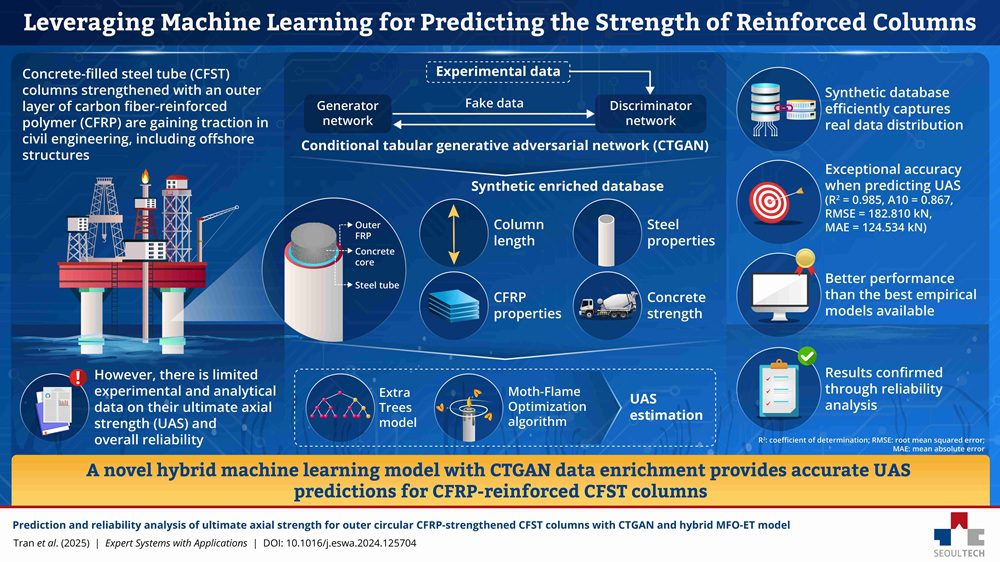
The hybrid model exhibited better accuracy than even the best alternatives available, achieving lower error rates across several key metrics. The results were further solidified via a reliability analysis, which indicated that the model can consistently deliver accurate predictions under various conditions.
Using the proposed model, engineers would be able to create safer and more efficient designs using CFRP-strengthened CFST columns; useful in skyscrapers, high-rise constructions, and offshore structures alike.
Moreover, it could help make necessary predictions for strengthening older buildings or bridges by retrofitting them with CFRP materials. Notably, CFRP-strengthened CFST columns are resilient against corrosion and other natural processes, which is important in the face of climate change and more frequent extreme weather events.
To make the proposed model more easily accessible and widely applicable, the research team also created a web browser-based tool that can be used to make ultimate axial strength predictions in CFRP-strengthened CFST columns for free. It can be accessed from any device and without installing any software locally, the team says.
Overall, the proposed model is said to represent a valuable tool for improving the design and assessment of CFRP-strengthened CFST columns. By providing reliable strength predictions, it’s claimed it will help engineers optimise construction processes and enhance the safety of both new and existing structures at a lower cost.
Read next: Tony Gilbert joins BESA as its first COO
Are you a building professional? Sign up for a FREE MEMBERSHIP to upload news stories, post job vacancies, and connect with colleagues on our secure social feed.
