
Utility providers in the US state of Arizona are teaming up to explore the potential for adding nuclear generation to its energy portfolio to meet growing demand.
Arizona Public Service (APS), Salt River Project (SRP), and Tucson Electric Power (TEC) have announced the collaboration earlier this month.
Ted Geisler, APS president, said: “Energy demand in Arizona is increasing rapidly. To ensure a reliable and affordable electric supply for our customers, we are committed to maintaining a diverse energy mix.
“While new nuclear generation would take more than a decade to develop, the planning and exploration of options must begin now. We are partnering with neighbouring utilities to assess the feasibility of new nuclear generation, alongside other resources, to meet the state’s growing energy needs.”

The companies have been monitoring emerging nuclear technologies and have a shared interest in evaluating their potential to support growing energy needs in the state.
APS is leading the effort in collaboration with SRP and TEP to assess a wide range of possible locations, including at the sites of retiring coal plants.
Jim Pratt, SRP’s general manager and chief executive, said: “SRP is exploring all options to meet the growing energy needs of the Phoenix metropolitan area affordably, reliably and sustainably. We appreciate the collaboration with our neighbouring utilities to help determine the role new nuclear generation could play in powering Arizona’s future.”
Susan Gray, TEP’s president and chief executive, added: “New nuclear generation could provide Arizona with reliable, around-the-clock carbon-free energy to power economic growth while helping us make progress toward a clean energy future.
“We know the development timeline would be long, so it makes sense for our state’s energy providers to begin this preliminary evaluation as soon as possible.”
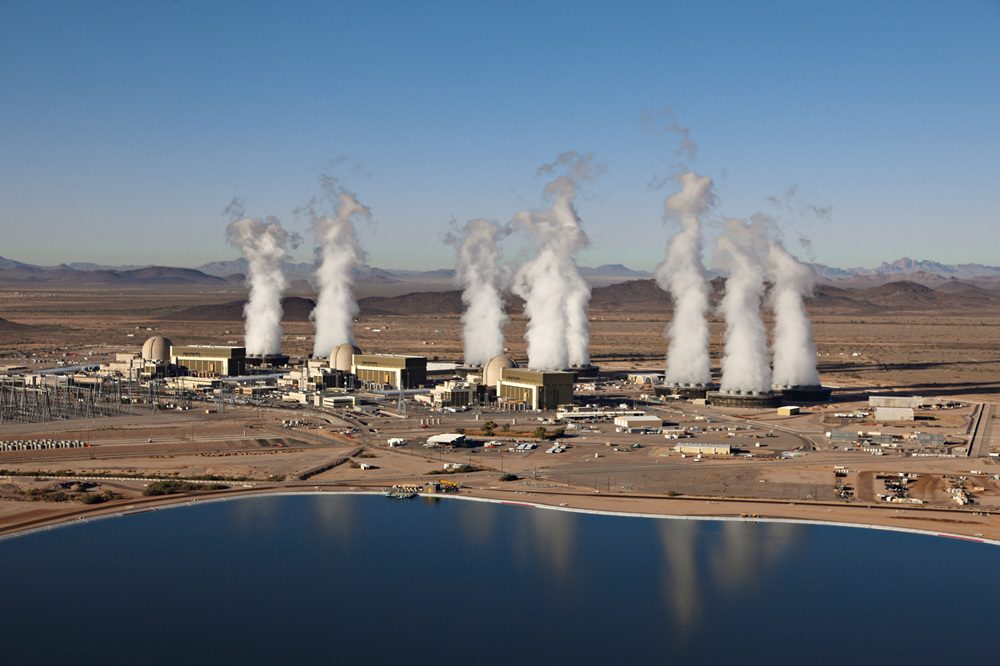
Siting work for additional nuclear would consider small modular reactors (SMRs) and potential large reactor projects, the utilities say. SMRs, which are smaller than traditional nuclear power reactors, generate 300 megawatts (MW) or less of energy per unit. For comparison, each unit at Palo Verde Generating Station, located west of Phoenix, is able to generate 1,400 MW. One megawatt of electricity is enough to power about 160 Arizona homes.
The utilities have applied for a grant from the US Department of Energy (DOE) to begin preliminary exploration of a potential site for additional nuclear energy for Arizona.
The grant application is an initial step in a larger collaborative effort by the utilities to explore the possibility of adding reliable, efficient and clean nuclear energy in the state. This joint effort could see the selection of a preferred nuclear site in the late 2020s, at the earliest, potentially enabling additional nuclear to be in operation in the early 2040s.
APS serves about 1.4m homes and businesses in 11 of Arizona’s 15 counties. It is the owner and operator of Palo Verde Generating Station, said to be one of the United State’s largest producers of carbon-free electricity, and with one of the country’s most substantial renewable energy portfolios, the company says its current energy mix is about 54% clean.
SRP is a community-based, not-for-profit public power utility and the largest provider of electricity in the greater Phoenix metropolitan area, serving more than one million customers. It is also the metropolitan area’s largest supplier of water.
TEP serves more than 450,000 electricity customers in Southern Arizona. TEP and its Tucson-based parent company, UNS Energy Corporation, are subsidiaries of Fortis Inc.
Main image: Palo Verde Generation Station. Image courtesy of Arizona Public Service
Read next: Start values down as major projects stall, says Glenigan
Are you a building professional? Sign up for a FREE MEMBERSHIP to upload news stories, post job vacancies, and connect with colleagues on our secure social feed.
