
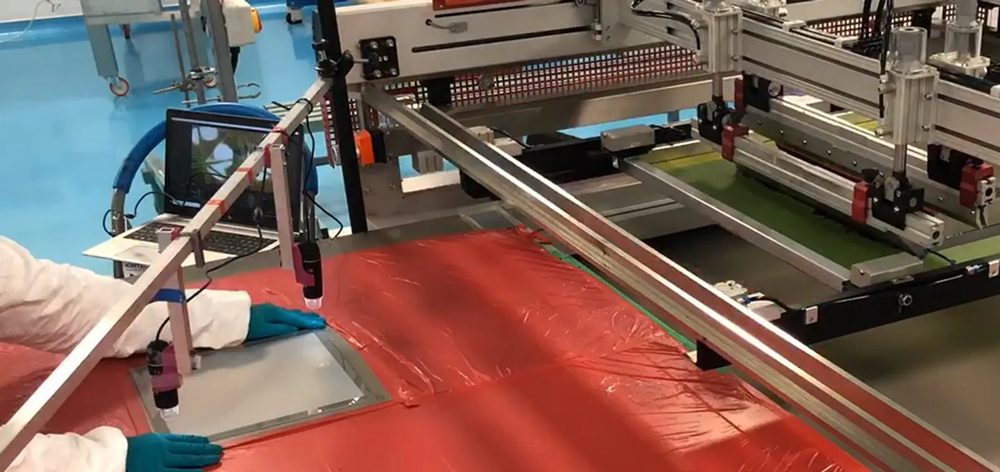
A new project has been awarded £3m to develop and manufacture sustainable perovskite solar modules (PSM) in Africa, intended to empower local communities and promote sustainable energy.
The project, led by a team from Swansea University in Wales, is called REACH-PSM – standing for Resilient Renewable Energy Access through Community-Driven Holistic Development in Perovskite Solar Module Manufacturing.
It aims to establish Africa’s first full-scale demonstration of next-generation solar manufacturing.

Funded by the UKRI Ayrton Challenge Programme, REACH-PSM is a collaboration with universities, businesses, and local communities in Nigeria, Rwanda, Kenya, and South Africa.
The project builds on existing programmes at Swansea University, including TEA@SUNRISE and UNESCO Chair in Sustainable Energy Technologies, which focus on sustainable solar technologies in low- and middle-income countries.
A key element of REACH-PSM will be developing efficient end-of-life treatment to minimise waste and maximise the circular flow of materials through reuse, refurbishment, and recycling of solar modules. A new manufacturing process designed for a circular economy from the outset.
Professor Matthew Davies, principal investigator of REACH-PSM, said: “Through REACH-PSM, we are bringing together world-class expertise in sustainable materials, photovoltaic technology, and local manufacturing to help revolutionise energy access and resilience across Africa.
“By developing perovskite modules that are not only efficient but also sourced and produced locally and designed for efficient end-of-life processes, we hope to empower communities, strengthen supply chains, and help usher in a more equitable, low-carbon energy future.”
Perovskite solar cells are considered an exciting emerging solar technology nearing commercialisation. They can be manufactured at a lower cost and with less energy compared to silicon, and can use more sustainable materials and processes, providing a more resilient and adaptable energy solution.
Currently, more than 500 million people in Africa lack access to electricity, a figure that has risen in recent years. However, with the potential for manufacturing PSM on the continent, REACH-PSM aims to improve social welfare and promote new, clean economic growth.
Frances Wood, UKRI’s international director, said: “The Ayrton Challenge Programme demonstrates the power of research and innovation to address critical global challenges. These projects exemplify how equitable, interdisciplinary collaboration can unlock transformative solutions, ensuring a sustainable and inclusive energy future for all.”
Main image: A large area perovskite solar module being manufactured. Credit: SPECIFIC Innovation and Knowledge Centre
Read next: Ecocem looks to scale-up with commercial production
Are you a building professional? Sign up for a FREE MEMBERSHIP to upload news stories, post job vacancies, and connect with colleagues on our secure social feed.
