
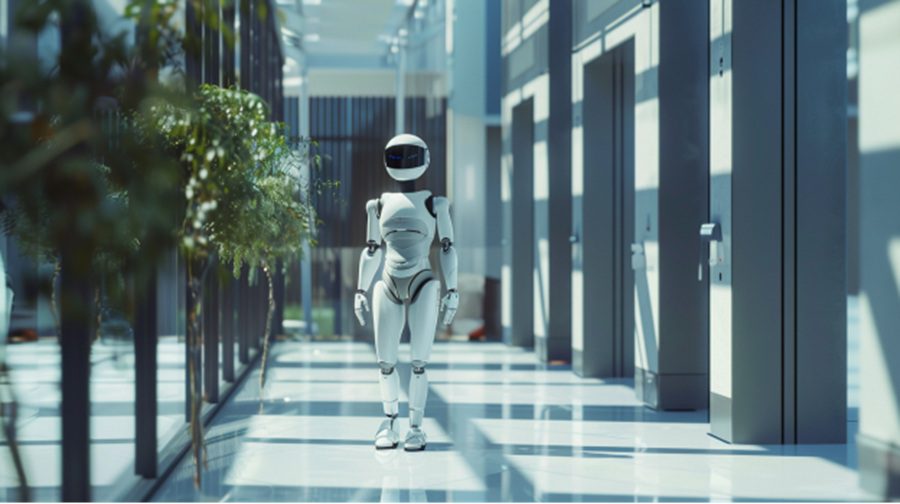
Exergio is experimenting with humanoid robots, training them for the task of maintaining a building’s energy efficiency
A Lithuanian company that specialises in AI-driven energy management tools for commercial buildings is bringing humanoid robots into the field.
Exergio says it has started training its first humanoid robot, powered by NVIDIA’s GR00T system, to improve management, detect faults, and enhance real-time system monitoring in commercial buildings.
Investment in humanoid robotics is growing, with the market valued at approximately $2.43bn in 2023, and projected to grow to $66bn by 2032, so interest in inevitably growing.
Meta, for instance, has recently launched a new division within its Reality Labs to develop AI-powered humanoid robots for physical tasks.

Similarly, Tesla is launching its Optimus robot, a general-purpose humanoid meant to perform tasks that are dangerous, repetitive, or boring for humans. Google’s DeepMind has partnered with Apptronik to advance humanoid robots for dynamic environments.
While most humanoid robots today are designed for general-purpose tasks such as aiding in household chores, Exergio says their deployment in specialised professional fields has been limited so far.
Donatas Karčiauskas, chief executive of Exergio, said: “Application of humanoid robots can be used beyond household tasks. They have plenty of potential in professional environments.
“Managing energy in commercial buildings is complex. It’s not just about turning off lights or adjusting the thermostat. It requires real-time monitoring, predictive analysis, and the ability to act fast.
“AI-powered humanoid robots can process vast amounts of sensor data, identify inefficiencies, and respond instantly to anomalies. For example, a robot can detect an overheating component before it fails or pinpoint false alarms that would otherwise waste time and resources.”
The humanoid robots used by Exergio will be equipped with NVIDIA’s GR00T system, which has an advanced AI framework designed to enhance perception and motor skills.
Unlike proprietary humanoid AI models, GR00T is said to offer open accessibility, and allows companies to train and adapt robots for their specific needs.
Karčiauskas added: “We chose the NVIDIA GR00T platform because it provides the adaptability necessary in real-world industrial applications. With GR00T, we can train robots to conduct on-site equipment inspections, detect early signs of system failures, and respond to alerts faster than human operators.
“In theory, such robots can verify false alarms, analyse inefficiencies in HVAC systems, and even assist in emergency scenarios by guiding personnel to safe exits. We’re here to train them.”
Exergio’s expertise in AI-driven energy management comes from years of optimizing large commercial buildings, where efficiency gains translate directly into cost savings. The company’s AI-based solutions applied in shopping mall Ozas in Vilnius, Lithuania, helped reduce energy waste by 29% and save more than €1m.
The company says that extensive amounts of data from different types of properties, ranging from hotels to office buildings, will help train humanoid robots to operate effectively within different energy management scenarios. It will also ensure the robots are well-equipped to analyse, predict, and respond to energy system inefficiencies.
Read next: The mood after MIPIM
Are you a building professional? Sign up for a FREE MEMBERSHIP to upload news stories, post job vacancies, and connect with colleagues on our secure social feed.
