
Heritage bodies Cadw, Historic England, and Historic Environment Scotland (HES) have published a new handbook to support people undertaking net zero retrofit qualifications.
There are approximately 6.5m pre-1919 buildings in England, Scotland and Wales. That’s around 20-30% of all buildings in the UK, so it is crucial that historic buildings are part of the solution to fight climate change.
As the three organisations point out, the most sustainable building is the one that already exists.
Cadw, Historic England and HES have been working together to improve the standard of retrofit training delivery in response to known skills and knowledge gaps in the retrofit workforce.
A particular focus of this work is a qualification that centres on buildings of traditional construction. The Level 3 Award in Energy Efficiency Measures for Older and Traditional Buildings plays a key role in disseminating heritage knowledge to the retrofit workforce.
It is a requirement for certain retrofit roles under PAS2035 and PAS2038 – the industry standards that set out good practice for retrofit interventions – where buildings being treated are of traditional construction.

The new publication is aimed at learners undertaking the Level 3 Award or other retrofit qualifications and is designed to be used as an additional resource to support training delivered by a registered provider.
The qualification gives learners an understanding of how older and traditional buildings perform and the suitability of energy efficiency measures for their construction type.
Ian Morrison, director of policy and evidence at Historic England, said: “This collaboration with Cadw and Historic Environment Scotland demonstrates our commitment to ensuring that our historic buildings play a key role in tackling climate change. By improving the standard of retrofit training, we are ensuring that our historic buildings can be made energy efficient and climate resilient while preserving their unique heritage.”
Gwilym Hughes, head of Cadw, said: “This collaborative handbook is a significant milestone in our shared commitment to preserving traditional buildings while addressing the urgent challenge of climate change. Our historic buildings can and should be part of our journey to net zero and this partnership demonstrates how the UK’s heritage bodies are working together to champion practical, sensitive approaches to adapting our most treasured buildings.”
Dr David Mitchell, director of cultural assets at HES, said: “There is no route to net zero without viewing the buildings we already have as assets. The retrofit of these traditional buildings has the potential to bring many wider gains, including economic and employment opportunities as well as environmental benefits.
“To deliver these, it’s crucial we are able to develop and deliver vital skills training to ensure we have a workforce equipped to undertake retrofit in a way that works for both buildings and their occupants.
“Collaboration is key to addressing the gaps in provision that currently exist, and we’re pleased to have worked with Cadw and Historic England to produce this important resource, which is a key component of the qualification we deliver through our dedicated building conservation centre at the Engine Shed in Stirling.”
Traditional challenge
Traditionally constructed buildings from before 1919 were typically built using different methods to modern buildings, therefore they need different treatment.
They are an important part of our heritage, helping us to understand our history and enrich our sense of place. They are increasingly at risk in the face of a changing climate, but also play an important part in mitigating these risks.
Climate change is also one of the most significant challenges for the management of historic places, with the growing intensity and frequency of climate hazards – such as increasing maximum summer temperatures and the volume and intensity of rain and storm events – impacting the performance of our buildings.
Adaptation is critical to ensuring traditional buildings are resilient to climate change impact. However, there are known knowledge and skills gaps in the workforce expected to work on these buildings.
Only 28% of respondents to Historic England’s recent Skills Needs Analysis are confident that existing training provision for work on traditionally constructed buildings will give tradespeople the skills they need to install low carbon and energy efficiency measures.
Cadw, HES and Historic England are therefore collaborating with awarding bodies and industry to strengthen the training available.
At the heart of the qualification and the guidance and research that underpin its content is a key message: Traditional buildings can be retrofitted and have a role to play in climate action.
Through this and wider work in the retrofit industry, the nation’s heritage bodies hope to break down the perceived barriers to retrofitting historic buildings and demonstrate that, with carefully considered intervention, traditional buildings can be part of the climate change solution and can be made resilient for the enjoyment of future generations.
Further collaborative efforts to improve the standard of retrofit training include reviewing National Occupational Standards, working with awarding bodies to review their qualifications, collaborating on consultations on standards (British, PAS) and training developments, and sitting on trailblazer groups for development of a Level 5 Retrofit Coordinator apprenticeship.
Steve Muscroft, senior product developer at NOCN, said: “This is an authoritative and informative publication. Not only is it aligned to the Level 3 Award in Energy Efficiency Measures for Older and Traditional Buildings, but it will also serve as an excellent reference for other PAS 2035 disciplines, such as Retrofit Coordinator, Assessor and Designer, as well as the wider retrofit and construction sector.”
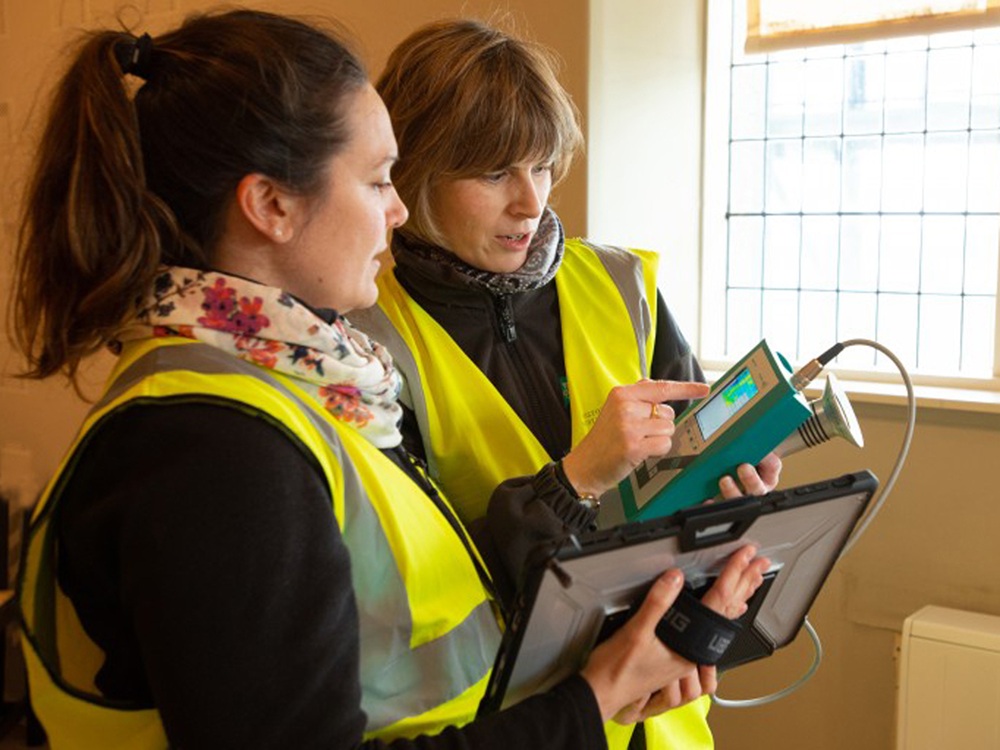
Main image: Surveyors conducting a moisture survey. © Historic Environment Scotland
Read next: Trump tariffs tighten pressure on UK construction
Are you a building professional? Sign up for a FREE MEMBERSHIP to upload news stories, post job vacancies, and connect with colleagues on our secure social feed.
