
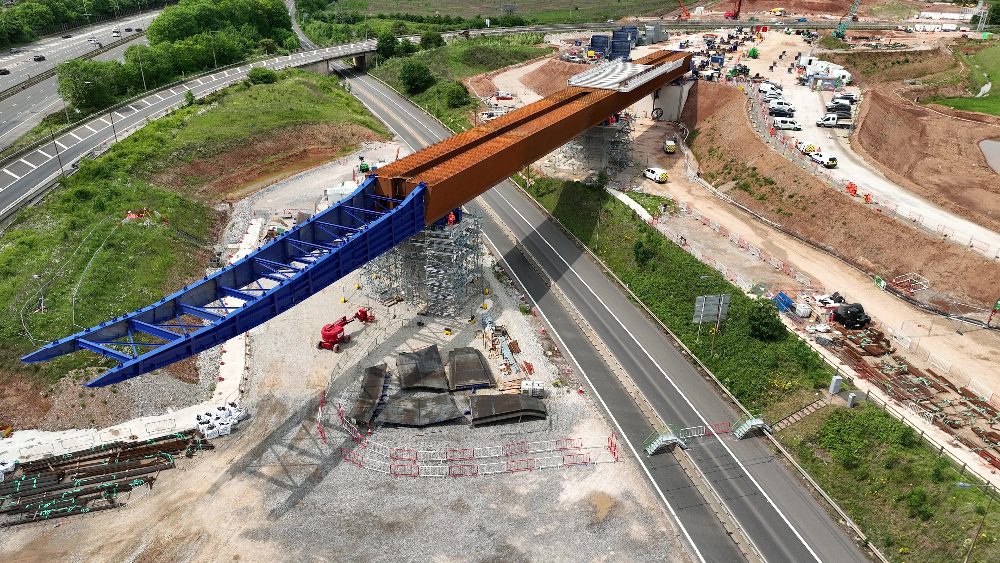
The first part of a major 320-metre-long viaduct that will carry high-speed trains across the M6 near Birmingham Airport has been slid into position.
Balfour Beatty VINCI successfully slid the first stage of the project, the 119m ‘East Deck’ of the M6 South viaduct, out over a slip road adjacent to the motorway.
To minimize disruption for motorists, the viaduct deck was assembled on one side and slid across the motorway over three weekends. Each part was pushed out before later sections were added behind it.
This multi-stage process means that the weight of the deck will increase with each push, from 1,300 tonnes this weekend to 3,290 tonnes for the final slide. These subsequent slides will take the deck out over the main M6 carriageway and then finally the M6-M42 link roads.
The weight includes pre-cast concrete deck slabs on top of the steel structure. Launching the viaduct with the deck units already in place further reduces the number of closures of the motorway.
The East Deck will carry two tracks taking trains towards London, while an adjacent ‘West Deck’ will carry a further two tracks for services heading to Birmingham and further north. This will be assembled and slid out next year using the same technique.


Taking shape
Russell Luckhurst, the Balfour Beatty VINCI’s engineer leading the delivery of the works, said: “This complex viaduct spanning the M6 motorway and adjoining slip roads is beginning to take shape, now we’ve successfully moved the first section into place.
“It’s a huge achievement for the dedicated project team who’ve worked tirelessly over the past three years to reach this point. We’re now focused on delivering the next phase, which includes two further launches later in the year.”
Liam Kenney, HS2 Ltd’s Senior Project Manager, said: “It’s great to see the first section of the East Deck in position. Once complete, these twin viaducts will carry high-speed trains over the M6, helping to improve journeys and free up space on the existing rail network for more freight and local services.
“I’d like to thank everyone who has worked so hard to deliver the first slide safely and efficiently, opening the road to traffic 11 hours early.
The complex operation was led by Balfour Beatty VINCI, supported by specialist steelwork company Victor Buyck Steel Construction (VBSC).
The viaduct section was moved using a series of winches, known as strand jacks, at an average speed of twelve metres per hour, sliding across non-stick pads to reduce friction – a material usually found on the surface of a household frying pan.

Launch nose
A 36-metre-long temporary launch nose was installed at the front of the structure to guide the viaduct on its launching path and reduce the weight of the cantilevered section.
The viaduct and the launch nose will remain in its current position while the next section is assembled. The viaduct is restrained temporarily by equipment located on the piers and the abutments.
Each viaduct span is formed of a hollow double-box structure made of weathering steel. This kind of steel boasts a natural protective layer of oxidation, which gives it a characteristic ‘rusty’ appearance and reduces maintenance by eliminating the need for regular repainting.
Four pairs of concrete piers support the viaducts, with the tallest one 9.9m in height. A 4.5m high parapet will be provided on the side facing Chelmsley Wood to reduce noise and disturbance from passing trains.
The structural design was carried out by Balfour Beatty VINCI’s Design Joint Venture, made up of Mott MacDonald and SYSTRA.
Read next: CIBSE appoints new President – Build in Digital
Are you a building professional? Sign up for a FREE MEMBERSHIP to upload news stories, post job vacancies, and connect with colleagues on our secure social feed.

