
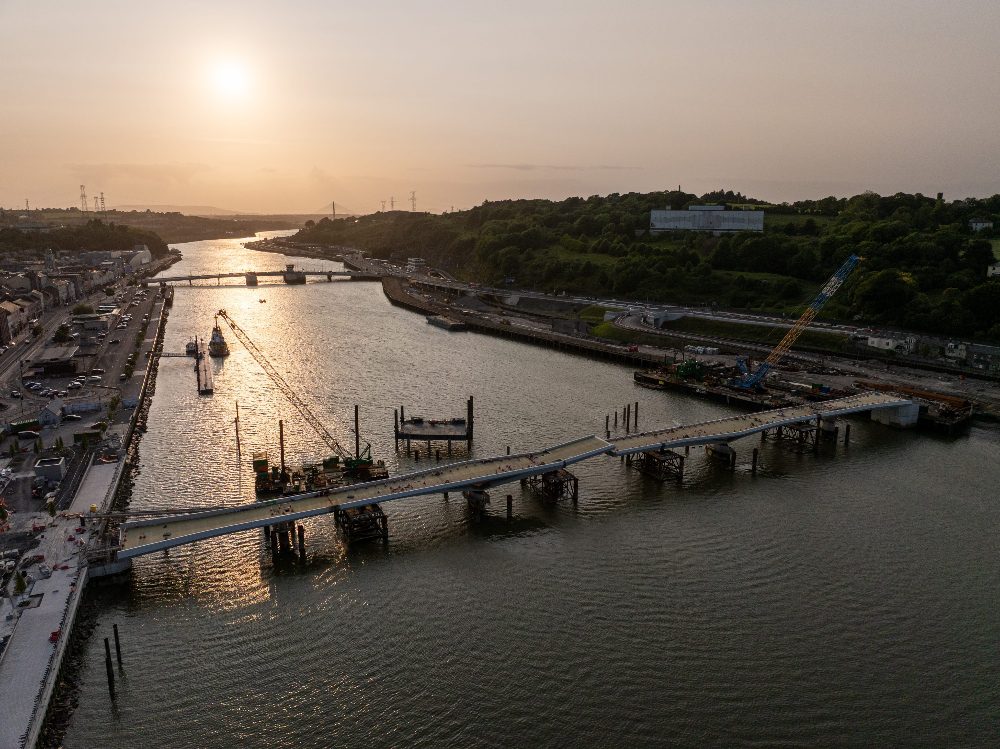
Waterford’s skyline is quietly transforming. Rising above the slow, tidal sweep of the River Suir, the newly installed superstructure of the River Suir Sustainable Transport Bridge marks a pivotal moment for Ireland’s oldest city—and for Irish urban regeneration as a whole.
The 207-metre-long pedestrian and cycle bridge, designed by Knight Architects in collaboration with Roughan & O’Donovan as lead engineer and Hardesty & Hanover as M&E engineer, is not merely an elegant addition to the cityscape—it is a critical piece of infrastructure that redefines how Waterford connects, moves, and grows. Commissioned by Waterford City & County Council and constructed by BAM, this landmark structure will open to the public in 2026, forging a vital active travel corridor across the River Suir.
Its understated geometry, inspired by Waterford’s renowned crystal heritage, speaks to both legacy and ambition. Faceted steel elements echo the craftsmanship for which the city is known, while the bridge’s twin-leaf bascule span, seamlessly integrated into the deck, ensures the Suir remains navigable to marine traffic—a thoughtful nod to the city’s enduring maritime life. Above the water, widened sections at each feature pier offer generous viewing platforms, providing not only a practical connection but also space to pause, observe, and engage with the river’s evolving surroundings.

Not an isolated gesture
Yet, the bridge is not an isolated gesture. It is the centrepiece of the €200 million Waterford North Quays Infrastructure Project, the largest urban regeneration initiative in Ireland. This ambitious project, set within the North Quays Strategic Development Zone (SDZ), lays the groundwork for significant private sector-led investment. Once completed, the area will welcome new homes, office space, hospitality venues, and public amenities, transforming an underutilised industrial landscape into a vibrant, accessible waterfront district.
The bridge itself has been meticulously designed to accommodate pedestrians, cyclists, and future electric shuttle buses, knitting together key sections of the region’s greenway network. Its south landing features a carefully considered urban realm, with surfaces and forms that guide movement intuitively while enhancing the city’s public space. By encouraging sustainable travel and reducing reliance on cars, the project also advances Ireland’s national climate targets, making Waterford not only more connected but also more resilient.
For Tom Osborne, Director at Knight Architects, the project represents more than just infrastructure: “This bridge does far more than connect two sides of a river. It connects the past with the future, catalysing the transformation of Ireland’s oldest city whilst responding sensitively to its historic cultural and urban context. It represents a bold and forward-looking investment in the city’s future and will act as a key enabler for the North Quays development, bringing new homes, jobs and cultural offerings to Waterford.”
From concept to completion, Knight Architects’ long-term, collaborative approach exemplifies the kind of design thinking that places people and place at the centre of infrastructure. As the bridge reaches its structural milestone, it signals not just the spanning of a river, but the bridging of opportunity, heritage, and the next chapter for Waterford.
Read next: Tackling skills shortages and boosting construction jobs – Build in Digital
Are you a building professional? Sign up for a FREE MEMBERSHIP to upload news stories, post job vacancies, and connect with colleagues on our secure social feed.