
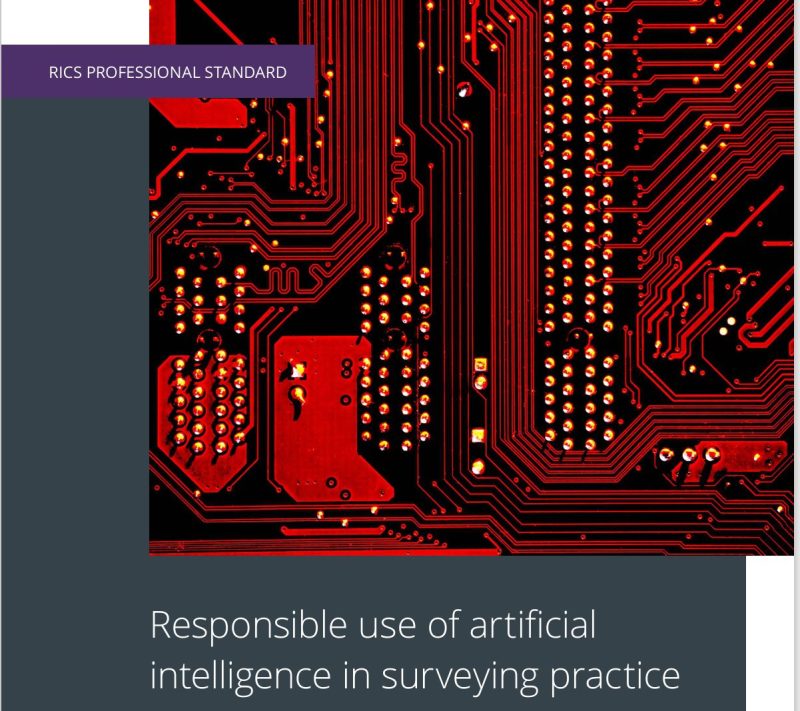
The Royal Institution of Chartered Surveyors (RICS) has taken a historic step in shaping the future of the built environment with the launch of the world’s first global professional standard on the responsible use of artificial intelligence (AI) in surveying.
Effective from 9 March 2026, this standard represents a pivotal moment for digital construction, offering clear guidance to professionals and firms as AI becomes increasingly embedded in surveying, valuation, construction, land, and infrastructure services.
With AI revolutionising workflows in data analysis, project management, and predictive modelling, the new RICS AI standard aims to ensure that innovation is harnessed responsibly. It sets out mandatory requirements and best-practice expectations for RICS members and regulated firms worldwide, focusing on ethics, transparency, and accountability.
Why the RICS AI standard matters for the digital construction sector
The construction and surveying industries are in the midst of a digital transformation, with AI adoption accelerating in areas such as:
- Automated property valuations
- Predictive maintenance and lifecycle modelling
- Risk analysis and compliance monitoring
- Smart infrastructure and digital twins
- Geospatial mapping and land-use planning
While these applications promise efficiency and accuracy, they also raise concerns about data quality, bias, accountability, and client trust. By introducing this global framework, RICS ensures that the surveying profession leads the way in ethical AI adoption, reinforcing confidence across the industry.
Key provisions of the RICS AI standard
The new professional standard sets out clear rules and expectations to guide responsible AI use. Among its most significant provisions are:
1. Governance and Risk Management
- Firms must establish robust AI governance structures.
- Risk registers and due diligence procedures are required for all AI systems.
- Policies must address data usage, system reliability, and accountability.
2. Professional Judgment and Oversight
- Surveyors remain responsible for all outputs generated by AI tools.
- Professionals must apply scepticism, verification, and expertise before acting on AI-driven insights.
- Human oversight cannot be replaced by automated decision-making.
3. Transparency and Client Communication
- Clients must be informed, in writing, of when and how AI will be used.
- Service providers must offer clients the option to opt out of AI-enabled processes.
- Firms must provide clear routes for redress if AI-based outputs prove unreliable.
4. Ethical Development of AI
- AI systems developed by firms must undergo rigorous assessments of data quality.
- Stakeholder engagement and sustainability impacts must be factored into system design.
- Compliance with international data protection and legal frameworks is mandatory.
Industry response
Commenting on the launch, Maureen Ehrenberg, Acting President Elect of RICS, emphasised the importance of balancing innovation with professional ethics: “Artificial intelligence offers real promise to the surveying profession – but only if used responsibly and ethically. This standard ensures surveyors remain at the forefront of innovation while protecting clients, data, and public trust.”
The statement reflects a wider recognition that AI in digital construction must be deployed with caution, ensuring that efficiency gains do not come at the cost of professional integrity or client confidence.
Implications for digital construction and surveying firms
The introduction of the RICS AI standard has several implications for the wider digital construction ecosystem:
- Competitive advantage for firms that can demonstrate compliance with ethical AI practices.
- Greater client trust in AI-assisted services, reducing resistance to digital transformation.
- Alignment with ESG principles, as responsible AI adoption supports sustainability and social responsibility goals.
- Global consistency, with RICS setting a benchmark for AI governance that could influence other professions.
For firms already integrating AI into surveying workflows, early adoption of the standard’s requirements will ensure smoother compliance and position them as leaders in the responsible digitalisation of construction services.
Preparing for March 2026: What firms should do now
To prepare for the rollout of the RICS AI standard, surveying and digital construction firms should:
- Review existing AI systems for compliance with the forthcoming standard.
- Develop internal governance frameworks that align with RICS expectations.
- Train professionals on responsible AI oversight and client communication.
- Engage with stakeholders, including clients and technology partners, to embed ethical practices.
- Monitor legal and regulatory developments, ensuring AI adoption remains compliant across jurisdictions.
The launch of the RICS global standard on responsible AI in surveying marks a transformative moment for the digital construction sector. By embedding accountability, transparency, and ethics into AI adoption, RICS provides professionals and firms with a clear pathway to harness innovation without compromising trust.
As AI continues to redefine the built environment, this landmark initiative ensures that surveyors remain the guardians of professional integrity – combining cutting-edge technology with trusted expertise. For the digital construction sector, it represents both a challenge and an opportunity: to lead the future of AI responsibly, sustainably, and with global impact.
Read next: A game-changer for welding automation – Build in Digital
Are you a building professional? Sign up for a FREE MEMBERSHIP to upload news stories, post job vacancies, and connect with colleagues on our secure social feed.
