
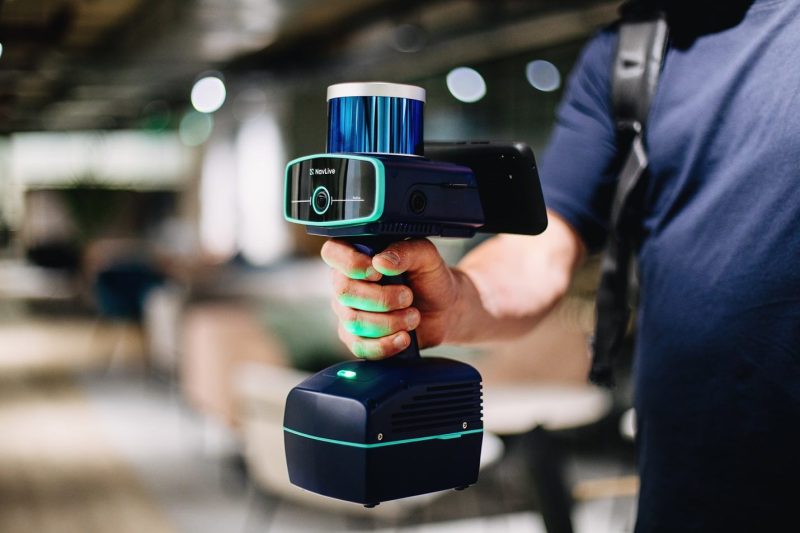
In the rapidly evolving landscape of digital construction and AI for building measurement, NavLive has selected the NVIDIA Jetson Orin NX system-on-module as the compute heart of its next-generation handheld construction scanner. The NavLive scanner integrates five sensors, including three cameras, LiDAR, and an IMU, all streaming data simultaneously to support simultaneous localisation and mapping (SLAM) and computer vision tasks on site. Previous generations required separate microcontrollers for each sensor, but with Jetson, all processing is consolidated into a single platform.
Why the shift matters
NavLive’s move to Jetson Orin NX consolidates the processing into one unified AI compute module. This consolidation unlocks performance, efficiency, and form factor benefits that are critical in handheld / portable devices.
By adopting Orin NX, NavLive achieves:
- Compact system-on-module (SoM): One module combining CPU, GPU, and AI accelerators (tensor cores) reduces board count and frees up space.
- Reduced power draw and weight: Lower energy consumption permits smaller batteries and lighter builds, supporting a full scanning session (approx. one hour) without undue burden.
- High-bandwidth interfaces: The integrated design supports multiple MIPI CSI-2 camera inputs and sensor buses, essential for multi-camera architectures.
- Full edge processing: All SLAM, object detection, and fusion tasks execute locally on the device — no dependency on cloud connectivity, which means lower latency, greater robustness, and enhanced data privacy.
Dr. David Wisth, CTO and Co-founder of NavLive, summarises this shift: “By moving to Jetson Orin NX, we reduced weight and power requirements while increasing capability. Customers immediately notice that the device is easier to hold, yet it delivers much more in terms of performance.”


NavLive leverages NVIDIA’s software ecosystem, including Linux for Tegra (L4T), Vision Programming Interface (VPI), and the Multimedia API (libargus), to optimise performance. A custom camera driver developed by NavLive engineers uses these tools to completely offload heavy computer vision tasks, such as debayering and undistortion, to specialised hardware (VIC and PVA), freeing up the CPU and GPU for other workloads.
“Jetson gave us a platform that was powerful, efficient, and well supported,” said Dr. Wisth. “It allows us to deliver a lightweight, practical tool for construction professionals while keeping all processing secure and on-device.”
Rise of edge AI in construction technology
NavLive’s decision is emblematic of a broader shift: moving compute to the field, not the cloud. In sectors where latency, connectivity, and data privacy matter, edge AI is becoming the standard. The consolidation of multiple sensor processing into one AI module is a powerful enabler for portable, autonomous tools.
NavLive’s selection of the NVIDIA Jetson Orin NX to power its handheld construction scanner represents a strategic and technical leap as it signals a shift away from distributed microcontroller-based architectures to unified, high-performance edge AI platforms. This enables compact, lightweight, power-efficient scanners capable of delivering real-time SLAM and object detection for conversion to BIM, all while keeping data local and secure.
For the architecture, construction, and survey industries, this development signifies faster, smarter, more integrated workflows, where geometry capture, processing, and BIM-ready output occur within minutes on-site.
Read next: Celebrating final Birmingham tunnel breakthrough for HS2 – Build in Digital
Are you a building professional? Sign up for a FREE MEMBERSHIP to upload news stories, post job vacancies, and connect with colleagues on our secure social feed.

