
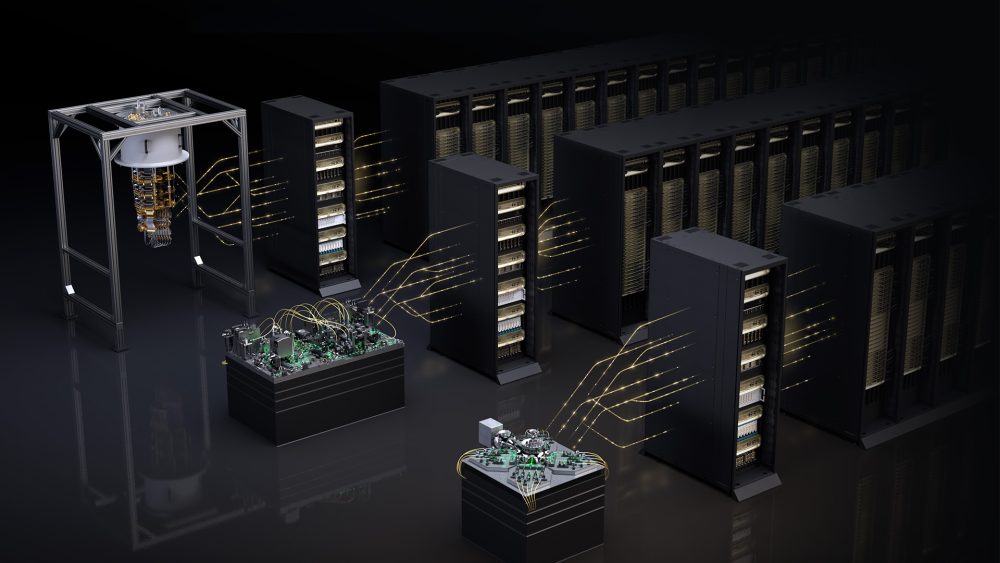
NVIDIA has unveiled NVIDIA NVQLink™, an open system architecture designed to connect the power of GPU computing with quantum processors. This marks a pivotal step towards hybrid quantum supercomputers, bringing together classical and quantum computing to accelerate discovery and innovation across research, science, and industry.
Developed in collaboration with researchers from leading U.S. national laboratories, including Brookhaven, Fermi, Lawrence Berkeley, Los Alamos, MIT Lincoln, Oak Ridge, Pacific Northwest, and Sandia National Laboratories, NVQLink has been shaped by some of the most advanced computing minds in the world. The initiative also includes 17 quantum processor unit (QPU) builders, five controller developers, and nine national labs, ensuring an open and collaborative foundation for quantum-GPU integration.
At the core of this breakthrough is the challenge of managing qubits, the fundamental units of quantum information. Qubits enable quantum computers to handle complex computations beyond the reach of classical systems, but they are notoriously fragile and error-prone. To function effectively, qubits require precise calibration, quantum error correction, and real-time control algorithms. These operations depend on ultra-low latency and high throughput, traditionally managed by conventional supercomputers.


NVIDIA NVQLink provides this critical link. By creating a direct, high-speed connection between GPUs and quantum processors, it enables the responsive environment required to stabilise qubits and run complex hybrid applications. This integration sets the stage for transformative breakthroughs in data analysis, simulation, and scientific modelling, fields central to innovation in construction, materials science, and sustainable infrastructure.
Founder and CEO Jensen Huang described NVQLink as “the Rosetta Stone connecting quantum and classical supercomputers”. He emphasised that future NVIDIA GPU supercomputers will be hybrid systems, tightly coupled with quantum processors to unlock new computational frontiers.
The U.S. Department of Energy has also recognised NVQLink’s potential in advancing national and industrial computing capabilities. U.S. Secretary of Energy Chris Wright stated that maintaining leadership in high-performance computing depends on bridging to the next era, accelerated quantum supercomputing. NVIDIA’s collaboration with national laboratories and industry partners will play a key role in developing the powerful systems needed to solve complex scientific and engineering challenges.
Beyond its technical capabilities, NVQLink offers an open platform for quantum integration, connecting diverse approaches to quantum hardware and control systems with artificial intelligence and GPU supercomputing. This interoperability supports quantum hardware builders such as IonQ, Oxford Quantum Circuits, Rigetti, Quantinuum, and Silicon Quantum Computing, alongside control system providers like Keysight Technologies and Zurich Instruments.
Through its integration with NVIDIA CUDA-Q™, researchers can already begin developing hybrid quantum-classical applications that combine CPUs, GPUs, and quantum processors. This capability allows engineers and data scientists to test new computational workflows, paving the way for quantum-accelerated solutions in sectors such as energy, materials, construction technology, and advanced design.
As industries move towards increasingly data-driven operations, the emergence of hybrid quantum computing represents a major shift in capability. NVIDIA’s NVQLink provides not just the technology, but the open ecosystem needed to bring this vision to life. By uniting classical GPU power with quantum innovation, NVQLink establishes the foundation for the next generation of supercomputing, one that will transform research, engineering, and digital construction alike.
Read next: Enhancing efficiency and customer service – Build in Digital
Are you a building professional? Sign up for a FREE MEMBERSHIP to upload news stories, post job vacancies, and connect with colleagues on our secure social feed.

