
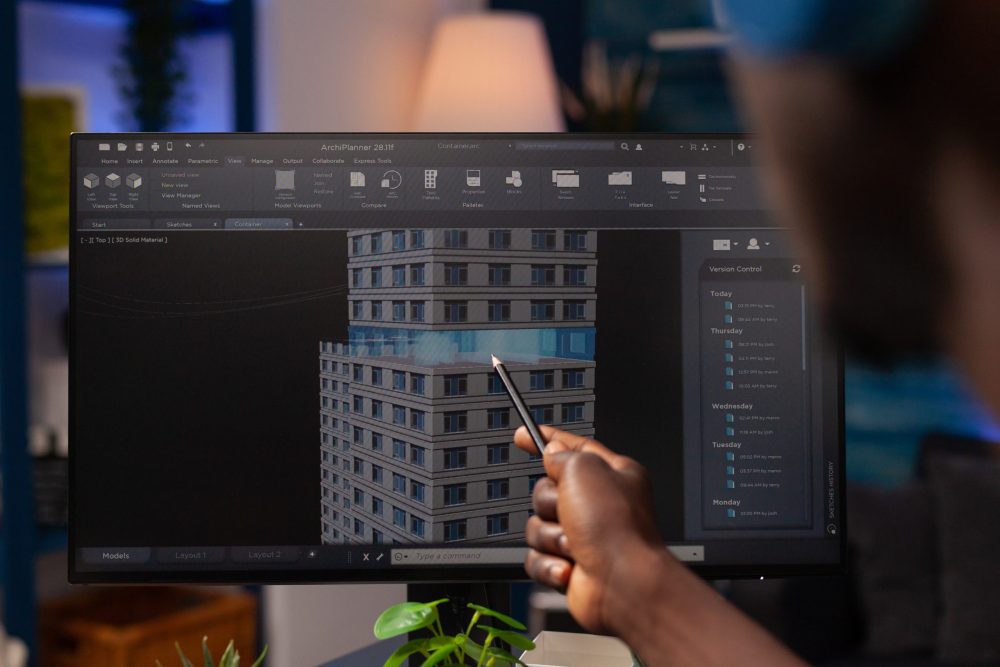
BIM 2.0 connects data, design, and delivery across the entire project lifecycle, empowering teams to move faster, make informed decisions, and align on outcomes from concept to completion.
Collaborating in today’s data-driven construction landscape is critical to architects, engineers, contractors, and clients, and BIM 2.0 enables them to benefit as it reshapes how the sector operates.
Here, we look at ten tasks BIM 2.0 can take in its stride:
1. Build massing models in minutes
BIM 2.0 enables project teams to create accurate massing models within minutes, not days. Early-stage design is no longer restricted to manual 3D modelling. Parametric tools and integrated datasets allow users to visualise spatial arrangements instantly, test scenarios, and adapt in real time. This acceleration helps design teams validate feasibility and performance earlier in the process, reducing risk and improving design quality from the outset.
2. Generate floor plans automatically
With AI-assisted automation, BIM 2.0 can generate detailed floor plans directly from early models or design inputs. This means layouts are produced automatically based on parameters such as site constraints, room adjacencies, and building codes. The result is faster, more consistent documentation and a significant reduction in repetitive drafting work. Automation frees up designers to focus on decision-making and design intent rather than technical production.
3. Reuse design intelligence from past projects
BIM 2.0 allows teams to build on the collective knowledge of previous projects through design intelligence reuse. Data libraries, templates, and proven digital components can be applied to new developments, speeding up delivery and improving accuracy. Whether it’s structural systems, MEP layouts, or material assemblies, design intelligence becomes a reusable digital asset, enabling continuous improvement and better outcomes over time.
4. Explore hundreds of design options instantly
With generative design and computational workflows, BIM 2.0 makes it possible to explore hundreds of design options instantly. By setting parameters and constraints, designers can automatically generate and compare multiple scenarios, assessing them for performance, cost, and buildability. This data-driven approach supports better decision-making, allowing teams to identify optimal design solutions faster than ever before.
5. Collaborate live across teams and stakeholders
BIM 2.0 is designed for real-time collaboration. Multi-user cloud platforms enable architects, engineers, contractors, and clients to work together within the same model simultaneously. This eliminates version control issues and allows stakeholders to see changes as they happen. Live collaboration ensures greater transparency, reduces miscommunication, and aligns all parties on shared project goals.


6. Optimise for off-site and prefabricated construction
The rise of offsite manufacturing and prefabrication is transforming how buildings are delivered, and BIM 2.0 sits at the centre of that shift. By embedding detailed component information and construction sequencing data, BIM 2.0 helps teams plan for modular assembly, logistics, and installation. The result is more predictable delivery, less waste, and better alignment between design and manufacturing workflows.
7. Simulate environmental and performance outcomes
Sustainability is no longer a separate process. With BIM 2.0, environmental and performance simulations can be integrated directly into the design model. Teams can analyse daylighting, energy use, embodied carbon, and thermal comfort from the earliest stages of design. This ensures that performance outcomes are quantified, traceable, and aligned with net-zero targets and regulatory standards.
8. Move from sketch to data-driven insight in one platform
One of BIM 2.0’s most powerful attributes is its ability to connect conceptual design and data analysis in a single environment. Instead of shifting between disconnected tools, designers can move seamlessly from sketching massing concepts to extracting data insights such as area calculations, cost estimations, and performance metrics. This continuous workflow supports evidence-based design and reduces inefficiency across the project lifecycle.
9. Turn massing studies into visualisations
BIM 2.0 integrates advanced visualisation tools that transform simple massing studies into photorealistic renderings and immersive experiences. Stakeholders can view projects in real time through VR, AR, or interactive digital twins. This enhances client engagement and enables better decision-making by clearly communicating design intent and spatial relationships before construction begins.
10. Integrate sustainability and financial metrics as exportable data
BIM 2.0 unifies sustainability and financial data in a common digital environment. Teams can link embodied carbon values, lifecycle cost analysis, and material sourcing data directly to the 3D model. Exportable datasets provide stakeholders with a transparent view of both environmental and economic performance, supporting compliance, reporting, and funding applications.
The future of digital construction
BIM 2.0 marks a step change for the digital construction industry. It shifts the focus from model creation to data connectivity, bridging the gap between design intent and real-world outcomes. By combining automation, analytics, and collaboration in one platform, BIM 2.0 empowers the entire project ecosystem to make smarter, faster, and more sustainable decisions. The result is a more connected, transparent, and intelligent construction process that reflects the future of design and delivery.
Read next: Shaping design guidelines for women’s football stadiums – Build in Digital
Are you a building professional? Sign up for a FREE MEMBERSHIP to upload news stories, post job vacancies, and connect with colleagues on our secure social feed.

