
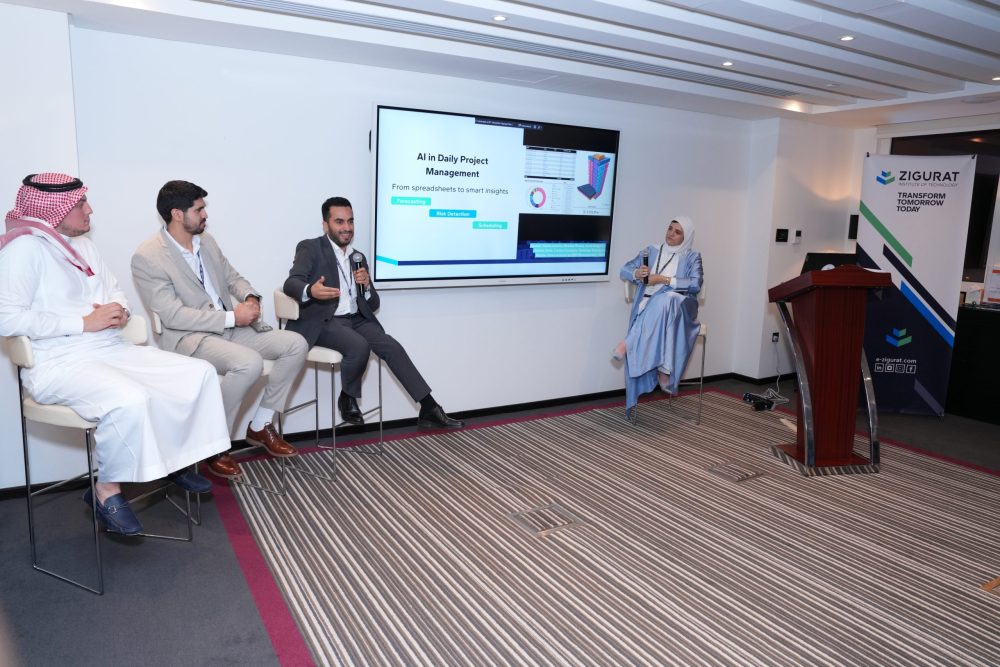
The ZIGURAT Institute of Technology hosted its first Middle East Local Hub in Riyadh, gathering over 100 professionals, students, and alumni to discuss digital innovation and AI in construction.
The event, titled “Unlimited Possibilities with Digital Transformation & AI in AEC” and sponsored by GRAPHISOFT, exceeded expectations in both scale and engagement. Held at the Olaya Centre, it reflected Saudi Arabia’s increasing demand for advanced digital skills aligned with the Vision 2030 programme. The strong turnout demonstrated the region’s commitment to developing a workforce equipped for new digital standards in construction.
Education as the foundation for transformation
Opening the event, Pau F. Aldomà, CEO of ZIGURAT, emphasised the institution’s commitment to local capacity building and long-term collaboration within Saudi Arabia’s digital ecosystem. He highlighted that achieving the country’s ambitions requires a combination of talent development, industry partnerships, and accessible high-quality training. Education, he noted, remains one of the most reliable drivers of sustainable digital transformation in construction.
The programme featured two panel discussions exploring how digital tools, artificial intelligence, and new project delivery methods are reshaping the AECO sector. A networking session enabled participants to form new collaborations and take part in a connection-card challenge, concluding the day with prize raffles and community-building activities.
Rethinking construction processes through digital transformation
The first panel, “Digital Transformation in Construction: Rethinking Project Delivery,” brought together Hossam Abdulaziz, Dr Omar Dahan, Mohamed Dorra, and Ahmed Fadhl Al Mawla. Their discussion addressed the digital construction skills gap and the need for academic institutions to better align curricula with professional requirements.
Panellists noted that the rapid growth of digital construction in Saudi Arabia has created significant demand for expertise in BIM workflows, data-driven project management, and digital delivery frameworks. Dr Dahan explained that institutions such as ZIGURAT play a critical role by providing training that can be applied immediately in real project environments. Dorra added that university programmes should integrate BIM, AI, and Digital Twin technologies to prepare graduates for future project roles.
Dahan also offered an analogy that resonated widely with the audience: “BIM is the skeleton, AI is the brain, and Digital Twins are the nervous system of the future of construction.” This comparison captured the interconnected nature of digital tools and the need for coherent strategies that link design, operation, and asset performance.
AI adoption in construction: automation, ethics, and professional judgement
The second panel, “AI in Construction: Automation and Innovation,” moderated by alumna Sarah Sakr, focused on practical applications of artificial intelligence in construction project management. Findings and case studies were presented by Ahmed Elhadidi, Maged Elhamady, and Kamal Bairagdar of Jacobs.
The speakers demonstrated how AI-enabled workflows are already improving data analysis, project monitoring, forecasting accuracy, and communication across project teams. Elhadidi shared practical resources and launched an interactive AI challenge that received strong participation.
A key theme was the balance between automation and human expertise. The panel agreed that while AI strengthens efficiency and supports decision-making, core professional judgement should remain the responsibility of qualified practitioners. Their discussion also examined the ethical considerations that accompany the growing use of automation in the construction industry, including the need to safeguard transparency and maintain human oversight.
Strengthening global networks and digital construction skills
The event also showcased selected projects from students of ZIGURAT’s International Master’s in BIM Management. These examples demonstrated how emerging technologies—such as BIM, Digital Twins, and AI-supported simulations—are being integrated into real project environments.
The networking activities highlighted the strength of ZIGURAT’s global community. Participants exchanged contacts, explored collaboration opportunities, and reflected on the value of professional learning networks in supporting career progression. One attendee, who had travelled more than 300 kilometres to join the event, noted the importance of such gatherings for gaining insights into the future of digital construction.
A milestone for digital construction in the Middle East
With its successful first edition in Riyadh, ZIGURAT has strengthened its position as a global provider of specialised AECO training and as a contributor to the digital transformation initiatives emerging across the Middle East. The discussions throughout the day reinforced a shared message: the future of construction in Saudi Arabia will be shaped by education, collaboration, and continued innovation.
As the country advances its Vision 2030 urban development and infrastructure programme, the adoption of BIM, AI, and Digital Twin technologies will play a central role. Events such as ZIGURAT’s Local Hub are helping build the digital capabilities required to meet these goals and to support the region’s long-term growth in the digital construction sector.
Read next: Controlling a buildings full lifecycle with digital twins – Build in Digital
Are you a building professional? Sign up for a FREE MEMBERSHIP to upload news stories, post job vacancies, and connect with colleagues on our secure social feed.

