
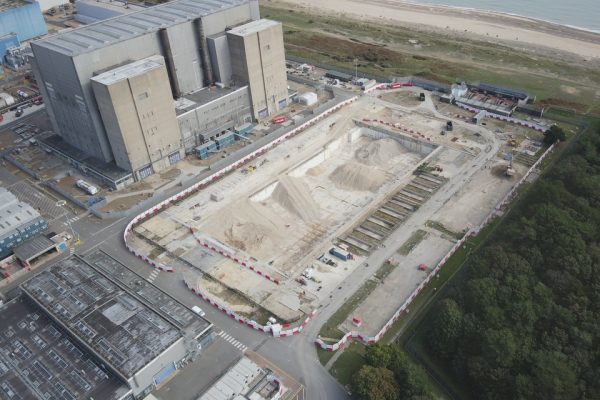
A new circular economy initiative at Sizewell is demonstrating how the UK’s nuclear sector can integrate sustainable construction practices into large-scale infrastructure delivery.
More than 15,000 tonnes of concrete from the decommissioned Sizewell A power station is now being reused at Sizewell C after a cross-site agreement that supports resource efficiency, carbon reduction, and responsible material management.
The agreement between Nuclear Restoration Services (NRS) at Sizewell A and the Sizewell C project team marks a shift in how demolition material from nuclear sites can be repurposed. For the digital construction sector, it also highlights how data-driven planning, rigorous testing, and cross-project collaboration can enable low-carbon construction workflows at scale.
Approved for reuse
The concrete originates from the turbine alternator plinths within the former Sizewell A turbine hall, recently demolished as part of ongoing decommissioning activities. After processing and crushing, the material underwent a full programme of quality and safety testing before being approved for reuse. Rather than being treated as waste, the recycled concrete has been transported a short distance to Sizewell C’s Main Construction Area, where it is now serving as a sub-base across several foundation platforms.
This reuse strategy aligns with long-term ambitions to reduce the volume of primary aggregates used in major projects. It also demonstrates how recycled concrete can meet the technical requirements of modern nuclear construction when supported by robust certification processes. All material was verified against the WRAP Quality Protocol, an important benchmark for projects adopting circular economy approaches to aggregate supply.
Beyond material reuse
According to the Sizewell C team, the benefits of the initiative extend beyond material reuse. Damian Leydon, Site Delivery Director at Sizewell C, said the collaboration reduces vehicle movements across East Suffolk and supports efforts to lower the environmental impact of construction activity. He emphasised that working with local partners enables more efficient sourcing and supports regional supply chain goals.
For NRS, the project signals an important step in applying circular economy principles to nuclear decommissioning. Wendy Heath, NRS Senior Project Manager at Sizewell A, noted that diverting the concrete from landfill avoided 28 tonnes of CO₂ emissions while demonstrating how decommissioning projects can contribute to wider clean-energy goals. She highlighted the value of cross-project cooperation in enabling safe, sustainable outcomes while supporting local communities.

Support for material reuse
The initiative also reflects increasing regulatory support for material reuse in the nuclear sector. Senior representatives from the Environment Agency and the Local Authority approached the Sizewell C project team with the proposal to repurpose the concrete, recognising its potential to reduce waste streams and support regional sustainability targets. Sally Coble, Nuclear Regulation Group Manager South at the Environment Agency, said the project illustrates how the agency is enabling responsible reuse across nuclear sites and influencing industry practice.
Operationally, the recycling effort has been active since September. Sizewell A has overseen all crushing, testing, and certification activities, ensuring that the material meets the necessary standards before being moved to Sizewell C. Transfers have now been completed, marking the close of a significant logistical phase.
Recycled reductions
For the Sizewell C project, the benefits are clear. Using recycled aggregate reduces procurement costs, limits the extraction of new primary materials, and aligns with UK content and Suffolk spend commitments. The short transfer distance confined almost 800 vehicle movements to the immediate Sizewell area, offering further reductions in road traffic and associated emissions.
Councillor Tom Daly, Cabinet Member for Energy and Climate Change at East Suffolk Council, welcomed the reuse of material, noting its importance in reducing the environmental impact of construction and supporting responsible local development.
Safety-critical infrastructure
As digital construction continues to drive change across the built environment, the Sizewell initiative offers a practical model for integrating recycled materials into complex, safety-critical infrastructure. It provides a reference point for future projects seeking to adopt circular economy principles, reduce carbon impacts, and apply intelligent resource management across construction lifecycles.
The collaboration between Sizewell A and Sizewell C demonstrates how sustainable construction materials, rigorous testing protocols, and data-enabled project coordination can work together to support low-carbon infrastructure in the UK’s nuclear sector. It also reinforces the value of shared planning and communication in delivering outcomes that support both industry goals and community expectations.
Watch the story unfold – Concrete recycling powers sustainability at Sizewell A and Sizewell C
Read next: Accelerating low-carbon timber construction skills – Build in Digital
Are you a building professional? Sign up for a FREE MEMBERSHIP to upload news stories, post job vacancies, and connect with colleagues on our secure social feed.