
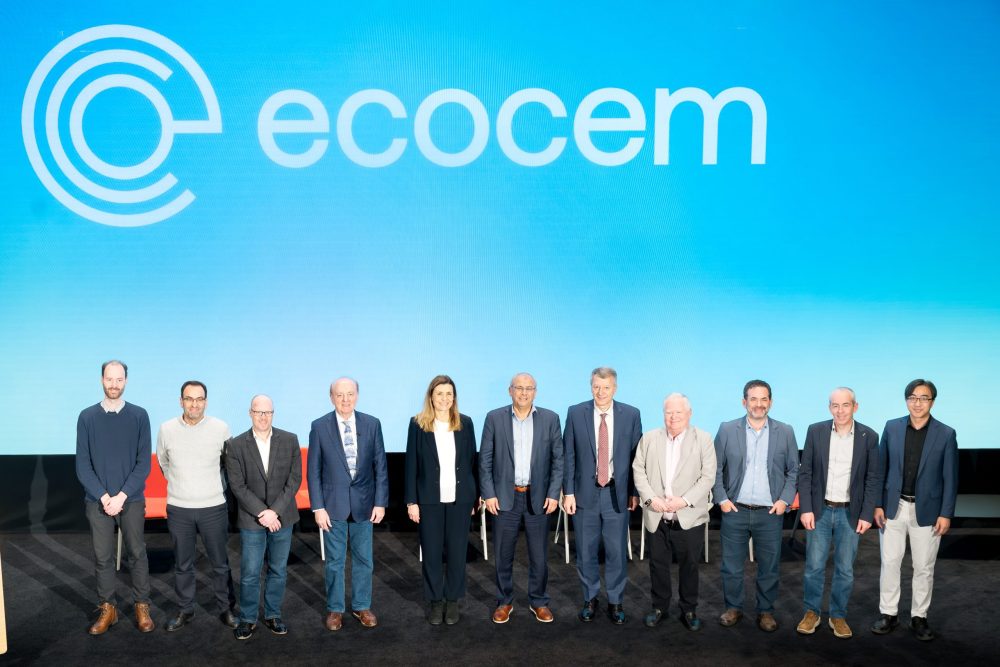
Ecocem has launched a global Materials Science Advisory Council to strengthen the development and adoption of low-carbon cement technologies across the construction sector. The announcement follows the organisation’s recent Materials Science Symposium in Paris, which brought together researchers, policymakers, and industry leaders to examine pathways to decarbonise cement and concrete production.
The cement sector accounts for 8% of global CO₂ emissions, making the shift to alternative cement materials a priority for the built environment. Ecocem’s new Council aims to advance this transition by consolidating global scientific expertise and aligning it with industry needs and policy frameworks. Comprising eleven recognised materials scientists from leading international institutions, the Council will advise on research priorities, review global innovation programmes, and support the development of standards that enable low-carbon cement to scale.
Collaborative opportunities
The Council will also explore collaborative opportunities that build on Ecocem’s long-term scientific partnerships. These partnerships have already informed the company’s ACT technology, which achieves a 70% reduction in CO₂ emissions compared with traditional cement. With growing interest in sustainable construction materials and the industrialisation of low-carbon concrete solutions, the Council will work to close the gap between technical feasibility and practical deployment.
Its remit includes an annual review of global research trends, guidance to policymakers and standards bodies, and the identification of new areas where materials science, regulation, and industry practice can converge to accelerate cement decarbonisation.
Sustainable technologies
The announcement follows intensive discussions at Ecocem’s Science Symposium, where researchers and construction stakeholders assessed how next-generation low-carbon cement technologies can be deployed at scale. These discussions highlighted a need for better alignment between science, regulation, and investment to support faster industrial adoption of sustainable cement technologies.
Donal O’Riain, Founder and Managing Director of Ecocem, emphasised that the sector has the capability to decarbonise earlier than current timelines suggest. He noted that a 70% CO₂ reduction is already achievable without additional cost or reliance on carbon capture technologies. However, he pointed to a lack of policy support for a wider range of solutions. The Council, he said, will contribute independent scientific insight to encourage regulatory frameworks that support the rapid adoption of low-carbon cement.


Materials science
Roberta Alfani, Ecocem’s Director of Research & Innovation, reinforced the urgency of bringing science, policy, and industry together. She highlighted that advances in materials science now make low-carbon cement a viable option without major process changes or new infrastructure, but that firm action is required to realise its global impact.
The formation of the Advisory Council strengthens Ecocem’s long-term focus on materials science, industrial collaboration, and scalable climate solutions. The company has invested more than €70 million in research and development over the past decade, including its new Research and Innovation Centre in France. Additional milestones include the €50 million ACT production plant in Dunkirk and a €170 million commitment to build four more ACT production lines in France by 2030.
With partnerships across the construction value chain, including Sisk, Cemex France, Bouygues Construction, Vinci Construction, CB Green, and the Titan Group, Ecocem is positioning low-carbon cement as a core component of future digital construction strategies.
Advisory council
The establishment of the Materials Science Advisory Council signals a coordinated, global effort to accelerate sustainable cement technologies and support the wider decarbonisation of the built environment. By uniting scientific expertise with industrial application, the Council aims to advance practical, scalable solutions that help the sector cut emissions at pace and support more sustainable construction worldwide.
The Advisory Council members include:
Dr. Mohend Chaouche – Université Paris-Saclay, France.
Prof. Martin Cyr – Université de Toulouse, France.
Prof. R. Douglas Hooton – University of Toronto, Canada.
Prof. Kamal Khayat – Missouri University of Science and Technology, USA.
Dr. Hongyan Ma – Missouri University of Science and Technology, USA.
Prof. Ciaran McNally – University College Dublin, Ireland.
Prof. Rafael G. Pileggi – University of São Paulo, Brazil.
Prof. Johann Plank – Technical University of Munich, Germany.
Prof. Francesca Ridi – University of Florence, Italy.
Prof. Ruben Snellings – KU Leuven, Belgium.
Prof. Arezki Tagnit Hamou – Université de Sherbrooke, Canada.
Read next: Preventative project management with IoT – Build in Digital
Are you a building professional? Sign up for a FREE MEMBERSHIP to upload news stories, post job vacancies, and connect with colleagues on our secure social feed.
