
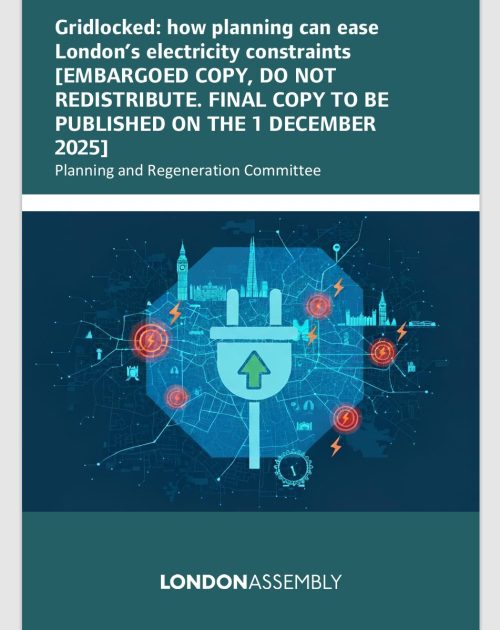
Rising electricity demand across London is placing new pressure on the capital’s ability to deliver planned housing, with the rapid expansion of data centres emerging as a significant factor in local grid constraints. According to a new London Assembly Planning and Regeneration Committee report, Gridlocked: how planning can ease London’s electricity constraints, the challenge is becoming a core issue for digital construction planning, long-term development strategies, and the future of London’s built environment.
Growing strain
The report highlights the growing strain on the London electricity grid and sets out the implications for both digital infrastructure and new homes. West London, particularly Hillingdon, Hounslow, and Ealing, has faced the most acute capacity limitations. In 2022, sections of the grid reached maximum load, causing temporary delays to new housing delivery and creating uncertainty for developers and local authorities.
In response, the Greater London Authority (GLA), National Grid and Ofgem introduced short-term mitigation measures. These interventions enabled more than 12,000 homes to be connected by early 2025, providing temporary relief for housing programmes already in the pipeline. However, the report stresses that these fixes do not address the scale of long-term energy demand.

Rising energy requirement of data centres
A central driver of this challenge is the rising energy requirement of London’s data centre sector. Forecasts suggest the sector could grow between 200% and 600% in the coming years. The concentrated electricity demand of a single data centre can, in some cases, match that of tens of thousands of homes. This creates local grid pressure, increases connection complexity for developers, and has become a contributing factor to London’s wider housing delivery delays.
The Committee argues that current planning frameworks do not give local authorities the tools needed to balance data centre energy demand with the requirements of new homes and other development. To support more coordinated digital infrastructure planning, the report recommends creating a separate planning use class for data centres. This would allow their significant power requirements to be assessed consistently and factored into long-term spatial and energy planning.
Dedicated data centre policy
A further recommendation is the introduction of a dedicated data centre policy within the next London Plan. This is intended to guide investment, manage grid impacts, and support coordinated electricity infrastructure planning across boroughs. The Committee also calls for the GLA’s Infrastructure Coordination Service (ICS) to publish its data centre forecasting project without delay, ensuring that developers and local planning authorities have access to up-to-date insights on projected grid demand.
Additional measures include prioritising retrofit funding for social housing and essential infrastructure, aiming to reduce energy cost pressures on low-income households while improving system efficiency.
Pivotal moment
James Small-Edwards AM, Chair of the Planning and Regeneration Committee, emphasised that London is approaching a pivotal moment for both housing and economic growth. He noted that councils, developers and residents are already experiencing delays linked to electricity constraints, and that a long-term strategic approach will be essential as demand rises further, particularly from data-intensive industries.
London’s ability to meet its housing targets, support digital infrastructure, and sustain economic development will depend on coordinated planning and a clear strategy for managing rising energy demand. The Committee’s recommendations signal a shift towards aligning digital construction needs with long-term electricity grid capacity, ensuring future development is supported by resilient and well-planned infrastructure.
Read next: Accelerating automation in construction – Build in Digital
Are you a building professional? Sign up for a FREE MEMBERSHIP to upload news stories, post job vacancies, and connect with colleagues on our secure social feed.
