
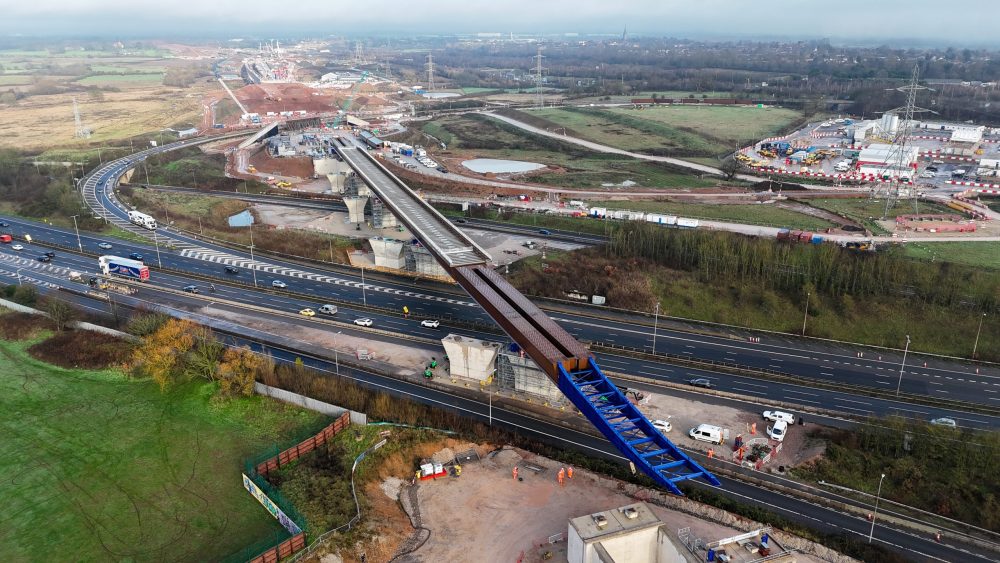
HS2 has reached a major construction milestone on the M6 South viaduct, demonstrating how digital construction planning and innovative engineering techniques can significantly reduce disruption on one of the UK’s busiest motorways. Engineers have successfully slid a 4,600-tonne viaduct deck into position across the live M6 without closing the motorway during the day, an approach believed to be a UK first.
The operation marks the completion of the third and final slide of the 315-metre East deck of the M6 South viaduct, which will carry high-speed trains towards Birmingham and the north. By avoiding a full motorway closure, the project team cut traffic disruption and set a new benchmark for complex bridge installation on live transport infrastructure.
Digital construction enables precision bridge installation
The 17-hour slide was the culmination of a carefully planned three-stage process led by HS2’s main works contractor, Balfour Beatty VINCI (BBV), in close collaboration with National Highways. Central to the success of the operation was the use of digital construction methods, including detailed construction sequencing, structural modelling and risk simulation, to develop a ‘fully restrained’ sliding technique.
Unlike previous phases, which required full weekend closures of the M6, the final slide was carried out while traffic continued to flow beneath the structure. This approach demanded precise control of movement, load distribution and structural stability, all supported by advanced digital design and engineering analysis.
A UK-first fully restrained viaduct slide
To prepare for the final slide, the M6 was closed overnight between Junctions 4 and 5 on Thursday 11 December, allowing the viaduct to be moved forward by 12 metres. This ensured that both ends of the steel structure were fully supported on concrete piers before the main operation began.
On Saturday, December 13, engineers pushed the viaduct the remaining distance across the motorway at a controlled speed of approximately 13 metres per hour. Only the M42 slip road was closed during the weekend, significantly reducing the impact on road users compared with traditional bridge installation methods.
This fully restrained bridge slide is thought to be the first of its kind on a UK motorway, demonstrating how innovation in construction methodology can improve safety, efficiency and public outcomes on major infrastructure projects.

Strand jacks, low-friction materials and engineered control
The viaduct was moved using a series of high-capacity strand jacks, which applied controlled force to guide the structure into its final position. To reduce friction, the deck was slid across specialist low-friction pads, using a material more commonly associated with non-stick cookware than large-scale civil engineering.
These techniques, combined with continuous monitoring and precise sequencing, allowed engineers to maintain full control throughout the operation. The result was a smooth, predictable movement of a structure weighing 4,600 tonnes over live traffic, without compromising safety.
Designed for efficiency and reduced disruption
The M6 South viaduct has been designed using a staged construction approach to minimise motorway closures and maximise off-site assembly. Each section of the viaduct is assembled to one side of the motorway before being pushed into position, with subsequent sections added behind it.
The East deck has already been launched with 82 precast concrete slabs installed on top of the steel structure. Completing this work off the motorway will further reduce the need for future road closures when final deck works are carried out.
Each viaduct deck is formed from a hollow double-box structure fabricated from weathering steel. This material develops a natural protective oxidised layer, reducing long-term maintenance requirements by removing the need for regular repainting.
Progress on the HS2 M6 viaduct programme
With the East deck now in place, construction of the M6 South viaduct has reached its halfway point. Over the next year, the same sliding process will be repeated to install the parallel West deck, which will carry high-speed trains heading south. The West deck will be launched in multiple phases throughout 2026, alongside completion of finishing works on the East deck.
Four pairs of concrete piers support the viaducts, with the tallest reaching 9.9 metres in height. A 4.5-metre-high parapet will also be installed on the side facing Chelmsley Wood to reduce noise impacts on nearby communities.
The structural design has been delivered by Balfour Beatty VINCI’s Design Joint Venture, comprising Mott MacDonald, SYSTRA and WW+P Architects, integrating architectural, structural and constructability requirements from the earliest stages.
Setting a precedent for digital construction on live highways
For HS2, the M6 viaduct slide reflects a wider programme focus on improving productivity, reducing risk and lowering disruption through better planning and innovation. By halving the number of motorway closures required for this phase of works, the project demonstrates how digital construction and collaborative working can deliver tangible benefits for road users and local communities.
National Highways has highlighted the importance of approaches that maintain road safety while minimising disruption, particularly on strategic routes such as the M6. Techniques proven during this operation are likely to influence future bridge construction and replacement projects across the UK.
The successful fully restrained slide of the M6 South viaduct East deck represents a significant achievement for the UK digital construction sector. By combining advanced engineering design, innovative construction techniques and close collaboration between infrastructure partners, HS2 has shown that large-scale bridge installation can be delivered with fewer closures and reduced impact on the travelling public.
As work progresses on the West deck and beyond, the lessons learned from this UK-first operation are expected to inform future major infrastructure projects, reinforcing the role of digital construction in delivering complex assets more efficiently and responsibly.
Read next: Women in Tech Taskforce launched – Build in Digital
Are you a building professional? Sign up for a FREE MEMBERSHIP to upload news stories, post job vacancies, and connect with colleagues on our secure social feed.
