
Local planning authorities are increasingly exploring how digital construction and planning technologies can improve engagement, evidence and decision-making. Plymouth City Council, South Hams District Council and West Devon Borough Council have jointly tested how artificial intelligence and data-led tools can enhance public consultation analysis as part of their Joint Local Plan (JLP) partnership.
Delivered through the PropTech Innovation Fund, the pilot programmes tested a digital-led consultation approach alongside a benchmarking tool designed to strengthen insight, reduce processing time and improve transparency. The work reflects a growing focus across the UK planning sector on AI-enabled consultation analysis, natural language processing in planning, and data-driven local plan development.
Addressing a complex planning challenge
The JLP area spans a wide and diverse geography, from the urban context of Plymouth to rural and coastal communities across South Hams and West Devon. Previous consultation approaches relied heavily on manual processing, which limited the ability to analyse large volumes of free-text feedback quickly and consistently.
The councils identified several recurring challenges, including reaching under-represented groups, reflecting lived experience across all three authorities, and producing timely insights to inform plan-making. There was also a desire to reduce reliance on specialist GIS skills for reporting, while freeing planning officers to focus on engagement and policy evidence rather than administration.
Digital consultation and AI-led analysis
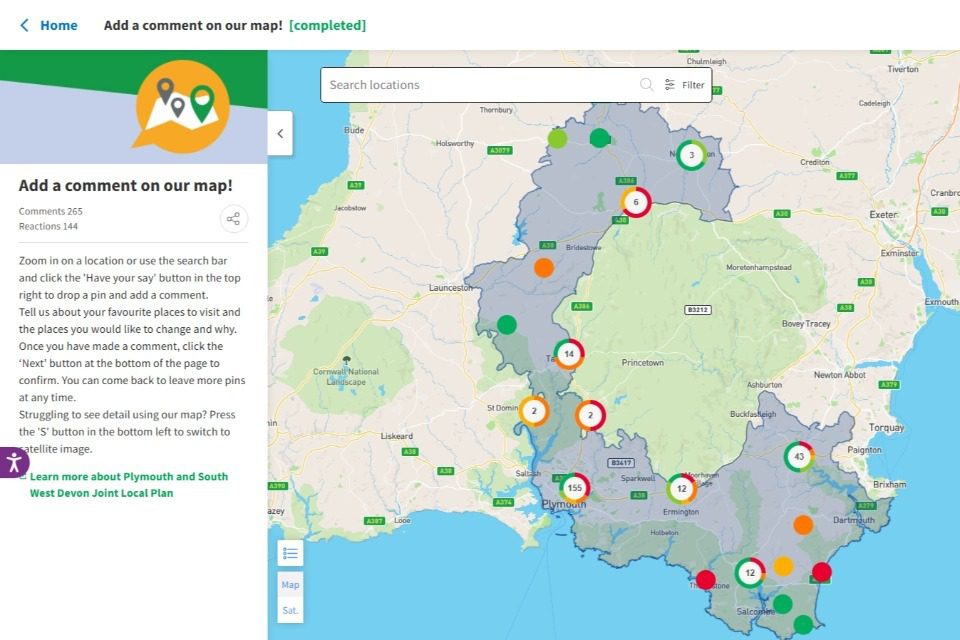
To address these issues, the councils partnered with Commonplace and City Science to redesign both consultation delivery and analysis. The consultation phase centred on a digital engagement platform featuring an interactive map. Residents could comment on specific locations, highlighting issues related to access to facilities, transport, open space and local priorities.
Survey design focused on plain language, short open-text responses and quick polls, supported by targeted communications, posters, drop-in events and paid social media. Crucially, live monitoring allowed officers to adapt communications during the consultation, supporting more responsive digital engagement in planning.
For analysis, the councils tested natural language processing (NLP) tagging and summarisation using Commonplace’s AI tools. Responses were categorised by theme, sentiment and location, supporting faster early-stage analysis. In parallel, City Science developed a benchmarking tool linking public sentiment to open data on access to services, enabling comparisons across locations. Power BI dashboards were used to visualise findings and produce a pilot interactive strategic planning consultation report.
The primary objective was to assess whether AI-assisted consultation analysis could reduce processing time and support earlier understanding of emerging planning issues.

Measurable outcomes and performance
The pilot delivered clear quantitative benefits. More than 1,400 residents participated, with engagement increasing in three out of four electoral wards compared with the previous consultation. Notably, 69% of participants had not taken part in a Joint Local Plan consultation before, indicating improved reach.
Ease of use was also a factor, with 75% of respondents stating that the survey was easy or very easy to complete. From an operational perspective, NLP testing delivered a 66% improvement in processing time, saving up to ten minutes per response. This enabled officers to produce initial high-level analysis within a week of the consultation closing.
However, challenges remain. Residents under 35 were still under-represented, and participation levels were lower in areas with higher deprivation, reflecting wider national trends in planning engagement.
Lessons for digital construction and planning teams
Several key lessons emerged from the pilot. Simple digital survey design proved effective in attracting first-time participants, while workshops and in-person events remained essential for reaching a broader demographic. AI-assisted tools demonstrated clear value in speeding up tagging and summarisation, but officer oversight was critical to ensure accuracy and context.
The councils also found that NLP models performed better when trained on local datasets, reinforcing the importance of place-specific data in planning analytics. Consistent data standards significantly increased the usefulness of benchmarking tools when developing planning strategies and evidence documents.
Overall, the pilot demonstrated early potential for AI in planning consultation analysis, while highlighting the ongoing need for transparency, governance and professional judgement.
Looking ahead
Plymouth, South Hams and West Devon plan to refine their NLP models and benchmarking approach ahead of future Joint Local Plan stages. Future work will expand training datasets, test AI summarisation on longer technical submissions and explore deeper integration with existing consultation platforms. Strengthening engagement with younger residents and aligning analytical methods with emerging planning data standards are also priorities.
Early results show that AI-supported consultation analysis can improve efficiency, transparency and evidence-led planning, while reinforcing the continuing need for inclusive engagement, strong governance and professional judgement.
Read next: Digital tools piloted to improve planning transparency – Build in Digital
Read next: Are you a building professional? Sign up for a FREE MEMBERSHIP to upload news stories, post job vacancies, and connect with colleagues on our secure social feed.