
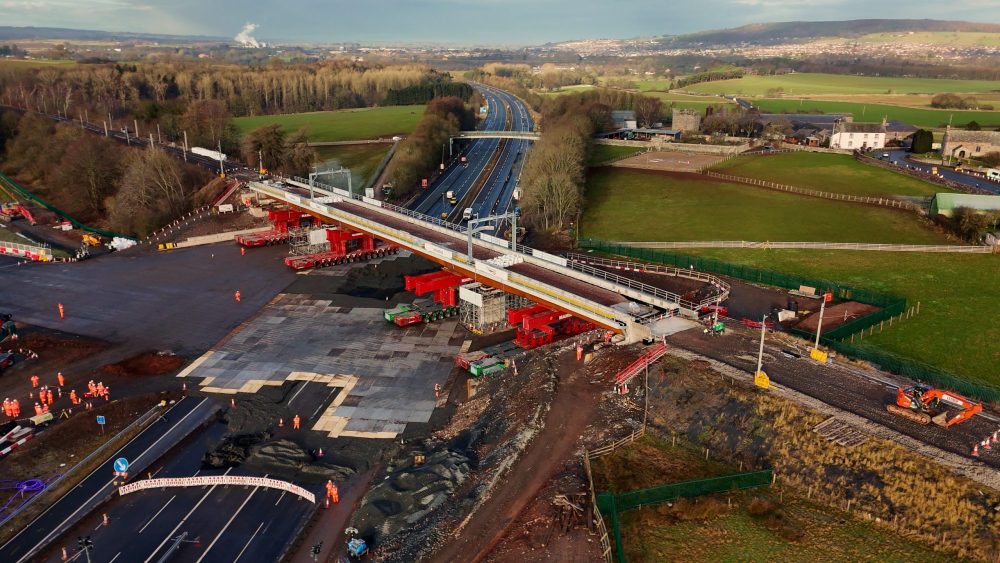
The early reopening of the M6 demonstrates how digital construction planning enables complex infrastructure delivery at national scale.
The M6 motorway through Cumbria reopened 13 hours earlier than planned following the successful installation of a new railway bridge near Penrith. The achievement highlights how advanced construction planning, offsite manufacturing, and collaborative digital delivery can reduce disruption on one of the UK’s busiest transport corridors.
The Clifton railway bridge replacement forms part of a £60 million Network Rail investment to future-proof the West Coast Main Line. Delivered by Network Rail and principal contractor Skanska, the project required two full weekend closures of the M6 between junctions 39 and 40, an unprecedented step reflecting the scale and complexity of the operation.
Millimetreaccuracy
On Saturday 10 January, the new 130-metre-long, 4,200-tonne bridge was manoeuvred into position with millimetre accuracy. The structure had been pre-built offsite and held nearby after the demolition of the existing bridge the previous weekend. Specialist self-propelled modular transporters, operating on more than 600 wheels, drove the structure into place over the motorway, a process captured in widely shared time-lapse footage.
From a digital construction perspective, the operation relied heavily on detailed modelling, logistics simulation, and sequencing. Preconstruction planning ensured that tolerances, loading, and movement paths were fully validated before the motorway closure began. This approach reduced on-site risk and enabled confident decision-making when progress exceeded expectations.
To facilitate the bridge installation, National Highways and Network Rail scheduled two consecutive 60-hour closures, selecting a period of historically lower traffic volumes. Approximately 48,000 vehicles use this section of the M6 daily, making minimisation of disruption a central project objective.
Despite sub-zero temperatures and challenging weather conditions, the work progressed faster than anticipated. The motorway reopened shortly before 4pm on Sunday 11 January, allowing diversion routes to be lifted significantly earlier than planned. During the previous weekend, both northbound and southbound carriageways had also reopened ahead of schedule.
Hard work
Christian Irwin OBE, Network Rail North West and Central region capital delivery director, said: “It’s a testament to the hard work of hundreds of people that we’ve been able to install this huge new structure both successfully and speedily. We’ve been in close contact with National Highways throughout so we could capitalise on that and get the M6 reopen over half a day ahead of schedule to alleviate pressure on local roads.”
He added: “I’d like to once again thank drivers for adhering to the road diversions, and also thank the local communities impacted by them this weekend, so we could carry out this vital work to secure journeys for both road and rail users in the future. Our focus now turns to final bridge checks before we reinstate the tracks, overhead power lines and signalling systems so we can fully reopen the West Coast Main Line.”
Steve Mason, National Highways programme delivery manager, emphasised the importance of long-term coordination and digital planning across organisations. “This is the first time in recent memory the M6 has been closed for whole weekends and follows years of careful planning with Network Rail,” he said. “This was an incredibly complex operation and reopening the M6 13 hours early is a tremendous achievement.”
He also highlighted the role of timing and data-led traffic management. “Some 48,000 vehicles use this section of the M6 daily but we chose a time of the year when traffic volumes are at their lowest. Despite severe weather conditions, the teams involved worked tirelessly to deliver this vital, one-in-a-lifetime project.”
Collaboration and reprioritisation
From a contractor perspective, collaboration and reprioritisation were key. Rosario Barcena, Skanska UK rail programme director, said: “Over the course of the weekend, we’ve worked closely with Network Rail and National Highways to re-prioritise our work so that we could re-open the motorway much earlier than planned.”
She continued: “It’s been achieved thanks to our whole team, including our supply chain partners. They’ve worked tirelessly across the weekend to successfully install the new Clifton railway bridge, a hugely complex and precise operation.”
With the bridge structure now in place, railway teams are completing final checks before reinstating track, reconnecting overhead line equipment, and reconfiguring signalling systems.
The Clifton bridge replacement is one element of a wider programme of digital rail and highway upgrades. Over the Christmas and New Year period, nearly £200 million has been invested along the West Coast Main Line, contributing to a £400 million programme planned over the next four years. These works demonstrate how modern construction methods, integrated data, and cross-industry collaboration can deliver safer, more reliable infrastructure with reduced impact on users.
The early M6 reopening illustrates how digital construction, offsite delivery, and collaborative planning can accelerate complex infrastructure projects while protecting network resilience and public confidence.
Read next: Moving a mountain in an innovative partnership – Build in Digital
Are you a building professional? Sign up for a FREE MEMBERSHIP to upload news stories, post job vacancies, and connect with colleagues on our secure social feed.
