
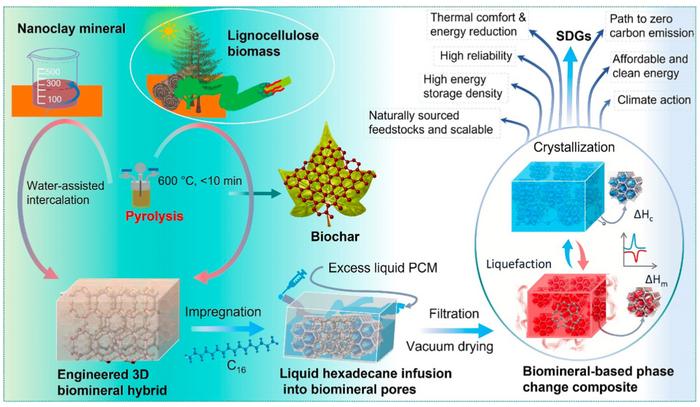
A research team at Yonsei University in South Korea has developed an engineered biochar–clay composite that functions as a thermal battery for buildings. Designed for use in digital construction and advanced building materials, the innovation stores and releases heat through a phase change process, helping stabilise indoor temperatures and reduce cooling energy demand.
The composite combines spruce-derived biochar with montmorillonite, a naturally occurring clay mineral, and is infused with hexadecane, a paraffin-based phase change material. Phase change materials for buildings absorb significant amounts of heat as they melt and release it as they solidify, enabling passive thermal energy storage within construction elements.
“By engineering a greener support framework for paraffin, we can capture more heat, move it more efficiently and do it with materials that come from biomass and earth minerals,” said lead author Dimberu G. Atinafu of Yonsei University.
A greener scaffold for phase change materials
Conventional phase change composites often rely on fossil-based or high-cost carbon materials, including graphene and carbon nanotubes, to stabilise molten paraffin and improve thermal conductivity. These materials can limit scalability and raise environmental concerns.
The Yonsei University team instead developed an engineered biomineral scaffold using lignocellulose-based biochar produced from waste spruce wood and modified montmorillonite clay. The clay was treated with an organic surfactant to expand its layered structure before being integrated into the biochar, forming a three-dimensional porous network.
This engineered biochar–mineral structure increased surface area by more than five times compared with untreated clay. The expanded pore network provides greater capacity for paraffin infiltration and crystallisation, improving both thermal energy storage and material stability. The approach aligns with circular economy construction materials principles by converting waste biomass into high-value building components.

Improved thermal energy storage and heat transfer
When infused with hexadecane under vacuum, the resulting composite, named EMBC16, demonstrated significantly improved performance compared with paraffin–clay systems without biochar. The material achieved latent heat storage values of up to 121.3 joules per gram, representing a 223 percent increase in thermal energy storage capacity over montmorillonite-only composites.
Thermal conductivity also increased by 78 percent relative to pure paraffin, enabling faster heat transfer during melting and solidification cycles. Repeated thermal testing between approximately 23 and 50 degrees Celsius showed strong durability, with EMBC16 retaining more than 95.9 percent of its latent heat capacity after 1,000 cycles and exhibiting less than 2.2 percent paraffin leakage. These characteristics are critical for long-term deployment of biochar thermal energy storage systems in buildings.
Building energy simulation demonstrates cooling savings
To assess real-world performance, the researchers used building energy simulation software to model the application of EMBC16 as an interior finishing material within a historic building in Seoul. Compared with bulk paraffin, walls incorporating the engineered composite reduced annual cooling energy consumption by approximately 54 percent. Cooling demand was also reduced by 24.3 percent compared with a baseline building without any phase change materials.
Laboratory thermal imaging further confirmed the composite’s performance. EMBC16 surfaces warmed more slowly than clay-based alternatives and cooled in a controlled manner, demonstrating both insulation and thermal buffering effects. These properties are particularly relevant for historic building retrofit projects, where passive cooling strategies must operate within material and conservation constraints.
Implications for scalable and circular construction materials
The use of waste-derived biochar and abundant clay minerals positions EMBC16 as a scalable solution for sustainable cooling materials in digital construction. However, the researchers note that current production methods rely on synthetic surfactants and water-intensive processing. Future work will focus on bio-based alternatives, such as plant-derived saponins, and closed-loop manufacturing systems to improve sustainability at scale.
“Biochar–mineral hybrids open a path to thermal materials that are not only high performing but also rooted in waste to resource thinking,” said corresponding author Sumin Kim. “These composites could help future buildings store daytime heat or coolth and release it when needed, reducing our reliance on active air conditioning systems.”
By integrating biochar mineral phase change materials into construction systems, digital construction can deliver scalable, circular, energy cooling solutions that support decarbonisation and long term building performance.
Read next: Revolutionising power grid stability – Build in Digital
Are you a building professional? Sign up for a FREE MEMBERSHIP to upload news stories, post job vacancies, and connect with colleagues on our secure social feed.
