
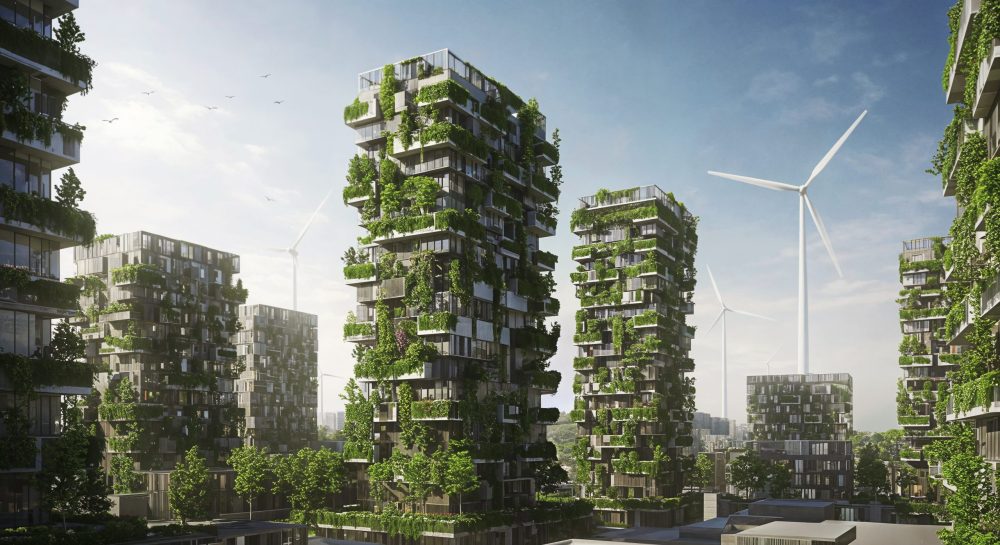
Digital twin analysis shows how early design decisions determine lifetime carbon emissions in commercial buildings worldwide.
Reducing carbon emissions across the built environment has become a priority for the global digital construction sector as buildings account for roughly one-third of worldwide energy consumption and associated CO₂ emissions. Heating, cooling and material production remain the largest contributors, particularly in regions experiencing rapid urban development.
A recent study published in Energy & Environment Nexus by a research team led by Yujing Yang at Shanxi University demonstrates how integrating Building Information Modelling (BIM) with life cycle assessment and digital twin modelling enables precise measurement of emissions across all stages of a building’s existence.
Using an office building in northern China as a case study, researchers developed a BIM-based Carbon Emission Estimation for Buildings (CEEB) framework capable of analysing emissions from material production, transportation, construction, operation, maintenance and demolition. This digital twin approach enables carbon impact assessments to be embedded directly into design workflows, allowing architects and engineers to evaluate low-carbon alternatives before construction begins.
Operational energy dominates building life cycle emissions
The study confirms that operational energy, particularly heating, overwhelmingly outweighs emissions from construction processes. According to the research team, “operation and maintenance overwhelmingly dominated total emissions (94.62%)”, highlighting the need to prioritise operational efficiency within building design strategies.
BIM-enabled energy modelling showed coal-based heating as the primary emission driver, with bituminous coal responsible for nearly 45% of operational emissions. Heating activities overall generated close to two-thirds of operational carbon output, reinforcing that energy systems selection strongly determines long-term building carbon performance.
Scenario analysis demonstrated that replacing coal-fired heating with ground-source heat pumps could reduce heating emissions by more than 50%, cutting total building life cycle emissions by almost 19%. In cold climate regions, this approach outperformed natural gas and air-source heat pump alternatives, presenting a practical decarbonisation pathway.

Material production and transport still present significant opportunities
Although operational energy dominated emissions, construction materials also contributed measurable carbon impacts. Steel production represented the largest share of embodied carbon, accounting for 46% of production emissions. Concrete and cement followed, contributing 29% and 21% respectively.
Transport logistics also revealed unexpected emission sources. Sand, despite having minimal production emissions, accounted for 40% of transport-related emissions due to its high transport volumes. Sensitivity modelling indicated that reducing delivery distances and switching to low-emission transport fleets could lower transport emissions by up to 73.9%.
These findings indicate that digital construction workflows integrating BIM carbon modelling can guide procurement strategies, support low-carbon material selection, and encourage local supply chain sourcing to reduce embodied carbon impacts.
BIM-driven design enables early carbon reduction decisions
The research underlines the importance of embedding carbon assessment at the design stage. By linking BIM models with life cycle carbon calculations, project teams can compare heating technologies, insulation performance, material efficiency and transport scenarios before construction begins.
This approach allows decision-makers to adopt renewable heating systems, improve building envelopes, reduce material quantities and source materials locally, ensuring measurable emission reductions throughout a building’s operational lifespan.
For digital construction professionals, digital twins and BIM-based life cycle assessment tools offer practical methods to align projects with decarbonisation targets while maintaining economic feasibility.
Embedding BIM-driven carbon analysis in digital construction workflows enables industry leaders to reduce operational emissions, optimise materials, and deliver measurable lifecycle decarbonisation across future projects globally today.
Read next: Neurodivergence: Unlocking talent & wellbeing in tech-driven roles – Build in Digital
Are you a building professional? Sign up for a FREE MEMBERSHIP to upload news stories, post job vacancies, and connect with colleagues on our secure social feed.
