
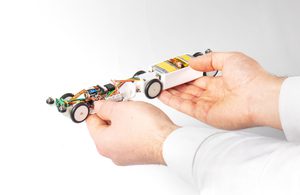
AI-trained robotic inspection technology is set to transform infrastructure monitoring inside the Large Hadron Collider beamline network.
A collaboration between the UK Atomic Energy Authority (UKAEA) and CERN has been recognised with a ‘Highly Commended’ distinction at the The Engineer Collaborate to Innovate Awards for developing a compact autonomous robot designed to inspect the Large Hadron Collider (LHC).
The project demonstrates how robotics, artificial intelligence, and remote inspection technologies are addressing complex operational challenges in highly constrained infrastructure environments. The mouse-sized robot, named PipeINEER, represents a new approach to infrastructure inspection within the world’s largest particle accelerator.
Autonomous robotic inspection inside the Large Hadron Collider
PipeINEER – a portmanteau of Pipe and Pioneer – is a 3.7cm-wide autonomous robotic inspection device designed to travel through narrow beamline pipes within the 27-kilometre LHC tunnel system. The accelerator, located near Geneva on the French–Swiss border, is the most powerful particle accelerator in operation and has enabled discoveries including the identification of the Higgs boson.
Within the collider, particles move through beamlines maintained under ultra-high-vacuum conditions and surrounded by superconducting magnets operating at approximately –271°C. These extreme conditions make manual inspection extremely complex and time-intensive.
To address these constraints, CERN partnered with UKAEA’s robotics centre Remote Applications in Challenging Environments (RACE), which specialises in robotic systems designed for hazardous and inaccessible environments.
Nick Sykes, Director of RACE at the UKAEA, said: “This award highlights the power of international collaboration, bringing together UKAEA and CERN alongside the wider global scientific community.
“We’re proud to apply our robotics expertise from fusion energy to support CERN’s world leading experiments. By combining our remote handling experience with CERN’s scientific excellence, we’re helping ensure the Large Hadron Collider operates safely and efficiently for years to come.”

AI-enabled beamline inspection technology
Inside the LHC infrastructure, the beamline system includes approximately 2,000 Plug-In Modules (PIMs), which accommodate thermal expansion and contraction caused by extreme temperature variations. Over time, components such as Radio Frequency (RF) fingers can deform slightly due to repeated thermal cycling.
Even minimal deformation can create obstructions within the beamline, interrupting particle experiments and requiring significant maintenance intervention.
PipeINEER has been engineered as a solution to this challenge. The robot measures around 20 centimetres in length and can navigate confined spaces measuring just 3.7 by 3.7 centimetres. Unlike traditional pipe inspection tools, the device can travel autonomously for up to six kilometres on battery power during a single mission.
As it moves through the beamline network, PipeINEER captures detailed images of each PIM module. Artificial intelligence trained on real LHC inspection imagery analyses the data to detect abnormalities and identify potential structural issues. The robot incorporates energy-efficient electronics and integrated monitoring systems to support long autonomous inspection runs.
If a fault is detected, the robot returns to its starting point and reports the precise location of the issue. This targeted maintenance approach reduces the need for large-scale disassembly and manual endoscopic inspection of beamline sections, a process that can otherwise require extensive downtime and operational costs.
Dr Giuseppe Bregliozzi, Beam Vacuum Operation Section Leader at CERN, said: “PipeINEER will transform how we inspect and maintain the LHC. It marks a major step forward in keeping our experiments running smoothly.”
Testing autonomous robotics for critical infrastructure environments
The PipeINEER robotic inspection system is currently in development, with extensive operational testing planned during 2026. The robots are expected to complete more than 60 kilometres of testing runs to validate navigation, imaging and AI-based anomaly detection capabilities.
Following these trials, final production units are scheduled to be manufactured in late 2026, with CERN operators expected to begin training on the new robotic inspection platform in early 2027.
The project illustrates the growing role of autonomous robotics, AI-driven inspection systems, and remote handling technologies in maintaining complex scientific and industrial infrastructure.
PipeINEER demonstrates how robotics, artificial intelligence and international collaboration can deliver practical infrastructure inspection solutions, supporting the safe, efficient operation of the Large Hadron Collider.
Read next: Accelerate breakthroughs in AI research lab – Build in Digital
Are you a building professional? Sign up for a FREE MEMBERSHIP to upload news stories, post job vacancies, and connect with colleagues on our secure social feed.
