
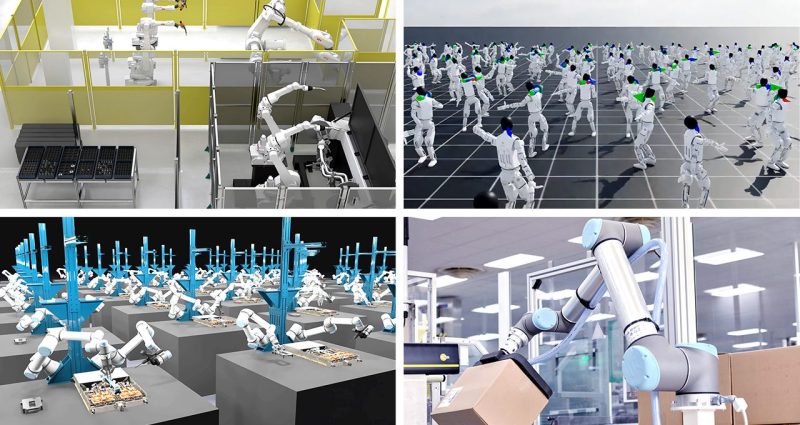
Strategic partnerships are accelerating physical AI adoption across robotics, construction, manufacturing and infrastructure sectors globally.
Strategic ecosystem partnerships are redefining how platform integrations translate into measurable industrial outcomes. From high-precision electronics assembly to autonomous construction deployment and AI-driven automation, the robotics landscape is entering a new phase shaped by scalable, production-ready physical AI systems.
NVIDIA have announced a series of collaborations with global robotics leaders, alongside new simulation frameworks and open models designed to accelerate the development, training and deployment of intelligent machines. These developments carry significant implications for the digital construction sector, where automation, digital twins and AI-driven workflows are increasingly central to project delivery.
NVIDIA’s physical AI platform and robotics ecosystem
The expansion of NVIDIA’s robotics ecosystem reflects a strategic alignment between software, hardware and AI model development. Industry leaders including ABB Robotics, FANUC, KUKA and YASKAWA are building on NVIDIA’s full-stack platform to enable production-scale deployment of robotics systems.
Jensen Huang, CEO of NVIDIA, emphasised the scale of transformation underway: “Physical AI has arrived, every industrial company will become a robotics company. NVIDIA’s full-stack platform, spanning computing, open models and software frameworks, is the foundation for the robotics industry, uniting a worldwide ecosystem to build the intelligent machines that will power the next generation of factories, logistics, transportation and infrastructure.”
For digital construction, this convergence signals a shift toward integrated robotics platforms capable of supporting autonomous site operations, predictive maintenance and real-time decision-making.
Digital twins and AI simulation in industrial robotics
As robotics systems become increasingly AI-driven, the demand for high-fidelity simulation environments is growing. Manufacturers require physically accurate digital twins to design, test and optimise systems prior to deployment.
Companies such as FANUC, ABB Robotics, KUKA and YASKAWA are integrating NVIDIA Omniverse libraries and Isaac simulation frameworks into their virtual commissioning workflows. These technologies enable full production lines to be simulated with physics-based accuracy, reducing risk and improving operational efficiency.
In digital construction, similar methodologies are being applied to simulate construction sites, validate autonomous equipment behaviour and optimise workflows before physical execution. The use of digital twins in construction robotics supports improved safety, reduced rework and enhanced project predictability.
Building generalised robot intelligence
Robotics is evolving beyond task-specific automation toward generalist systems capable of adapting to multiple environments. This shift is underpinned by the development of “robot brains” that integrate perception, reasoning and action.
Developers such as FieldAI and Skild AI are leveraging NVIDIA Cosmos world models and Isaac simulation frameworks to train robots using synthetic data and simulation-based validation. These systems allow robots to learn new tasks with minimal retraining, significantly improving scalability.
The introduction of Cosmos 3, described as the first world foundation model combining synthetic world generation, vision reasoning and action simulation, represents a step forward in generalised robot intelligence. For construction, this enables autonomous systems that can adapt to dynamic site conditions, variable materials and evolving project requirements.

Advancing humanoid robotics for construction and industry
Humanoid robotics remains one of the most complex areas of development, requiring integration of AI, perception systems and real-time control. NVIDIA’s ecosystem includes companies such as Agility Robotics, Boston Dynamics and Figure, all working toward deployable humanoid systems.
New tools including Isaac Lab 3.0 and GR00T foundation models are accelerating development cycles. These platforms enable large-scale robot learning, dexterous manipulation and improved performance in complex environments.
For the construction sector, humanoid robots present opportunities in labour-intensive tasks, hazardous environments and precision assembly. Their ability to operate in human-designed spaces without requiring infrastructure changes makes them particularly relevant for retrofit and maintenance projects.
AI-powered automation for manufacturing and construction supply chains
Strategic partnerships are already delivering measurable outcomes across manufacturing and supply chain operations. Skild AI’s collaboration with ABB Robotics and Universal Robots is enabling deployment of generalised robot intelligence across multiple industries.
In parallel, companies such as Foxconn are applying AI-driven robotics for high-precision electronics assembly, while Samsung is leveraging simulation tools to improve assembly line efficiency.
For construction, these advancements extend into offsite manufacturing, modular construction and logistics. Automated production lines, AI-driven quality control and robotic material handling are becoming integral to modern construction supply chains.
Cloud integration and scalable robotics development
Cloud platforms are playing a critical role in scaling robotics development. Integrations with Microsoft Azure, Alibaba Cloud and other providers enable access to synthetic data generation, simulation environments and AI training pipelines.
This cloud-enabled approach allows engineering teams to develop, test and deploy robotics solutions at scale. For digital construction, it supports collaborative workflows, remote monitoring and integration with Building Information Modelling (BIM) systems.
The ability to connect robotics platforms with cloud-based digital construction tools enhances interoperability, enabling seamless data exchange between design, simulation and execution phases.
Open ecosystems and startup innovation
NVIDIA’s approach includes fostering innovation through open ecosystems and startup support. The NVIDIA Inception programme provides robotics startups with access to computing resources, technical expertise and industry partnerships.
With over 40,000 members, the programme supports companies developing next-generation robotics solutions across industries, including construction. Additionally, collaboration with Hugging Face integrates robotics frameworks into open-source ecosystems, expanding access for developers worldwide.
This democratisation of physical AI tools is expected to accelerate innovation in construction robotics, enabling smaller firms to adopt advanced automation technologies without extensive in-house development.
Implications for the digital construction sector
The integration of physical AI, robotics and digital twins is reshaping how construction projects are planned and delivered. Key implications include:
- Increased adoption of autonomous construction equipment
- Expansion of offsite manufacturing and robotic assembly
- Enhanced safety through predictive and simulation-based planning
- Improved productivity through AI-driven workflows
- Greater scalability of automation across projects of varying sizes
As robotics platforms become more accessible and adaptable, construction firms can implement automation strategies aligned with project-specific requirements.
NVIDIA’s ecosystem strategy demonstrates how integrated physical AI platforms can scale robotics adoption, enabling digital construction to transition from experimental automation toward consistent, production-ready deployment across projects.
Read next: £2 Billion for quantum innovation – Build in Digital
Are you a building professional? Sign up for a FREE MEMBERSHIP to upload news stories, post job vacancies, and connect with colleagues on our secure social feed.
