
As the global construction industry faces mounting pressure to reduce carbon emissions and improve energy efficiency, researchers are increasingly exploring how traditional materials can play new roles in the transition to net zero.
Cement, one of the most widely used building materials on the planet, is now being reimagined not just as a structural material, but as an active energy generator. A recent comprehensive review by researchers from Shenzhen University, led by Prof. Chunyu Du and Prof. Guangming Chen, explores the fast-evolving field of cement-based thermoelectric materials (CTEMs) and their potential applications across smart buildings, energy harvesting systems, and structural health monitoring.
This research provides an important roadmap for how thermoelectric cement could transform the built environment by turning passive structures into active, energy-harvesting assets.
Why cement-based thermoelectric materials matter
Cement-based thermoelectric materials (CTEMs) can generate electricity from temperature differences, a property that has enormous implications for the digital construction and smart infrastructure sectors. By converting waste heat into usable energy, CTEMs could help power self-sustaining buildings, smart pavements, and low-energy monitoring devices, supporting the transition toward zero-energy infrastructure.
- Energy harvesting: CTEMs capture waste heat from buildings, pavements, and industrial structures and convert it into electrical energy. This could significantly reduce reliance on external power sources while supporting the wider goals of carbon neutrality.
- Self-powered sensing: With inherent thermoelectric properties, CTEMs enable real-time structural health monitoring without external batteries or wiring—crucial for long-term infrastructure management.
- Carbon reduction: By integrating thermoelectric fillers into cement, CTEMs promote low-carbon construction and contribute to the development of sustainable urban environments.
Innovative design and performance enhancements
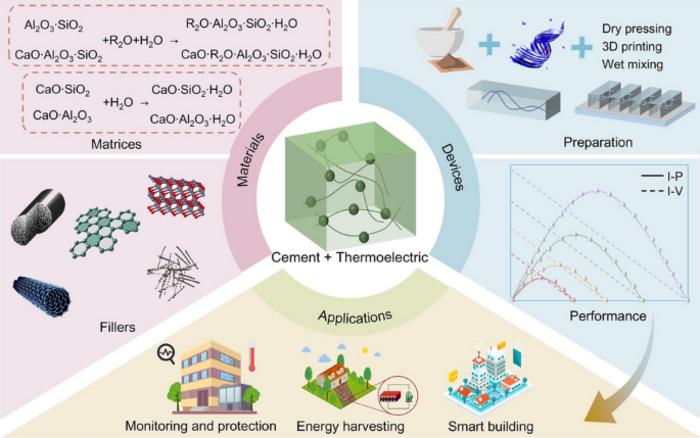
The review categorises CTEMs according to both their filler materials, such as carbon-based compounds, metal oxides, and composites, and their cementitious matrices, which include ordinary Portland cement, geopolymer, and alkali-activated cement. Each combination is engineered to improve the material’s Seebeck coefficient, electrical conductivity, and thermoelectric figure of merit (ZT).
Advanced optimisation strategies, such as defect engineering, interfacial design, and ionic–electronic mixed conduction, are being employed to enhance thermoelectric efficiency and ensure compatibility with large-scale construction processes. The research also highlights scalable fabrication techniques, including dry pressing, wet mixing, and 3D printing, as key enablers for practical thermoelectric device fabrication.
Smart applications for the built environment
The potential applications for cement-based thermoelectric materials extend across multiple sectors of the digital built environment:
- Structural monitoring: CTEMs can detect temperature gradients and mechanical strain, enabling continuous, non-destructive evaluation of infrastructure performance.
- Energy harvesting: Embedded within roads, bridges, or building facades, CTEMs can capture solar and ambient heat to generate power for low-energy electronics or wireless sensors.
- Smart buildings: Integrated within building management systems, CTEMs can support adaptive thermal regulation and energy-efficient building design, creating intelligent structures capable of responding to environmental changes in real time.
Challenges and future opportunities
While promising, CTEMs face technical challenges related to material compatibility, device stability, and cost-effectiveness. The review identifies the need for multiscale modelling, standardised testing, and application-specific design to accelerate real-world adoption.
With continued interdisciplinary research bridging materials science, civil engineering, and energy technology, cement-based thermoelectric materials could become a cornerstone of sustainable smart infrastructure.
Powering tomorrow’s infrastructure
This groundbreaking review underscores the transformative potential of thermoelectric cement in redefining how buildings and infrastructure interact with their environment. By turning everyday materials into energy-harvesting systems, cement-based thermoelectric technologies represent a pivotal step toward intelligent, net-zero construction, a future where structures do more than just stand; they actively contribute to a cleaner, more resilient world.
Read next: Global construction carbon footprint set to double by 2050 – Build in Digital
Are you a building professional? Sign up for a FREE MEMBERSHIP to upload news stories, post job vacancies, and connect with colleagues on our secure social feed.

