
Robotics innovation at Sellafield is reshaping digital construction safety across complex nuclear decommissioning environments.
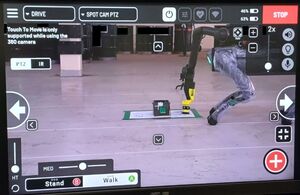
Sellafield Ltd has completed the first operational trial of a contamination swabbing tool mounted on a quadruped robot, marking a significant development in robotics for nuclear decommissioning and digital construction safety management. The deployment demonstrates how robotics, AI and remote systems can modernise hazardous inspection processes while supporting safer infrastructure management across complex sites.
The trial was delivered through collaboration with the Robotics & AI Collaboration (RAICo), which focuses on accelerating robotic and AI deployment across nuclear decommissioning and fusion engineering programmes throughout the UK.
Robotics and AI supporting nuclear decommissioning operations
Routine contamination swabbing remains essential across the Sellafield site, where health physics teams carry out hundreds of tests daily to monitor radiation levels. Circular paper filters are used to gather samples across multiple surfaces, generating data that guides decommissioning planning and ensures regulatory compliance.
Traditionally, these tasks require personnel to operate within contaminated areas. The newly trialled quadruped robot contamination swabbing solution demonstrates how remote robotics can reduce human exposure while maintaining operational accuracy.
Developed through RAICo’s partnership network, including the UK Atomic Energy Authority, Nuclear Decommissioning Authority (NDA), Sellafield Ltd, University of Manchester and AWE Nuclear Security Technologies, the patent-pending tool replicates the complex non-linear swabbing motion normally performed manually.
An off-the-shelf haptic controller from Haply Robotics, combined with RAICo-developed software, enables operators to translate real-time hand movements into commands for Boston Dynamics’ Spot robot manipulator, ensuring precise contamination sample collection.

Quadruped robot trial demonstrates remote inspection capability
Sellafield’s Remote Technologies Group, responsible for evaluating and deploying robotics and AI solutions, planned and delivered the controlled deployment.
During testing, Spot entered a restricted zone to inspect a simulated radiological spill and collected a swab sample from a mock contaminated surface. Blue chalk simulated contamination, and the robot successfully retrieved a sample using the robotic swabbing attachment.
The outcome confirms that contamination monitoring processes — traditionally performed manually — can be conducted remotely without compromising safety or data reliability, supporting digital construction and asset management strategies in hazardous environments.
Collaboration driving robotics deployment
Deon Bulman, ROV Equipment Programme Lead within Sellafield Ltd’s Remote Technologies Group, explained the operational significance: “Demonstrating a quadruped robot capable of remotely deploying swabbing equipment represents the significant opportunity we have to improve both safety and efficiency for nuclear decommissioning here at Sellafield.
“The quadruped’s agility and stability allow it to access areas that are hazardous for personnel, while intuitive haptic feedback provides precise, human-like manipulation, reducing task time and increasing confidence in the samples collected.
Together, these capabilities support faster, safer, and more cost-effective decommissioning operations while pushing forward the adoption of advanced robotics in the nuclear sector.”
Dr Kirsty Hewitson, Director of RAICo, emphasised the importance of cross-sector collaboration: “This deployment is a perfect example of how collaboration between RAICo partners generates significant benefits for end users in the nuclear sector… By working as a single, integrated team, we are all avoiding duplication and together we are delivering greater value from the public investment of taxpayer money.”
Transforming infrastructure risk management
The Sellafield deployment follows a successful inactive trial earlier in 2025 at the Joint European Torus (JET) facility in Culham, suggesting applications across both nuclear decommissioning and fusion engineering environments.
For the digital construction sector, this advancement signals wider adoption of robotics, AI-driven inspection systems and unmanned asset management tools across infrastructure projects where safety, compliance and operational efficiency remain priorities.
As robotics increasingly supports remote monitoring and maintenance, digital construction programmes stand to benefit from improved safety outcomes, enhanced data collection and reduced operational disruption.
Read next: Destination Earth’s digital twin for climate intelligence – Build in Digital
Are you a building professional? Sign up for a FREE MEMBERSHIP to upload news stories, post job vacancies, and connect with colleagues on our secure social feed.
