

By David Shepherd, Product Manager (Data & Construction Programme Enablers)
Part 1
When UK construction looks back at its 20th century digital achievements, BS 1192 and CI/SfB should get top billing.
In 1961, the RIBA introduced CI/SfB (Construction Industry Specification for Building), which was based on the Swedish SfB scheme. It provided an early, common language for organising construction information. When compared to today’s Uniclass specifications, it was primitive. Yet, it was a decisive and widely adopted method for cataloguing drawings, specs and product literature across practices and manufacturers. It established the cultural foundation for classification and reuse that Uniclass later refined.

Figure 1- CI/SfB classification coding.
BS 1192:1984 was comprised of four parts which focused on “recommendations for construction drawing practice.” However, in 1997, the development of CAD technology enabled the addition of a fifth part which provided “guidance and information on the structuring and exchange of data between CAD systems…to create 2D or 3D geometric models of construction projects in conjunction with the preparation of drawings.”
Ten years later, BS 1192:2007 then addressed the collaborative production of information with practical guidance on a common data environment (CDE), status codes, and drawing/model conventions that teams could follow immediately.
Crucially, this was more than theory: the Avanti programme embedded BS 1192 principles on real projects, and Heathrow Terminal 5 became the flagship demonstration of integrated working and relational contracting. T5’s bespoke “T5 Agreement” aligned incentives across more than a thousand work packages, co‑locating teams and using shared information to manage risk.

This social proof of value mattered because it drove the widespread embedding of those standards in CAD/BIM tools both nationally and internationally. It also established that coordinated digital information reduces rework, accelerates decisions and de‑risks delivery.
In parallel, the 2011 Government Construction Strategy (GCS) set a cost‑reduction target of 15 – 20% and one of the measures it introduced was the UK BIM Mandate for fully collaborative BIM on all centrally procured projects by 2016.
Earlier that year, the BIM Working Party Strategy Paper explicitly advocated a “push‑pull” approach: push supply‑chain capability while pulling through client requirements for structured deliverables such as COBie (Construction-Operations Building Information Exchange).
However, there was only a partial implementation of the five‑stage change programme and the Step 1 on‑ramp (“start using the new process documents and contracts to deliver COBie data drops via a basic but secure collaboration service”).
The assumption that Tier 1s would naturally coordinate and federate structured data from lower supply chain tiers proved overly optimistic.
If we look at the most influential work on technology adoption (Geoffrey A. Moore’s Crossing the Chasm) the late majority (see diagram), representing a third of any market, adopts innovation only under extremely specific conditions. Their posture is fundamentally conservative: they wait for solutions that are mature, proven, and turnkey. Their primary motivators are peer pressure and social proof, not conceptual clarity.
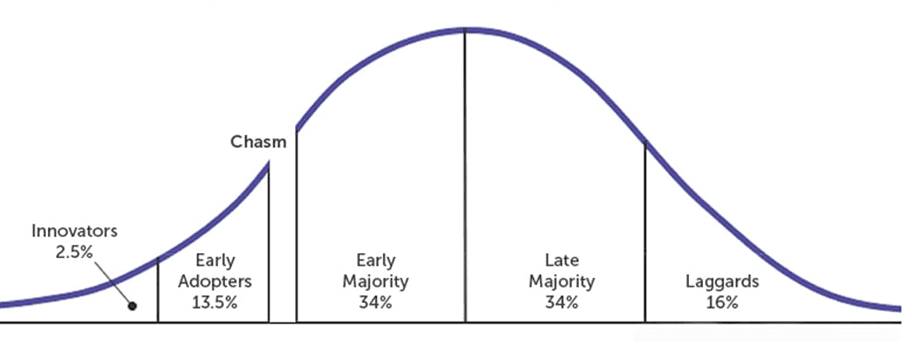
Figure 2- Diffusion of Innovation Curve
As Geoffrey Moore might have predicted, Tier 1s behaved like early adopters/early majority, but the lower tiers (i.e., the late majority) lacked the social proof and clear path‑to‑value needed to cross the chasm. For SMEs (small to medium-sized enterprises), completing BIM-related items in Pre-Qualification Questionnaires (PQQs) often amounted to a ‘tick-box exercise’. Understandably, even for those SMEs that did gain BIM certifications, procurement was rightly more focused on their tried‑and‑tested craft expertise, rather than their digital experience.
In 2013, PAS 1192 was published and it paid open homage to the Toyota Production System. For example, it explicitly emphasised the importance of cutting waste, reducing time spent waiting/searching for information, avoiding over‑production and over‑processing, and preventing defects through better coordination of graphical and non‑graphical data.
However, in practice, doctrinaire implementations of that guidance often created their own forms of waste through overly detailed 3D models, creation of more sophisticated digital artefacts (e.g., ‘4D’, ‘5D’ and beyond) mainly to ‘showcase’ BIM; and heavily policed file‑naming where use of metadata would have provided a faster (and less contentious) method of information retrieval.
Read next: Embodied carbon calculations guide for BIM – Build in Digital
Are you a building professional? Sign up for a FREE MEMBERSHIP to upload news stories, post job vacancies, and connect with colleagues on our secure social feed.
