
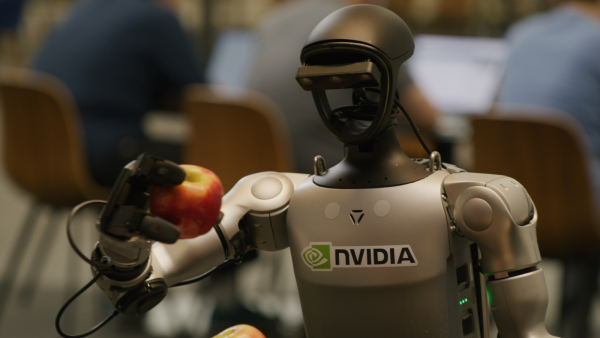
NVIDIA has unveiled a suite of powerful new tools set to redefine robotics research and development across sectors, from cutting-edge humanoid design to robotics simulation in construction. With the release of the open-source Newton Physics Engine, the Isaac GR00T foundation model, and the Cosmos world foundation models (WFMs), NVIDIA is building a unified ecosystem for what it calls physical AI, intelligent systems that can learn, reason and act in the real world.
These advancements are poised to transform how robotics researchers, developers, and construction innovators train, test, and deploy next-generation robots, both in simulation and on site.
A unified platform for accelerated robotics R&D
At the heart of NVIDIA’s announcement lies the open-source Newton Physics Engine, developed in collaboration with Google DeepMind and Disney Research, and now available in NVIDIA Isaac™ Lab. This GPU-accelerated simulation platform allows robotics researchers to model the physical world with unparalleled realism, an essential step toward teaching robots to operate safely and efficiently in complex environments.
Newton is designed to integrate seamlessly with NVIDIA Omniverse™, providing a shared foundation for digital twins, physics-based simulation, and AI-driven experimentation. For the digital construction sector, this offers enormous potential: enabling robots to be trained and validated in high-fidelity digital replicas of construction sites before being deployed in the field.
“Humanoids are the next frontier of physical AI, requiring the ability to reason, adapt and act safely in an unpredictable world,” said Rev Lebaredian, vice president of Omniverse and simulation technology at NVIDIA. “With these latest updates, developers now have the three computers to bring robots from research into everyday life, with Isaac GR00T serving as the robot’s brain, Newton simulating its body, and NVIDIA Omniverse as its training ground.”
Newton: a new standard in physical simulation
Humanoid and autonomous robots need to master fine-tuned movements, from balancing on uneven terrain to manipulating fragile materials. Traditional simulation engines struggle with these complexities, limiting the fidelity of virtual training.
Newton changes that. Built on the NVIDIA Warp and OpenUSD frameworks, it supports a flexible architecture capable of simulating intricate interactions such as walking through gravel, handling liquids, or manipulating tools. Its GPU acceleration enables large-scale simulations at higher speeds and accuracy, directly translating to more robust real-world performance.
Humanlike reasoning for robots: the Isaac GR00T model
While simulation is essential for training, true autonomy demands reasoning, the ability to understand instructions, interpret context, and act accordingly. Enter the NVIDIA Isaac GR00T N1.6 model, a foundation model designed to give robots humanlike cognitive capabilities.
Isaac GR00T N1.6 integrates NVIDIA Cosmos™ Reason, an open reasoning vision-language model built specifically for physical AI. This allows robots to interpret ambiguous commands and plan multi-step actions using common sense and prior knowledge,for instance, “stack those bricks neatly beside the scaffolding” or “pick up the screwdriver near the toolbox and hand it to me.”
Cosmos Reason, already downloaded over a million times and ranked top on the Hugging Face Physical Reasoning Leaderboard, can also curate and annotate data for model training, accelerating the creation of smarter, more generalisable robots. Available as an NVIDIA NIM™ microservice, it simplifies deployment across different platforms, from cloud systems to edge devices.
With GR00T, humanoid robots can now perform simultaneous movement and object manipulation, unlocking new capabilities for tasks that demand precision, such as opening heavy doors or assembling modular components on construction sites.
Cosmos WFMs: accelerating physical AI training at scale
Major updates have also been included into the NVIDIA Cosmos world foundation models (WFMs), which provide developers with the ability to generate vast and diverse datasets using text, image and video prompts.
The upcoming Cosmos Predict 2.5 model integrates multiple WFMs into a single, high-performance system capable of generating up to 30-second videos and multi-view camera outputs, perfect for simulating complex construction environments and workflows.
Meanwhile, Cosmos Transfer 2.5 delivers photorealistic synthetic data from 3D simulation scenes at 3.5x higher efficiency than previous versions. These tools dramatically reduce the cost and time of training physical AI models, allowing developers to iterate at unprecedented speed.
By integrating synthetic data generation into digital twin environments, construction firms and robotics researchers can create more robust datasets for teaching autonomous systems how to interact with the built environment, from material handling to equipment navigation.


Teaching robots to grasp: a new dexterous workflow
Grasping and manipulating objects remains one of robotics’ toughest challenges. NVIDIA’s new dexterous grasping workflow in Isaac Lab 2.3, built on Omniverse, takes a curriculum-based approach: training multi-fingered robotic hands to master simple tasks before progressing to complex ones.
Through dynamic variation in parameters like gravity, friction, and object weight, robots learn to adapt to unpredictable conditions, a key requirement for real-world deployment in construction or manufacturing.
This workflow has already been used by Boston Dynamics’ Atlas robots to improve their manipulation capabilities. Similar techniques could be applied to construction robots, enabling them to handle tools, sort materials, or interact safely alongside human workers.
Evaluating learned skills in simulation
Training is only half the journey, evaluation ensures reliability. NVIDIA and simulation engine company Lightwheel are codeveloping Isaac Lab – Arena, an open-source policy evaluation framework designed for large-scale, standardised testing of robotic skills.
For robotics developers, this eliminates the need to build bespoke testing environments. For the construction sector, it offers the ability to assess autonomous systems in diverse virtual site conditions, ensuring safety and performance before deployment on live projects.
AI infrastructure for next-generation robotics
NVIDIA’s push into physical AI is supported by a robust hardware backbone purpose-built for high-performance robotics workloads:
- NVIDIA GB200 NVL72: a rack-scale system combining 36 Grace CPUs and 72 Blackwell GPUs, designed for large-scale AI training and reasoning.
- NVIDIA RTX PRO™ Servers: a unified platform for training, simulation, and synthetic data generation, already adopted by the RAI Institute.
- NVIDIA Jetson Thor™: powered by the Blackwell GPU, it enables real-time, on-robot inference, essential for humanoid robots and other autonomous systems requiring instant decision-making on site.
Together, these systems bridge the gap between cloud-based training and real-world robotics deployment, supporting distributed and collaborative development across industries.
The future of physical AI in construction robotics
As the boundaries between digital simulation and physical performance continue to blur, NVIDIA’s latest ecosystem positions it at the forefront of robotics innovation.
For the digital construction sector, these technologies open new pathways for integrating AI robotics, digital twins, and autonomous systems into project delivery. Whether through robots trained to assemble prefabricated components, inspect structures, or assist workers on site, the combination of simulation, reasoning, and real-time inference will underpin the next phase of intelligent automation in the built environment.
By standardising robotics simulation, accelerating model development, and enabling seamless transfer from virtual to real-world applications, NVIDIA’s open ecosystem sets the stage for an era where robots are not only capable, but adaptable, safe, and construction-ready.
Read next: Modular techniques deliver speed and precision – Build in Digital
Are you a building professional? Sign up for a FREE MEMBERSHIP to upload news stories, post job vacancies, and connect with colleagues on our secure social feed.