
A new AI framework enables automated conversion of paper drawings into accurate 3D BIM models.
The development of digital twin technology in construction increasingly depends on accurate, scalable data capture. A persistent barrier across the built environment sector has been the reliance on legacy documentation, where existing buildings are recorded only through scanned or paper-based engineering drawings. These non-digital records limit the creation of reliable digital twin city systems and slow progress in smart city construction.
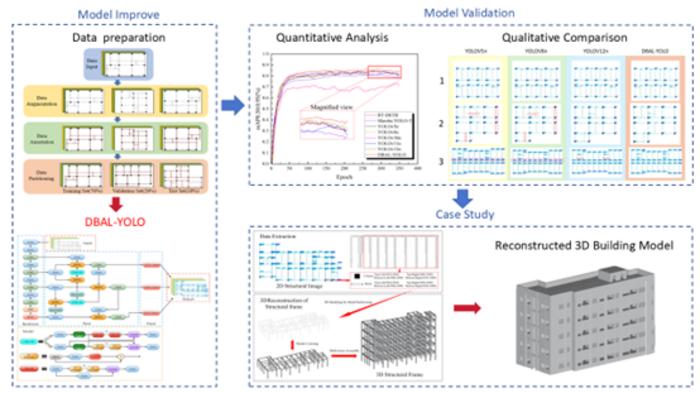
A newly developed deep learning framework, DBAL-YOLO, addresses this constraint by enabling automated BIM modelling from non-digital engineering drawings. Designed to convert 2D drawings directly into 3D Building Information Models (BIM), the system removes the need for manual modelling workflows, improving both speed and accuracy in digital reconstruction.
“Efficient 3D modelling technologies for existing buildings are critical for digital twin systems,” explain the researchers from the Suzhou University of Science and Technology, China. “Our goal was to create a solution that could ‘read’ complex engineering drawings and build a 3D model automatically, without relying on traditional modelling software.”
Deep learning for engineering drawing recognition
At the core of the framework is DBAL-YOLO, an enhanced version of the YOLOv11n architecture, optimised for detecting structural elements within dense engineering drawings. Conventional object detection models often fail to identify narrow and elongated features such as beams and columns. This limitation is addressed through the integration of Dynamic Snake Convolution (DSConv), which improves sensitivity to linear geometries.
The framework also incorporates a Bidirectional Feature Pyramid Network (BiFPN), enabling multi-scale feature fusion and improving detection consistency across varying drawing resolutions. An attention mechanism combined with a lightweight asymmetric detection head further enhances performance while reducing computational overhead.
Testing on a dataset of 3,960 annotated engineering drawings demonstrated strong results, with 98.8% detection precision and 98.3% recall. These metrics position DBAL-YOLO as a high-accuracy solution for AI-based engineering drawing recognition and automated BIM generation.

OCR and geometric correction for BIM accuracy
Beyond object detection, the framework integrates Optical Character Recognition (OCR) to extract dimensional data embedded within drawings. This enables automated alignment of detected components with standard architectural modules, correcting distortions introduced through scanning or inconsistent source material.
The reconstruction pipeline is completed using a Python-based engine that combines structural detection outputs with wall segmentation derived from a U-Net model. This process produces complete and consistent 3D building models directly from 2D pixel data.
“This framework operates independently of commercial BIM software,” note the researchers. “It directly generates 3D solids from 2D pixel data, streamlining the workflow for urban renewal and facility management.”
Digital twin applications in smart cities
The implications for digital twin construction and smart city infrastructure are significant. By enabling rapid digitisation of legacy building stock, DBAL-YOLO supports the integration of older assets into digital twin platforms. This enhances capabilities in urban planning, infrastructure monitoring, and predictive maintenance.
The research was published in Smart Construction (ISSN: 2960-2033), a peer-reviewed open access journal focused on intelligent construction, operation, and maintenance across engineering and applied research domains.
DBAL-YOLO demonstrates how AI-driven BIM automation can transform legacy data into actionable digital twin assets, supporting scalable smart city construction, improved infrastructure management, and more reliable urban resilience strategies.
Read next: Close the gap: Business picture to industry picture – Build in Digital
Are you a building professional? Sign up for a FREE MEMBERSHIP to upload news stories, post job vacancies, and connect with colleagues on our secure social feed.
