
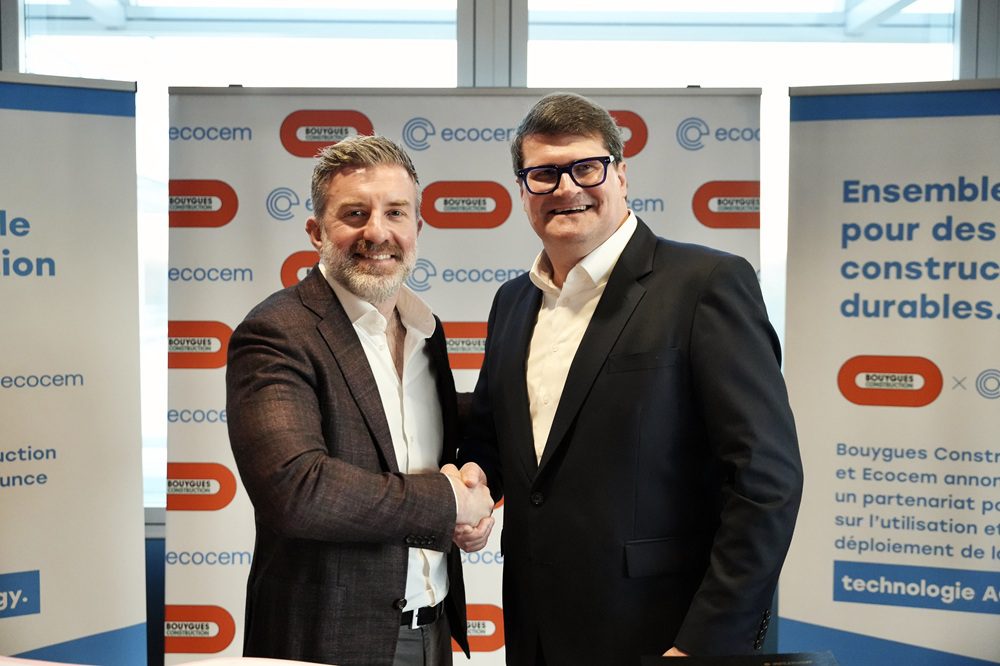
Bouygues Construction and Ecocem have signed a global innovation partnership involving the latter’s scalable low-carbon cement technology.
This partnership marks a pivotal step in both companies’ shared commitment to significantly reducing the carbon footprint of construction projects.
Following thorough laboratory and rigorous full-scale testing by Bouygues Construction’s R&D and innovation team in collaboration with Ecocem, the goal is to advocate and facilitate the use of Ecocem’s ACT cement technology in the construction firm’s projects.
Edward Woods, head of R&D and innovation at Bouygues Construction, said “We are committed to making construction sustainable and less resource-intensive. Any low carbon solution deployed by Bouygues Construction must deliver the required concrete performance, using standard working practice, and must be globally scalable and cost efficient.
“Together with Ecocem, we share a focus on and commitment to innovation and finding scalable solutions that drive down emissions at speed. Validating ACT technology in a variety of applications and conditions, with the ambition of incorporating it into our projects is an integral part of Bouygues Construction’s R&D and Innovation team’s remit in tandem with Bouygues Construction’s procurement department.”

The partnership is focused on three key areas designed to independently test, evaluate and validate Ecocem’s ACT technology:
- Independent laboratory testing: Bouygues Construction will conduct a comprehensive testing program at its COFRAC (French Committee for Accreditation) accredited Materials Engineering Lab (Laboratoire Ingénierie Matériaux) to evaluate the performance of ACT technology under laboratory conditions
- Initial full scale field testing: Structural concrete walls will be built at Bouygues Construction’s Scale One facilities in Chilly-Mazarin, France, during both winter and summer conditions, starting in early 2025. The walls will be monitored using instrumentation to ensure thorough testing on all aspects of preparation, handling, pouring, maturity measurements, and early formwork removal of the concrete. The process will be overseen by Bouygues Construction’s on-site production team and the Materials Engineering Lab
- Full-scale mock-up construction: After successful initial full-scale field testing, a full-scale model, including all structural components (slabs, walls, columns, beams), will be constructed by Scale One under typical site conditions. This will allow for full evaluation of the in-situ use of ACT technology, in parallel with the completion of the ACT technology certification process by Ecocem
Bouygues Construction’s Scale One is a facility designed to accelerate the environmental and digital transformation of the construction industry. Located in Chilly-Mazarin, near Paris, it provides a space where new construction materials, equipment, methods, and technologies can be tested under real-life conditions
The facility features test zones, a works team, and storage facilities, allowing innovators to validate new solutions more quickly. It includes roughly 2,500 m² of testing, co-working, and creative spaces, encouraging collaboration among companies, academics, and research institutes.
ACT, meanwhile, is a propriety technology that uses a specific blend of mineral, and some chemical admixtures combined with a particular particle size distribution design. Ecocem says it can be produced at almost all existing cement plants without significant investment or modifications and requires no change to working practices on the job site.
Conor O’Riain, Ecocem’s managing director for Europe, said “This commitment to validating Ecocem’s ACT technology by a major player like Bouygues Construction marks a decisive turning point in the decarbonization of the construction sector. This partnership will demonstrate that scalable, cost-effective solutions to drastically reduce the carbon footprint of concrete are ready for large-scale deployment.
“As the construction sector accelerates its environmental transition, speed, scale and cost efficiency are what matters. This collaboration highlights the convergence of technological innovation and climate commitment and will create an immediate and measurable impact on CO2 emissions.”
Read next: HS2’s Kenilworth ‘green’ bridge is taking shape
Are you a building professional? Sign up for a FREE MEMBERSHIP to upload news stories, post job vacancies, and connect with colleagues on our secure social feed.
